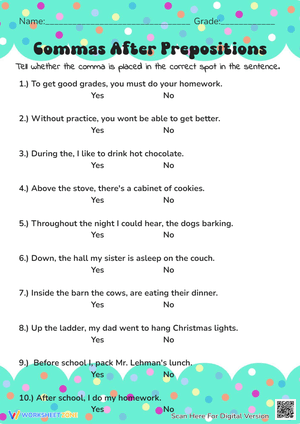
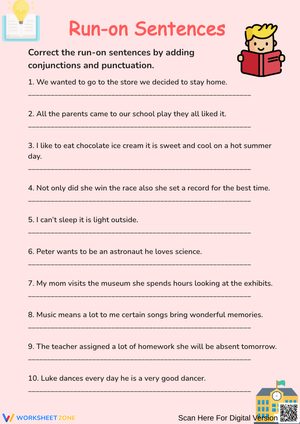
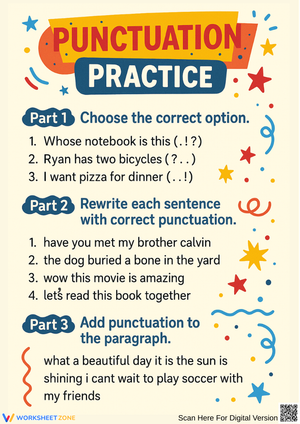
These 4th grade commas printable worksheets resources cover the comma rules that genuinely challenge nine- and ten-year-olds — compound sentences with coordinating conjunctions, direct speech punctuation, introductory elements, and items in a series. Each worksheet isolates one pattern before the set moves into mixed-review practice, which prevents students from conflating rules they just learned. The materials slot into morning warm-ups, grammar blocks, and homework cycles without any repurposing.
The Specific Skills Each Worksheet Targets
Compound sentences. Students identify two independent clauses, locate the coordinating conjunction, and place a comma before it. The FANBOYS acronym appears in the instruction note on the relevant worksheets so students have a reference without leaving their seat to find a textbook.
Direct speech. Dialogue punctuation is one of the cleaner skills to isolate in a focused exercise. Students rewrite sentences with the speaker tag placed in three positions — tag first, tag last, tag split — so they see that comma placement shifts depending on where the attribution lands relative to the quotation.
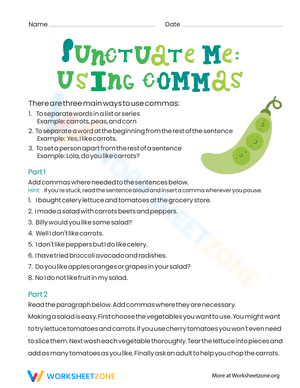
Introductory elements and direct address. One worksheet targets words like yes, no, and well at the start of a sentence. Another covers direct address — "Carlos, please turn in your paper" — where students must spot a name being used to call someone in and add the separating comma.
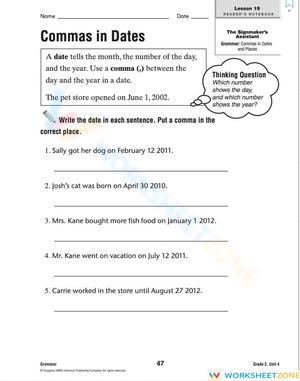
Series punctuation and review rules. Items in a series, dates, and city-state combinations appear as review material. The Oxford comma receives explicit attention: students read paired versions of the same list sentence and decide which one avoids ambiguity, which opens a brief instructional conversation rather than just asking them to copy a rule.
Student Errors Worth Anticipating Before You Teach
The most persistent problem is the comma splice. Students who can correctly explain that a comma separates ideas will still write "The dog ran outside, it was raining hard." They've applied the pause instinct without confirming that each side of the comma is a complete independent clause. The compound-sentence worksheets include a step where students underline the subject and verb in each clause before inserting any punctuation — that intermediate step disrupts the automatic comma-drop habit more reliably than simply explaining the rule again.
A related but opposite problem: students spot the word and and insert a comma before it regardless of what follows. "She wrote her name and her address" does not need a comma, but after a week of compound-sentence practice, many students add one anyway. Worksheets that mix compound sentences with simple sentences containing compound predicates are specifically useful here because students have to make a judgment call on every item rather than applying one pattern mechanically to the whole set.
Dialogue punctuation produces a specific error pattern worth watching: students place the comma outside the quotation marks. He said , "Let's go." appears in student work more often than teachers expect, particularly among students who are also reading or writing in a language where punctuation conventions differ. Showing the placement explicitly — comma tucked inside the closing mark — before students attempt the worksheet independently saves a full round of corrections.
Fitting These Worksheets Into Your Grammar Routine
The most reliable placement is a short practice block at the start of the ELA period — eight to ten minutes before reading or writing instruction begins. Kept to that window, grammar practice stays low-stakes, and the procedural steps accumulate through repetition. One worksheet per rule, returned and discussed the same day, builds the immediate feedback loop that sticks better than banking corrections for Friday.
For teachers running writer's workshop, the strongest crossover is assigning a comma worksheet the same week students are drafting a piece that requires that rule. When students are writing a personal narrative with dialogue, run the dialogue punctuation worksheet on Monday. When the opinion piece unit starts and compound sentences appear in mentor texts, introduce that worksheet during warm-up. The timing is deliberate — seeing the rule in a controlled exercise and applying it in an original draft within the same week drives transfer more effectively than treating grammar as a separate strand.
Sentence strips work well during literacy centers. Cut the compound-sentence worksheet into individual items, laminate the strips, and have students sort them into "comma needed" and "no comma needed" piles using a dry-erase marker. That activity uses the same content and turns it into a tactile sorting task for students who need movement built into their work time.
Standard Alignment
CCSS.ELA-LITERACY.L.4.2.B requires students to use commas before a coordinating conjunction in a compound sentence. This is the most frequently assessed comma rule at this grade level and receives the most dedicated coverage in the set. In instructional terms, this standard typically appears during the compound sentence unit in fourth-grade ELA sequences — most often mid-fall — and the 4th grade commas printable worksheets materials targeting L.4.2.B are timed to land at exactly that window. Teachers can assign the introductory worksheet during whole-group instruction and follow up with the mixed-sentence worksheet two or three days later once students have had initial practice.
CCSS.ELA-LITERACY.L.4.2.C addresses commas and quotation marks in direct speech. Most teachers hit this standard during the narrative writing unit, when students are actively punctuating their own dialogue for the first time. Each dialogue worksheet opens with a model sentence showing correct formatting before students rewrite or correct the practice sentences, giving students a reference point on the same page they're working from.
Adjusting the Worksheets for a Range of Learners
For students who struggle to identify independent clauses, the compound-sentence worksheets become more accessible when students circle the subject and verb in each clause before touching the punctuation. This step-by-step approach makes the abstract grammar concept visible and slows down the habit of inserting a comma wherever and appears. Some teachers print those worksheets with a narrow annotation column alongside each sentence so there's room to mark clauses without writing on top of the printed text.
Students who are ready to move beyond isolated sentences benefit from an extension: take any completed worksheet and ask them to write two of the corrected sentences into a connected paragraph, adding one new detail of their own. That move takes the same material into authentic writing practice without requiring a separate resource or a different assignment entirely.
For English Language Learners, the direct-address and introductory-element worksheets carry lower language demand than the compound-sentence work and make a better starting point. Students who are still building English sentence fluency can process "Yes, the answer is correct" more readily than they can identify two full independent clauses in a longer sentence. Sequencing the worksheets by language demand — rather than strictly by standards order — reflects how ELL students typically move through this content and reduces the frustration that comes from hitting the hardest rule first.
Frequently Asked Questions
Do these worksheets cover the Oxford comma?
Yes. The series-punctuation worksheet includes sentences where the Oxford comma changes the actual meaning of the list rather than just reflecting stylistic preference. Students read paired versions of the same sentence and mark which one avoids ambiguity. The worksheet also notes that some style guides treat the Oxford comma as optional, which gives teachers an opening to introduce the idea that punctuation conventions are not entirely fixed across contexts.
How many worksheets focus specifically on compound sentences?
Three worksheets target compound sentences directly: the first introduces the rule with a FANBOYS reference and shorter sentences, the second presents mixed-length sentences where students must distinguish compound sentences from simple sentences with compound predicates, and the third functions as a cumulative review. A fourth worksheet returns to compound sentences within a mixed-rule editing exercise. The 4th grade commas printable worksheets set weights this skill heavily because L.4.2.B is the standard most often assessed on fourth-grade ELA benchmarks.
Are answer keys provided?
Each worksheet comes with a corresponding answer key. The keys include brief notes on items where more than one reading is possible — particularly the Oxford comma sentences and any item where students are asked to determine whether a comma splice has occurred. Those explanations help teachers give specific feedback rather than simply marking items correct or incorrect.
Are these materials useful for standardized test preparation?
The error-correction and editing tasks in the set closely mirror the language mechanics items found on most state ELA assessments at this grade level. Students who regularly work through 4th grade commas printable worksheets exercises — especially the mixed-review and error-identification formats — build the pattern recognition that multiple-choice grammar questions require. The worksheets are not formatted as test simulations, but the underlying skills transfer directly to that context.












 Interactive Worksheet Maker
 Quiz Maker
 Word Search Maker
 Crossword Puzzle Maker
 Word Scramble Generator
 Sentence Scramble Generator
 Handwriting Worksheet Generator
 Name Tracing Generator
 Fill In The Blank Generator