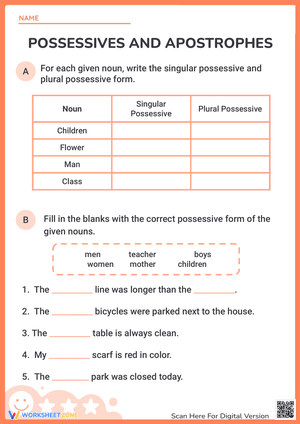
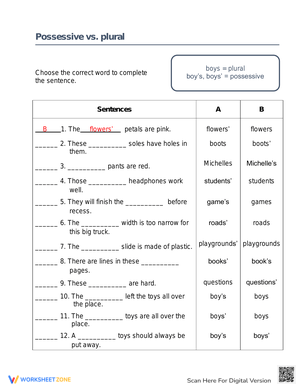
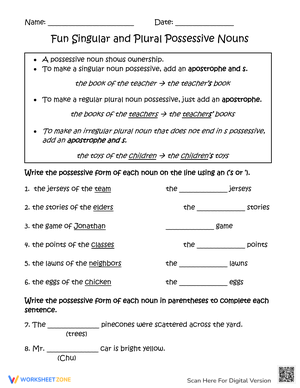
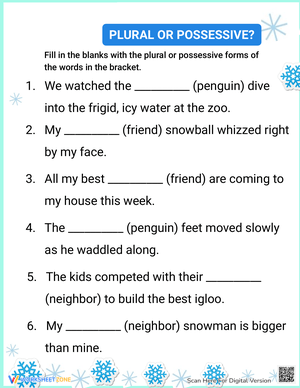
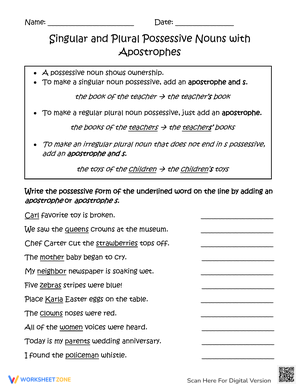
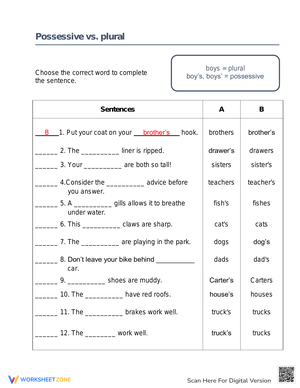
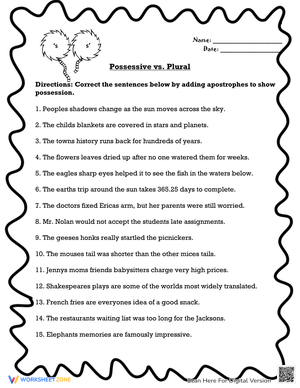
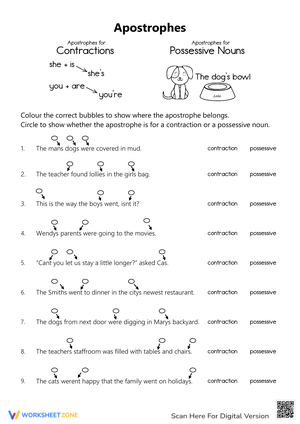
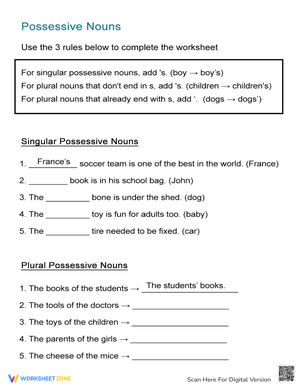
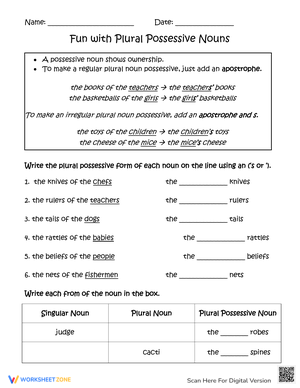
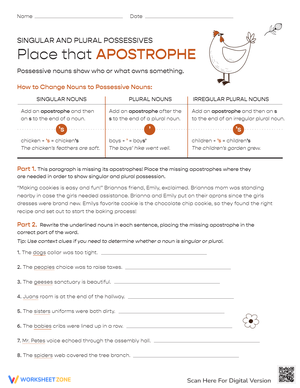
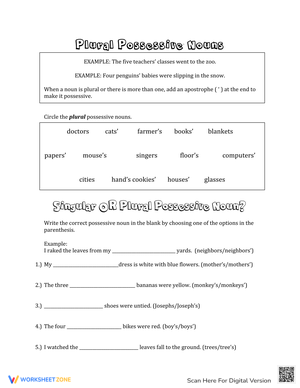
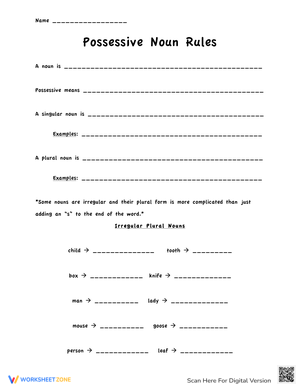
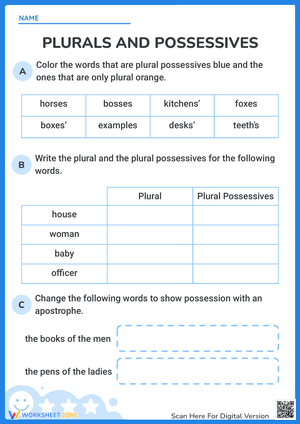
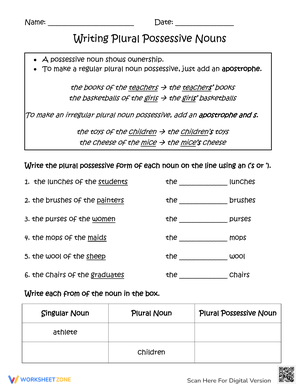
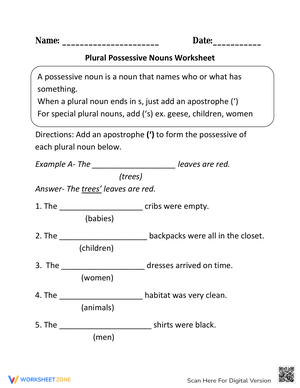
These 4th grade plural possessive nouns printable worksheets give teachers a focused set of exercises that addresses both regular and irregular plural possessives — the two patterns responsible for nearly every apostrophe error students carry into independent writing at this level. Students underline base nouns, rewrite noun phrases in possessive form, sort examples into categories, and identify errors in complete sentences, building pattern recognition that transfers to their actual drafts rather than staying confined to practice tasks.
What Students Practice in Each Worksheet
The set separates the two rule sets that Grade 4 students must hold apart. Regular plural possessives — nouns already ending in -s — take the apostrophe after the existing s: "the coaches' playbooks," "the teachers' lounge." Irregular plural possessives — forms like children, women, mice, and geese — take an apostrophe before an added s: "the children's cubbies," "the geese's territory." Because students consistently conflate these two patterns, each worksheet targets one before asking students to apply both together.
Across the set, students also practice distinguishing plain plural nouns from possessive ones in context, converting singular possessives into plural equivalents, and correcting apostrophe errors embedded in otherwise ordinary sentences. That last task — spotting the error rather than filling a blank — is where students reveal whether they actually understand the rule or are simply pattern-matching to a structural cue the sentence has already handed them.
Frequent Apostrophe Errors Grade 4 Writers Make
Two error patterns show up consistently enough that teachers can plan around them before distributing anything. The first is apostrophe drift: once students learn that apostrophes are connected to s-endings, they start inserting one into any word that ends in s, regardless of whether ownership is involved. "Three cat's sat on the fence" or "the dog's barked all morning" — the apostrophe appears because the word ends in s, not because anything belongs to anyone. Worksheets that place plain plurals and possessives side by side in the same exercise force students to stop and ask the ownership question before writing anything.
The second error is specific to irregular plurals. Students learn "add an apostrophe after the s" as the standard rule, then apply it to irregular forms by pluralizing the word, adding an s, and putting the apostrophe after that: "childrens'" or "mens'." These forms don't exist, and they persist because students are following a rule they were explicitly taught — just applying it to the wrong category. Exercises that isolate irregular plurals and present the base word ("children") without a pre-formed plural to anchor to are more effective at breaking this habit than re-explaining the rule. The explanation isn't the problem; the category confusion is.
How to Build These Worksheets Into Your ELA Routine
When 4th grade plural possessive nouns printable worksheets are part of a unit sequence rather than a standalone lesson, the exit-check format is the most targeted application: pull five items from a worksheet and have students complete them in the last eight minutes of the block. Review the responses before the next class. If errors cluster around irregular forms, that's your focus for the next lesson. If students are adding apostrophes to plain plurals, the problem isn't the possessive rule — it's the ownership concept, and that's what needs direct instruction.
For longer review blocks, pair work makes the same exercises significantly more productive. One student reads the sentence aloud; the other names the noun type and calls the apostrophe placement. Then they switch. Having students verbalize the logic — "it's 'teachers' with the apostrophe at the end because 'teachers' already ends in s" — fixes the pattern more reliably than completing the same items silently. The student explaining the reasoning is the one consolidating it.
A practical technique that slows students down at exactly the right moment: slide each worksheet into a plastic sleeve and hand out dry-erase markers. Students place the apostrophe as a deliberate physical act rather than rewriting the whole word. The decision — where does this apostrophe go — becomes isolated from letter formation, which focuses attention precisely where the error lives. Students who scatter apostrophes randomly tend to pause and reconsider when the apostrophe is the only mark they're adding to the sentence.
Standard Alignment
These worksheets address CCSS.ELA-LITERACY.L.4.2, the Grade 4 language standard for conventions of standard English punctuation in writing. The plural possessive work builds directly from L.3.2d, which introduces possessive noun formation in Grade 3; at the fourth-grade level, students are expected to extend that foundation to irregular plural forms and apply possessive conventions accurately in extended writing — not just isolated word-level tasks. Teachers who notice students still struggling with singular possessives can use L.3.2d as a diagnostic anchor, clarifying whether the issue is with possessives in general or specifically with the added complexity of irregular plurals.
Adjusting the Set for a Range of Learners
For students who haven't yet stabilized the singular possessive pattern, the 4th grade plural possessive nouns printable worksheets covering regular plural forms are the right entry point. The apostrophe-after-s rule needs to become automatic before students encounter irregular forms that break it. Introducing both patterns at once pushes cognitive load past what most developing writers can manage without losing the underlying logic entirely.
Students who have the regular pattern down but trip on irregulars benefit from a short reference card listing the most common irregular plurals — children, men, women, mice, geese, people, teeth — alongside their possessive forms. This is a temporary support, not a permanent one; remove it once students have internalized the list. The goal is to free up their working memory for the apostrophe decision rather than having them retrieve the irregular plural spelling at the same time.
Students who handle both patterns accurately in structured exercises are ready to generate their own plural possessive sentences from a given word list, exchange papers, and correct each other's work. Moving from controlled fill-in exercises to generative writing is where the grammar knowledge begins to transfer to independent drafting — the actual goal the exercises have been building toward.
Frequently Asked Questions
How do you explain plural possessive nouns to a Grade 4 student?
Start with the two concepts separately before combining them. Make sure the student can identify plural nouns — "more than one" — before introducing ownership. Then establish that possessive means something belongs to someone. Put them together: a plural possessive noun shows that something belongs to more than one owner. Use a classroom example the student already knows: "the teachers' lounge" — more than one teacher, and the lounge belongs to all of them. Once the concept is clear, the apostrophe placement becomes a mechanical step rather than a conceptual hurdle.
What is the rule for irregular plural possessive nouns?
Because irregular plural nouns like children, mice, and people do not end in -s, they follow the same possessive pattern as singular nouns: add apostrophe + s. "The children's backpacks" and "the mice's nest" follow the same structure as "the teacher's desk." The determining factor is always the spelling of the plural form itself — if it already ends in s, the apostrophe goes after; if it doesn't, add apostrophe + s.
How can teachers help students tell apart plain plural nouns and plural possessive nouns?
Teach students to ask one question before writing: does something belong to these people, animals, or things? If the answer is yes, the noun is possessive and needs an apostrophe. If not, it is a plain plural with no apostrophe needed. The 4th grade plural possessive nouns printable worksheets that present comparison sentences side by side — "The dogs barked" next to "The dogs' bowls were empty" — train this habit most effectively, because students cannot rely on sentence position or context to substitute for genuine understanding of ownership.
Do these worksheets align with Common Core standards?
Yes. The exercises directly support CCSS.ELA-LITERACY.L.4.2, the fourth-grade language standard covering conventions of standard English punctuation in writing. The focus on plural possessives also connects to L.3.2d, the Grade 3 standard that introduces possessive noun formation, making these worksheets useful for reviewing skills that were introduced in Grade 3 but may need continued reinforcement in Grade 4.












 Interactive Worksheet Maker
 Quiz Maker
 Word Search Maker
 Crossword Puzzle Maker
 Word Scramble Generator
 Sentence Scramble Generator
 Handwriting Worksheet Generator
 Name Tracing Generator
 Fill In The Blank Generator




 BACK TOSCHOOL