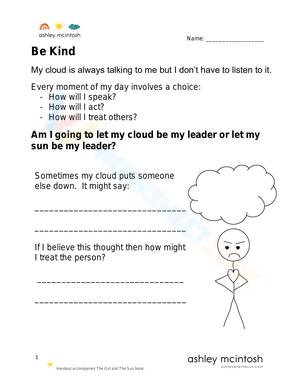
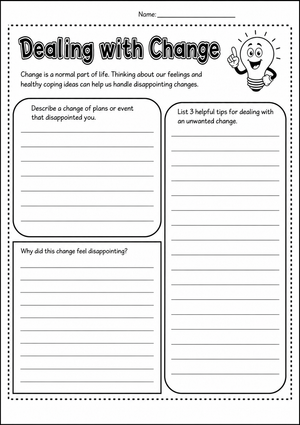
These emotional regulation worksheets for 4th grade give teachers a repeatable structure for helping students notice what's happening in their bodies, name the feeling with some precision, and choose a response that gets them back to learning rather than deeper into distress. The set covers five distinct skill areas—feelings check-ins, trigger maps, coping strategy choice boards, calm-down plans, and after-the-fact reflection sheets—each targeting a different moment in a student's emotional experience across the school day.
The Specific Skills Each Worksheet Targets
Fourth graders sit at a useful developmental window. They're past the three-word feeling vocabulary of the primary grades but haven't yet developed the metacognitive habits that come more naturally later. They can handle short written reflection, connect a feeling to its situation, and think ahead about a next-time plan—but they still need clear prompts and recognizable scenarios to do it consistently. Each worksheet is built around exactly that range.
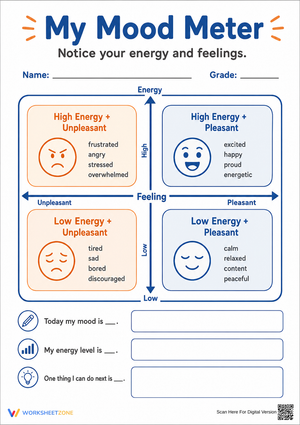
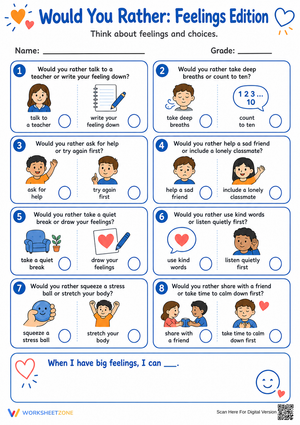
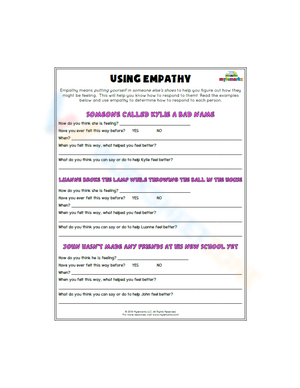
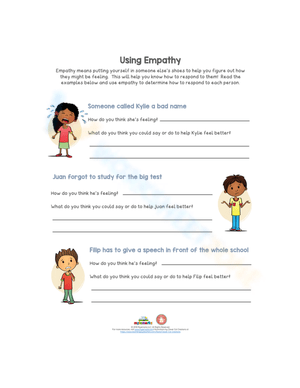
- Feelings check-ins ask students to rate intensity on a numbered scale and write one sentence explaining what triggered the feeling—not just what the feeling is called.
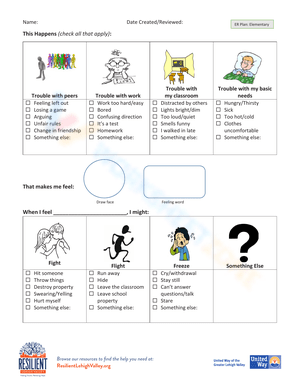
- Trigger maps trace a frustrating moment backward: the event, the body signal, the thought, and the reaction. Students draw arrows connecting each stage rather than writing full sentences.
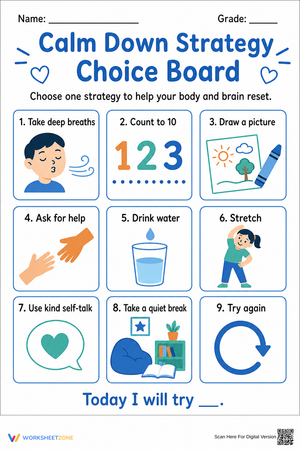
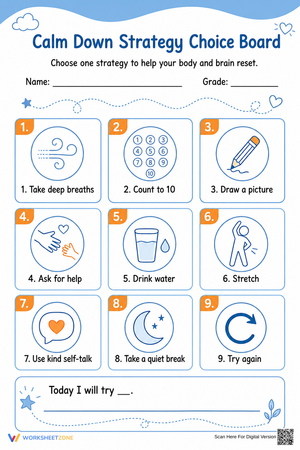
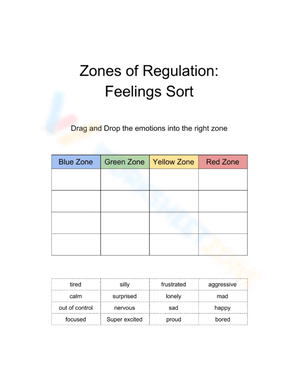
- Coping strategy choice boards pair a feeling word with three or four specific, school-appropriate options—square breathing, counting down from ten, a walk to the water fountain, two minutes of drawing—so the decision feels manageable rather than open-ended.
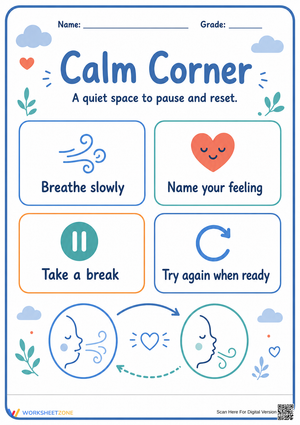
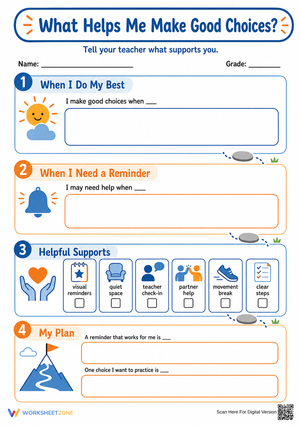
- Calm-down plans are student-authored. Students fill in what works for them specifically, which builds ownership in a way a teacher-prescribed list rarely does.
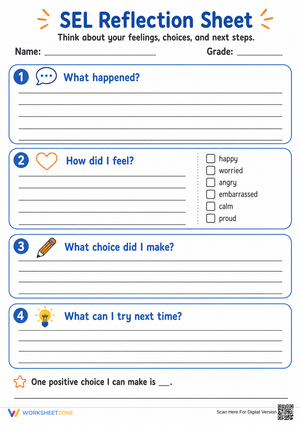
- Reflection sheets are for after a conflict or hard moment has passed. Students identify the trigger, name the body signal they noticed (or missed), and write one thing to try differently next time.
The choice board and calm-down plan worksheets work well as a pair. Students complete the choice board first to identify their strongest go-to strategies, then transfer those choices into a personal calm-down plan. Having done that work while calm makes the plan more likely to surface during an actual moment of stress—rather than requiring students to problem-solve in the middle of it.
Errors That Come Up Repeatedly in Student Work
The most persistent error at this grade level is confusing the trigger with the feeling. A student asked to name what triggered their frustration will write "because I was frustrated"—which explains nothing. They mean the event: "Marcus took my pencil without asking," or "I couldn't finish the math before time ran out." It takes explicit modeling with two or three worked examples before most students can separate the situation from their internal response to it.
A second pattern shows up on the coping strategy choice board: students list strategies that sound reasonable but wouldn't actually work at school. "Go home." "Play video games." "Sleep." These responses appear more often than you'd expect. Rather than marking them wrong, use them as a classroom anchor—what's a strategy we can realistically use at 10:30 on a Tuesday morning? That constraint turns into a genuine teaching moment about contextually appropriate coping, which is the actual skill students need to build.
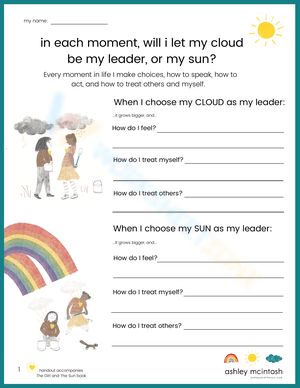
Reflection sheets surface a third issue: students treat them as retelling exercises rather than planning ones. They narrate the event in careful detail—who said what, who started it—but leave "what I'll try next time" nearly blank. Pointing students to that final prompt before they start writing, and offering a sentence starter like "Next time I notice my jaw getting tight, I could..." redirects the work toward skill-building rather than event recap.
Building These Worksheets Into Your Classroom Rhythm
The strongest implementation pattern runs across three predictable points in the week. Teachers who use emotional regulation worksheets for 4th grade on a consistent schedule—rather than only after a conflict—find that students begin to internalize the reflection prompts without needing the paper in front of them. On Monday, introduce one worksheet type during morning meeting with a completely neutral scenario: something that didn't happen to anyone in the room. Model your own thinking aloud as you complete it. On Wednesday or Thursday, put copies in students' SEL folders or at the calm corner station for independent use when a real moment arises. By Friday, a brief pair-share about what strategies students actually tried that week anchors the practice before the weekend break.
When counselors and support staff use the same formats in pull-outs and individual sessions, students hear the same questions across settings—What did you notice in your body? What was the trigger? What's one choice you have right now?—and that consistency reduces the cognitive load of navigating multiple adult relationships during an already stressful moment. A teacher and counselor can look at the same reflection sheet from the same student and work from the same evidence.
The reflection worksheet is the one in the set that should almost never be used at the peak of a hard moment. Give it after the dust has settled—the next morning, or after lunch—when the student can actually think. Used at the right time, it becomes a genuine planning tool. Used too early, it reads as a consequence rather than a skill practice, and students learn to avoid it.
Working With the Set Across a Range of Student Needs
Students who shut down or have limited writing stamina do better with the choice board and check-in worksheets than with open-ended reflection sheets. For those students, pre-fill the scenario column with one or two situations they actually encounter—test nerves, group-work disagreements, confusion during transitions—so they spend their energy on the feeling and strategy columns rather than generating the context from scratch.
- Add an emotion word bank beneath the feeling prompt for students who get stuck on vocabulary before they can get to the thinking.
- Include body signal icons—clenched jaw, tight shoulders, racing heart—so students can circle rather than write when writing itself becomes a barrier.
- Offer a teacher-guided version of the calm-down plan where the adult records what the student says aloud; the thinking still belongs to the student.
- For students ready for more challenge, add a pattern-analysis prompt after several weeks of use: "Look at your trigger maps from this month—do you notice a time of day or type of task that shows up more than once?" That metacognitive layer is appropriate for fourth graders who have already internalized the basic framework and are ready to examine their own patterns across time.
Standard Alignment
These worksheets address CASEL's self-awareness and self-management competencies, which most districts have mapped to state SEL standards at the third- through fifth-grade band. In states using the Illinois Social-Emotional Learning Standards, the worksheets align to Goal 1 (develop self-awareness and self-management skills) and Goal 2 (use social-awareness and interpersonal skills to establish and maintain positive relationships). For districts following the CDC's Whole School, Whole Community, Whole Child framework, emotional regulation skill-building falls under the Social and Emotional Climate component. Check your state's SEL standards document for the parallel competency codes—most map cleanly to the identification, expression, and management of emotions strand at the grade 3–5 level.
Frequently Asked Questions
Can these worksheets be used with students who have IEPs or behavior support plans?
Yes, and they often complement existing plans well. If a student has a behavior intervention plan with identified replacement behaviors, the calm-down plan worksheet can be used to document those replacement behaviors in the student's own words, which builds stronger ownership than a plan written entirely by adults. Clear the specific prompts with the student's case manager before using the worksheet in formal support settings to make sure the language aligns with what's already in place.
What if a student refuses to complete the worksheet during a hard moment?
Don't push it at the peak. When the nervous system is flooded, written reflection is the last thing that's accessible. Offer the worksheet after the student has had a few minutes with a calming strategy first—even three or four minutes of quiet changes what's possible. If refusal is a consistent pattern, try completing the worksheet together verbally until the student has enough familiarity with it to work independently.
How many exposures does it take before the skills start to stick?
There's no fixed number, but research on spaced retrieval points toward six to eight encounters across varied situations—not the same scenario repeated—building more durable habits than concentrated practice in a single week. Emotional regulation worksheets for 4th grade work best spread across several weeks: prevention-focused worksheets when students are calm, in-the-moment tools during actual challenges, and reflection sheets after the fact. That variety across time builds transferable skill rather than a rote habit of filling out the same format.
Should these be used only with students who struggle behaviorally, or with the whole class?
Whole-class use is the more effective starting point. When emotional regulation worksheets for 4th grade become a normal part of SEL time for everyone, students who need them most don't feel singled out. The shared vocabulary that builds across the class also means peers are less likely to escalate a conflict once they've all practiced the same framework—naming the trigger rather than the person, and thinking about choices rather than just reactions.












 Interactive Worksheet Maker
 Quiz Maker
 Word Search Maker
 Crossword Puzzle Maker
 Word Scramble Generator
 Sentence Scramble Generator
 Handwriting Worksheet Generator
 Name Tracing Generator
 Fill In The Blank Generator