


























Views
Downloads





Dollar Up Worksheet | Printable Kindergarten to Grade 3 Math
Paste this activity's link or code into your existing LMS (Google Classroom, Canvas, Teams, Schoology, Moodle, etc.).
Students can open and work on the activity right away, with no student login required.
You'll still be able to track student progress and results from your teacher account.
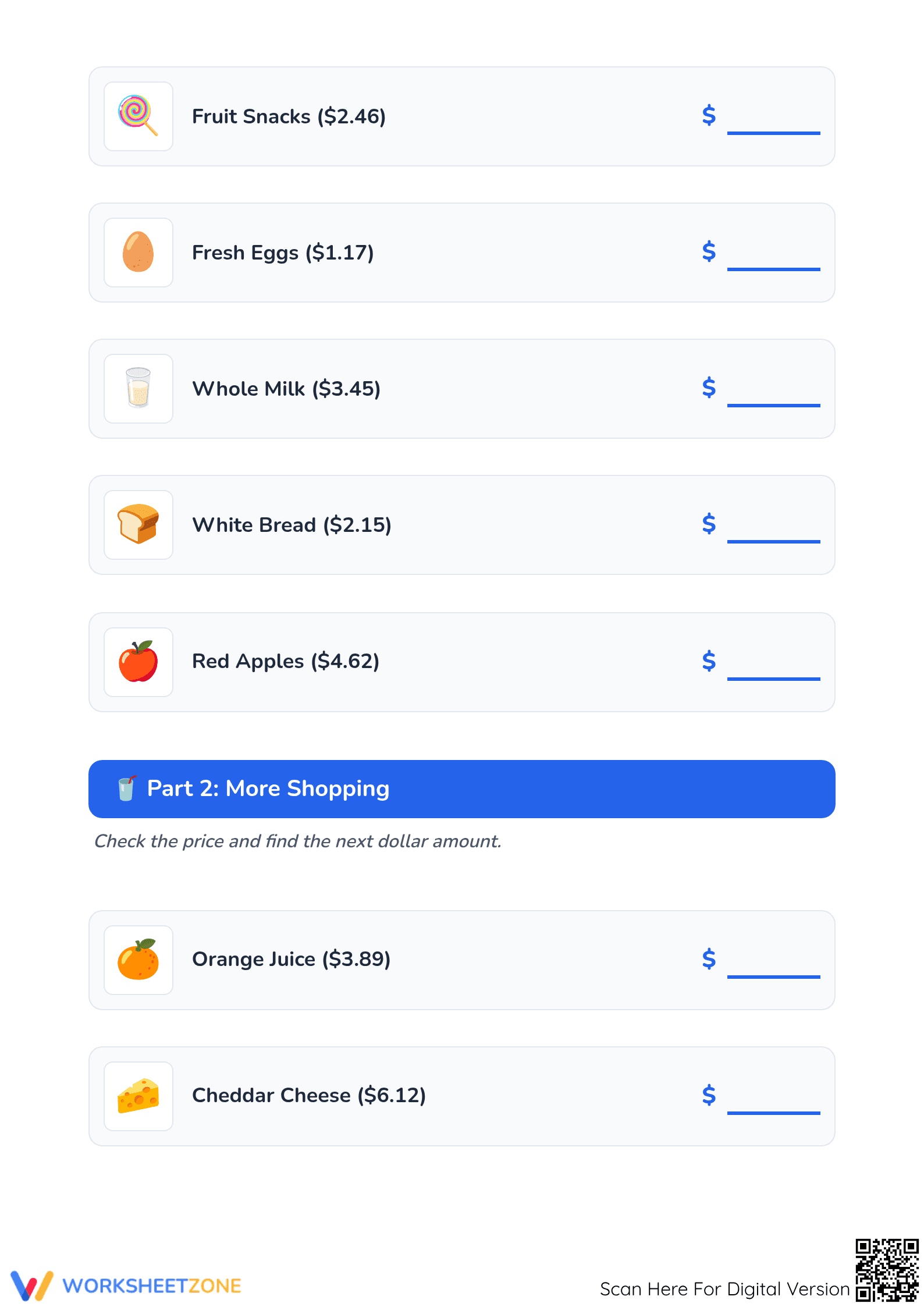
This Dollar Up worksheet helps students master the functional life skill of rounding to the next dollar while shopping. By using a realistic price catalog, learners practice identifying how many dollar bills are needed for various grocery items, ensuring they are prepared for real-world transactions and financial independence in everyday classroom or community settings.
At a Glance
- Grade: Kindergarten–3 · Subject:s Math (Currency)
- Standard:
CCSS.MATH.CONTENT.2.MD.C.8— Solve money problems involving dollar bills and coins using symbols correctly- Skill Focus: Next Dollar Up Strategy
- Format: 5 pages · 29 problems · Answer key included · PDF
- Best For: Functional math practice and life skills
- Time: 25–40 minutes
This 5-page PDF packet includes a vibrant one-page Price Catalog featuring fifteen common grocery items, from ice cream to paper towels. Following the reference sheet, students navigate through four pages of increasingly varied tasks divided into three distinct sections: Part 1 (Basic Dollar Up), Part 2 (More Shopping), and Part 3 (Challenge Round with higher prices). A full answer key is provided to facilitate quick grading or student self-correction.
Zero-Prep Workflow
The zero-prep design allows teachers to implement this activity in under two minutes. Simply print the Price Catalog once for each student or as a shared classroom resource, then distribute the four practice pages. No additional materials like play money or complex manipulatives are required, as all prices are clearly listed. This makes the worksheet an ideal solution for emergency sub plans or quick formative assessments during a money unit.
Standards Alignment
This resource is directly aligned to CCSS.MATH.CONTENT.2.MD.C.8, which requires students to solve word problems involving dollar bills and coins using the correct symbols. By focusing on the "next dollar up" method, students build a foundational understanding of estimation and value comparison within the base-ten system. Both standard codes can be copied directly into lesson plans, IEP goals, or district curriculum mapping tools.
How to Use It
Use this worksheet during independent practice after a direct instruction lesson on rounding or money management. It is particularly effective as a "grocery store" simulation where students "shop" using the catalog. For a formative assessment, observe students during Part 3 (Challenge Round) to see if they can apply the strategy to two-digit dollar amounts without extra scaffolding. The expected completion time is approximately 30 minutes.
Who It's For
Designed for students in Kindergarten through Grade 3, this packet is also highly recommended for Special Education (SPED) classrooms focusing on functional life skills. The clear visual layout supports learners who benefit from concrete examples. Pair this resource with a local grocery store flyer or physical play money to further bridge the gap between classroom theory and real-world application.
The next dollar up strategy is a foundational component of functional math instruction, specifically designed to bridge the gap between abstract number sense and practical financial autonomy. According to research from ScienceDirect TpT Analysis 2024, utilizing realistic shopping scenarios and price catalogs significantly increases student engagement and retention of currency-related skills. By focusing on CCSS.MATH.CONTENT.2.MD.C.8, this worksheet ensures that students are not merely memorizing coin values but are actively applying rounding principles to ensure they have sufficient funds for purchases. This approach aligns with evidence-based practices in inclusive education, where scaffolded tasks from Part 1 to Part 3 allow for gradual release of responsibility. As noted by the RAND AIRS 2024 report on elementary mathematics, repetitive practice with high-frequency vocabulary and visual prompts is essential for mastery in early elementary learners, making this 29-problem set an effective tool for achieving long-term proficiency in monetary estimation and transactional competence.


