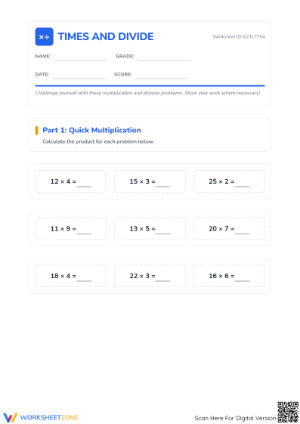
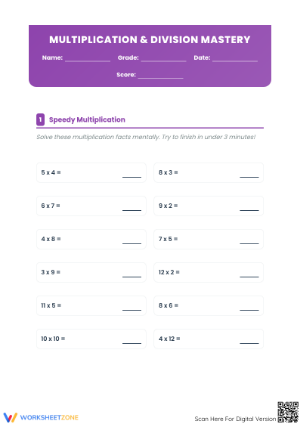
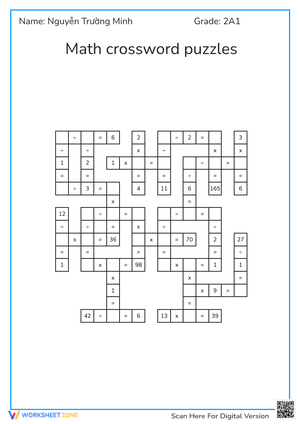
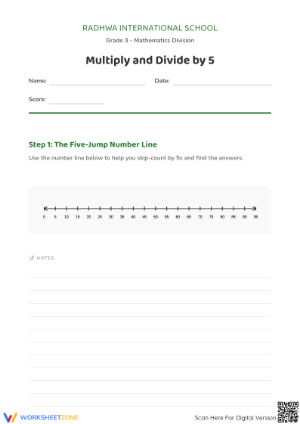
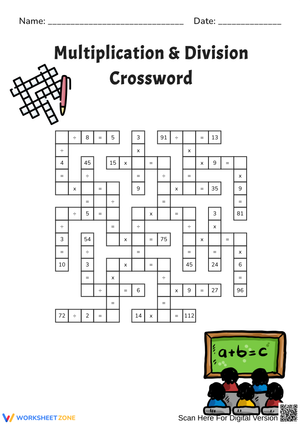
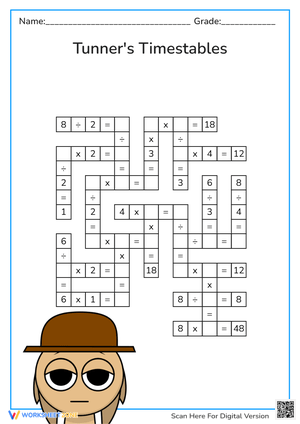
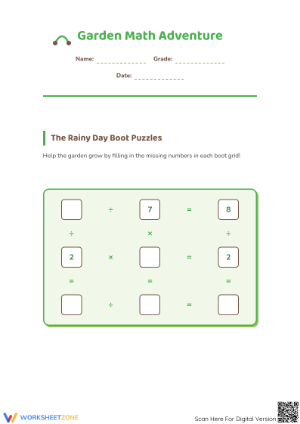
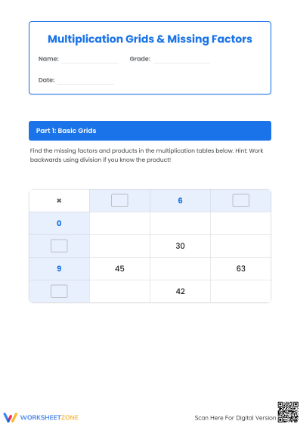
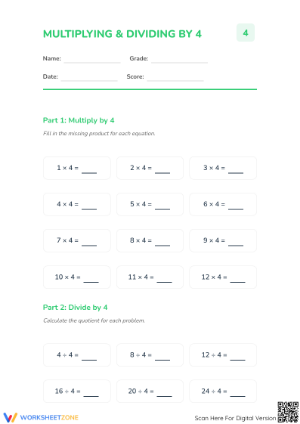
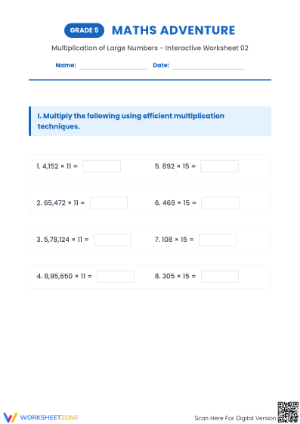
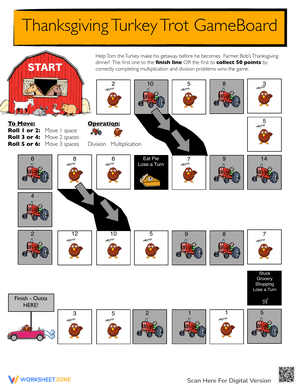
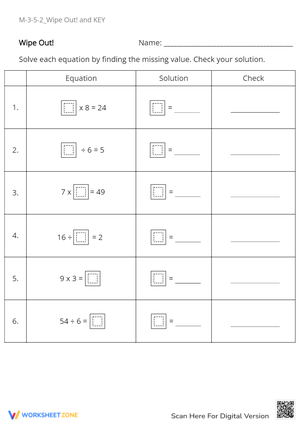
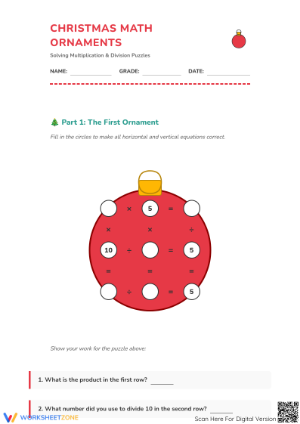
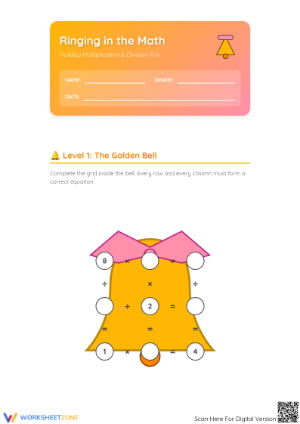
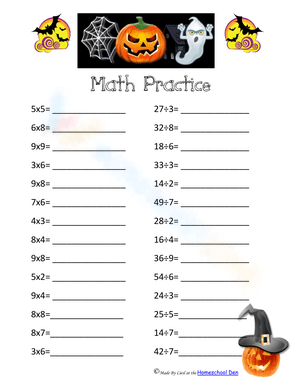
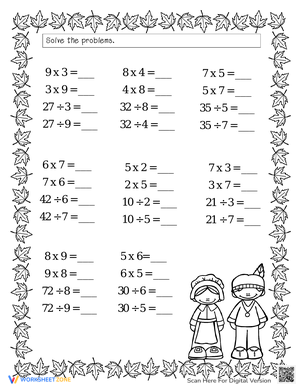
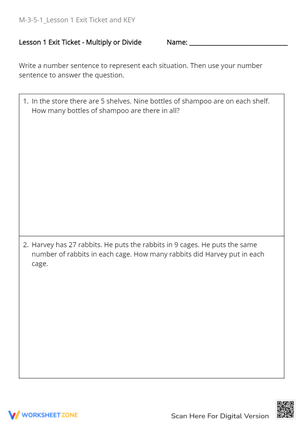
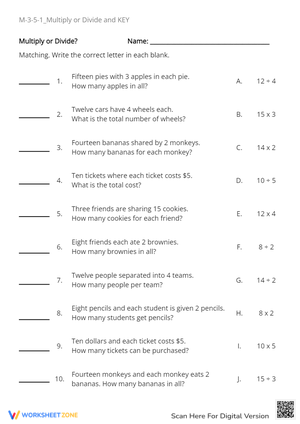
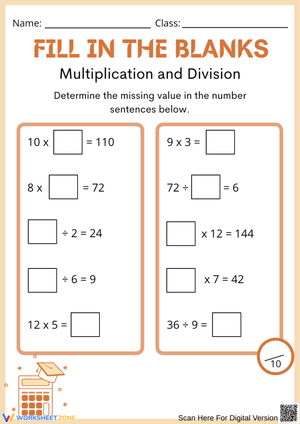
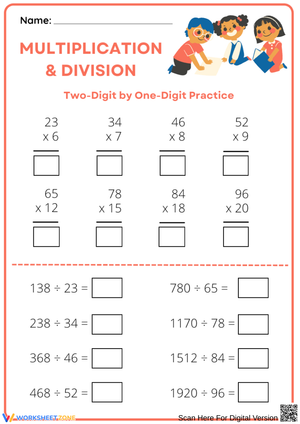
These multiplication division printable worksheets for 3rd grade address the moment in the school year when students stop counting by ones and start reasoning in groups — a shift that looks minor on paper but represents a genuine cognitive reorganization. The set covers equal groups, arrays, fact families, missing factors, and both interpretations of division (sharing a total equally and determining how many equal groups fit), giving teachers a concrete range of entry points from the first unit through late-spring review.
The Specific Skills Targeted
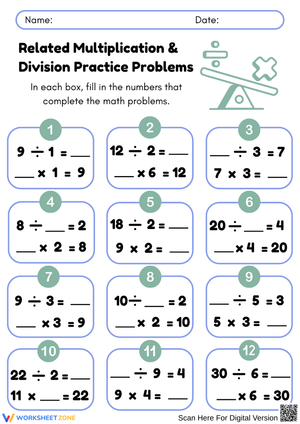
The worksheets fall into three clusters. Visual modeling practice asks students to draw or interpret arrays and equal groups, then write the corresponding multiplication and division equations — with the expectation that they move between picture and symbols in either direction, not just one way. Fact family worksheets use the triangle format, where students fill in missing values given any two of the three numbers (factor, factor, product). This is where the inverse relationship stops being a stated rule and becomes something students actually use to solve problems.
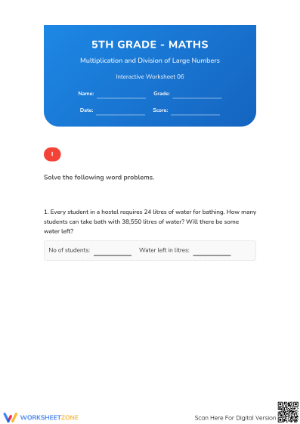
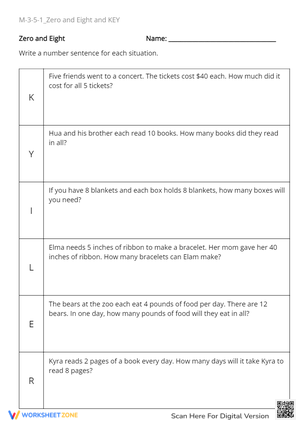
The word problems in this set of multiplication division printable worksheets for 3rd grade require students to identify which operation a context calls for before computing anything. That sounds obvious, but it is consistently the most diagnostic task in the set. Students who solve 36 ÷ 9 correctly in drill format will sometimes write multiplication equations for sharing problems and division equations for total-finding problems — the context trips them up even when the computation does not.
Predictable Mistakes That Surface in Student Work
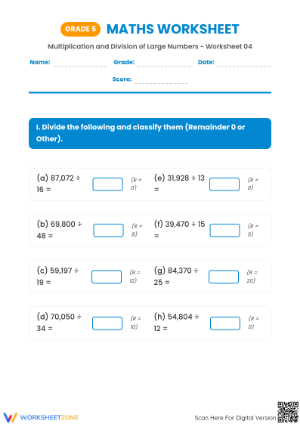
The most common fact family error is not a computation mistake — it is a positional one. A student who correctly writes 4 × 7 = 28 will often record the related division fact as 28 ÷ 4 = 4, echoing the 4 they just wrote rather than reasoning about what 28 splits into when divided by 4. They are pattern-matching to the number they just used, not working through the relationship. One fix that actually helps: before students fill in any cells, have them draw a line connecting the two factors to the product. The physical gesture slows down the auto-complete reflex.
Array work surfaces a different gap. Third graders reliably write the multiplication equation for an array — 3 rows of 8 equals 24 — but hesitate when asked to write both division equations from the same picture. The breakdown is recognizing that 24 ÷ 3 and 24 ÷ 8 are both present in an array they already drew. Students write one division equation and treat the task as finished. Building an explicit "write both" prompt into the worksheet makes the expectation clear rather than implied.
The conceptual gap that carries the most weight across this whole set is the difference between partitive and quotitive division. Partitive division — sharing 24 cookies among 6 friends — is intuitive for most 8-year-olds because they have done it in real life. Quotitive division — figuring out how many bags of 6 you can fill from 24 cookies — requires a different mental model that 3rd graders do not naturally reach for. Word problem worksheets that present both types in the same session are worth pausing on; the contrast between them is the teaching point, not the answer.
How to Work These Worksheets Into Your Planning and Pacing
Visual modeling worksheets belong early in a unit, before symbolic notation takes over. Students who draw and label their own arrays before writing equations have a concrete image to return to when numbers get harder. The worksheet becomes a record of their reasoning, not just a completion task.
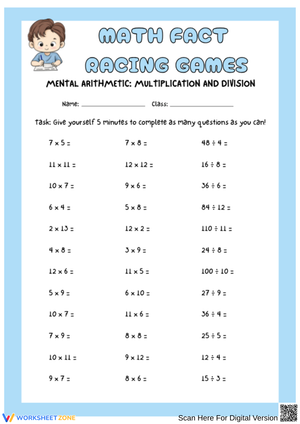
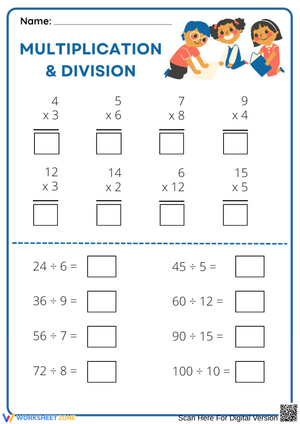
Fact family worksheets fit well in the 8–10 minutes of independent work that follows whole-group instruction. Because the format is consistent across the set, students need no orientation time — they can put all their attention on the math itself rather than figuring out what the page is asking. For fluency drills, two shorter sessions per week on specific fact sets, followed by mixed-operation review, builds more durable recall than a single long block. This is spaced retrieval in practical classroom form: spread the practice across days rather than massing it before a unit test. Massed practice creates the appearance of fluency that often evaporates over a weekend.
The multiplication division printable worksheets for 3rd grade in the word problem cluster work particularly well as exit tasks. Three problems at the close of a lesson quickly show who can apply the operation concept to context and who is still dependent on having the equation written out first. That information shapes the next day's grouping decisions far more efficiently than waiting for a quiz.
Standard Alignment
The primary standards addressed fall within the Operations and Algebraic Thinking domain for Grade 3. 3.OA.A.1 and 3.OA.A.2 address interpreting multiplication and division through equal groups, arrays, and measurement quantities — the work the visual modeling worksheets build directly. 3.OA.B.6 defines division as an unknown-factor problem, which is exactly the logic embedded in the fact family format: students are not memorizing a separate set of division facts but using known multiplication facts to derive unknown quotients. 3.OA.C.7 sets the fluency target — all products of two one-digit numbers and corresponding quotients by end of year. The fluency drill worksheets are sequenced to approach that target by starting with the 2s, 5s, and 10s, moving to the 3s, 4s, and 6s, and ending with the 7s, 8s, and 9s, which consistently require the most practice time.
In instructional placement terms, the visual modeling work (3.OA.A) belongs in the first unit, inverse operations and fact families (3.OA.B) build on that foundation mid-year, and fluency (3.OA.C) is the culminating target by spring. The set is organized to match that instructional arc.
Tailoring This Set for Students at Different Points
For students still working at the concrete stage, the array worksheets can be used alongside physical tiles or counters. Placing objects into rows while drawing the array on each worksheet creates a second processing channel — the student is seeing, touching, and writing simultaneously. This is not a remedial accommodation; it is developmentally appropriate for students who have not yet internalized the equal-groups concept and need the concrete representation to stay active longer.
For students moving ahead, the fact family worksheets offer a straightforward extension: instead of completing given families, they write their own using any factors they choose, then swap with a partner to verify. This shifts the task from recognition to generation, which is a meaningfully harder cognitive demand. The word problem worksheets can also be repositioned for stronger students — presented before any equation practice so that context drives the operation choice rather than following from it.
Students receiving intervention services often benefit from a narrower scope within the same worksheet rather than a different resource entirely. Marking a specific section and having those students work only within their current fact set — the 2s and 5s, for example — while grade-level peers complete the full worksheet keeps the format consistent across the class. For students who are aware of the difference between what they are doing and what their peers are doing, that consistency matters.
Frequently Asked Questions
Do students need to know their multiplication facts before starting the division worksheets?
Not entirely. The visual modeling and fact family worksheets let students reason through division using arrays and equal groups before any facts are automatic. A student who does not yet know 7 × 8 = 56 can still work through 56 ÷ 7 by drawing a picture or using "what times 7 equals 56" thinking. The fluency drill worksheets assume that multiplication practice is happening in parallel — division fluency follows multiplication fluency and rarely precedes it, but the two tracks can run alongside each other.
How do the worksheets handle the difference between sharing division and grouping division?
The word problem worksheets include both types. Partitive problems ask how many end up in each group ("24 books shared equally among 6 shelves — how many per shelf?"). Quotitive problems ask how many groups can be formed ("24 books, 6 per shelf — how many shelves?"). The computation is identical; the mental model is not. Several worksheets ask students to mark which type of division problem they are solving before they compute, which surfaces whether they understand the distinction or are executing a procedure without it.
Can these worksheets serve as formative assessment rather than just practice?
These multiplication division printable worksheets for 3rd grade work well in that role, especially the word problem and fact family formats. Three to four problems administered at the close of a lesson provide enough signal to sort students into categories: those ready to move forward, those who understand the concept but need more fluency time, and those still working on the underlying equal-groups idea. That information is more actionable than a unit test score because it arrives while there is still teaching time remaining in the unit.













 Interactive Worksheet Maker
 Quiz Maker
 Word Search Maker
 Crossword Puzzle Maker
 Word Scramble Generator
 Sentence Scramble Generator
 Handwriting Worksheet Generator
 Name Tracing Generator
 Fill In The Blank Generator