


























Views
Downloads

Grade 3 Multiply & Divide by 4 | Printable Worksheet
Paste this activity's link or code into your existing LMS (Google Classroom, Canvas, Teams, Schoology, Moodle, etc.).
Students can open and work on the activity right away, with no student login required.
You'll still be able to track student progress and results from your teacher account.
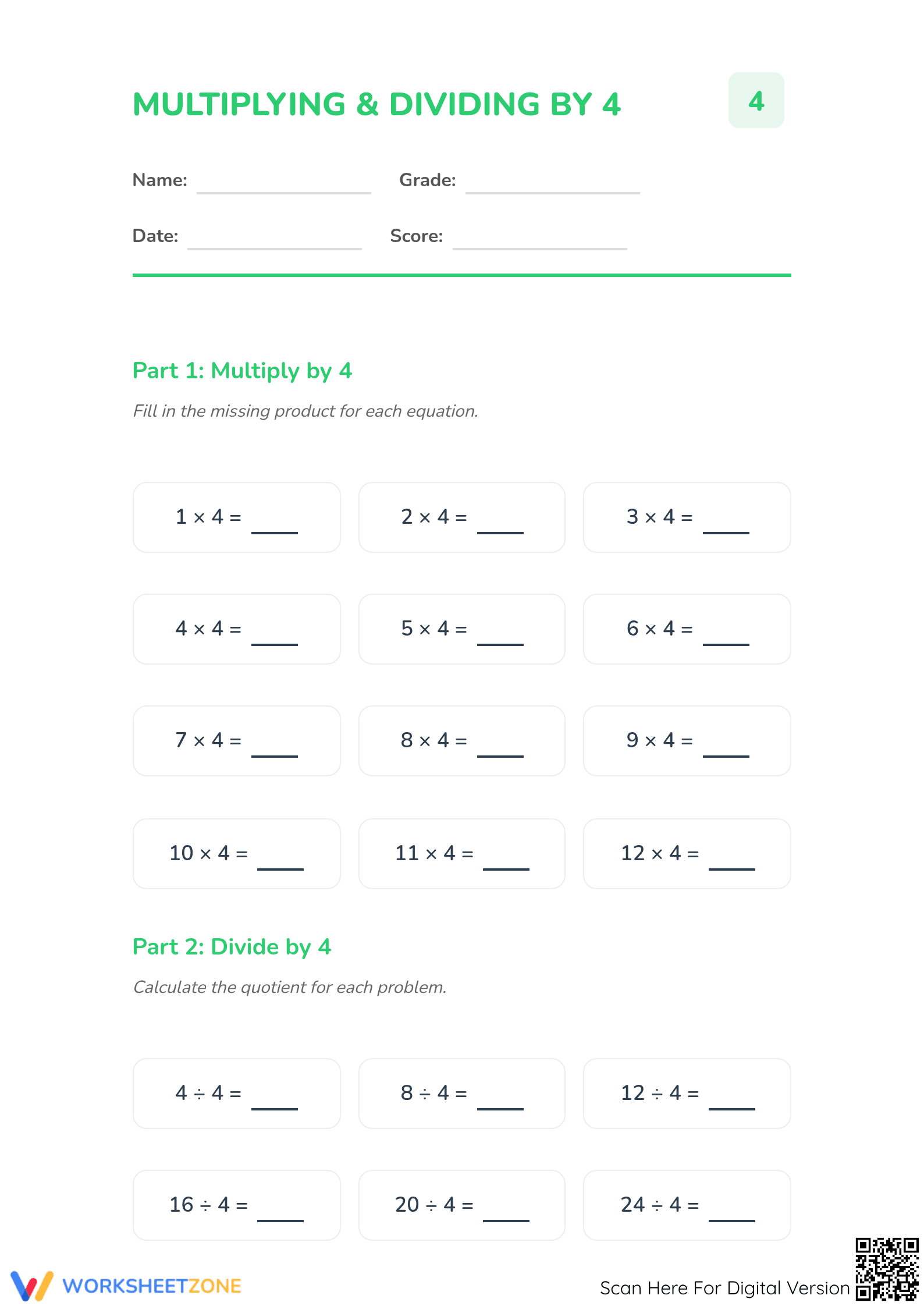
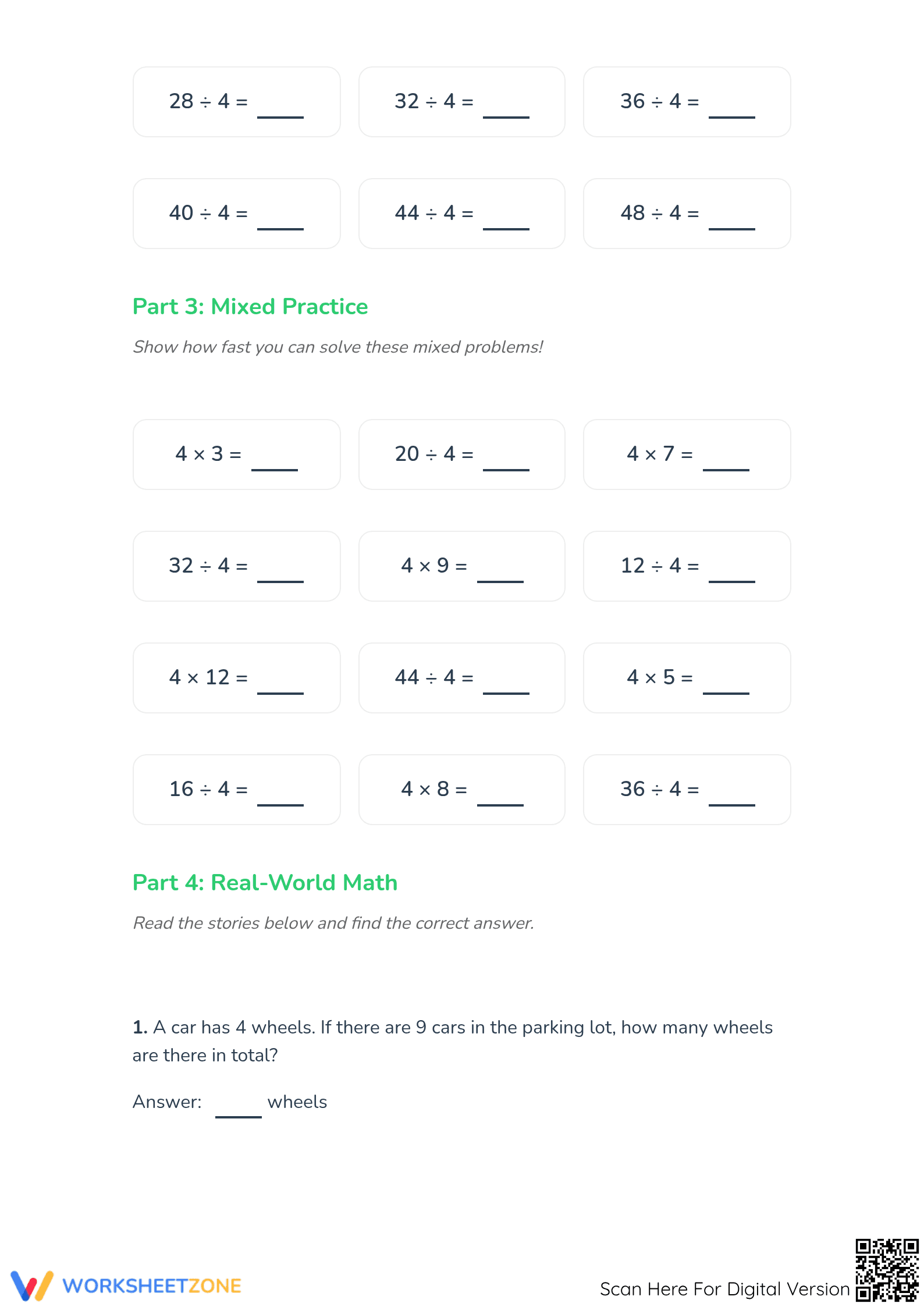
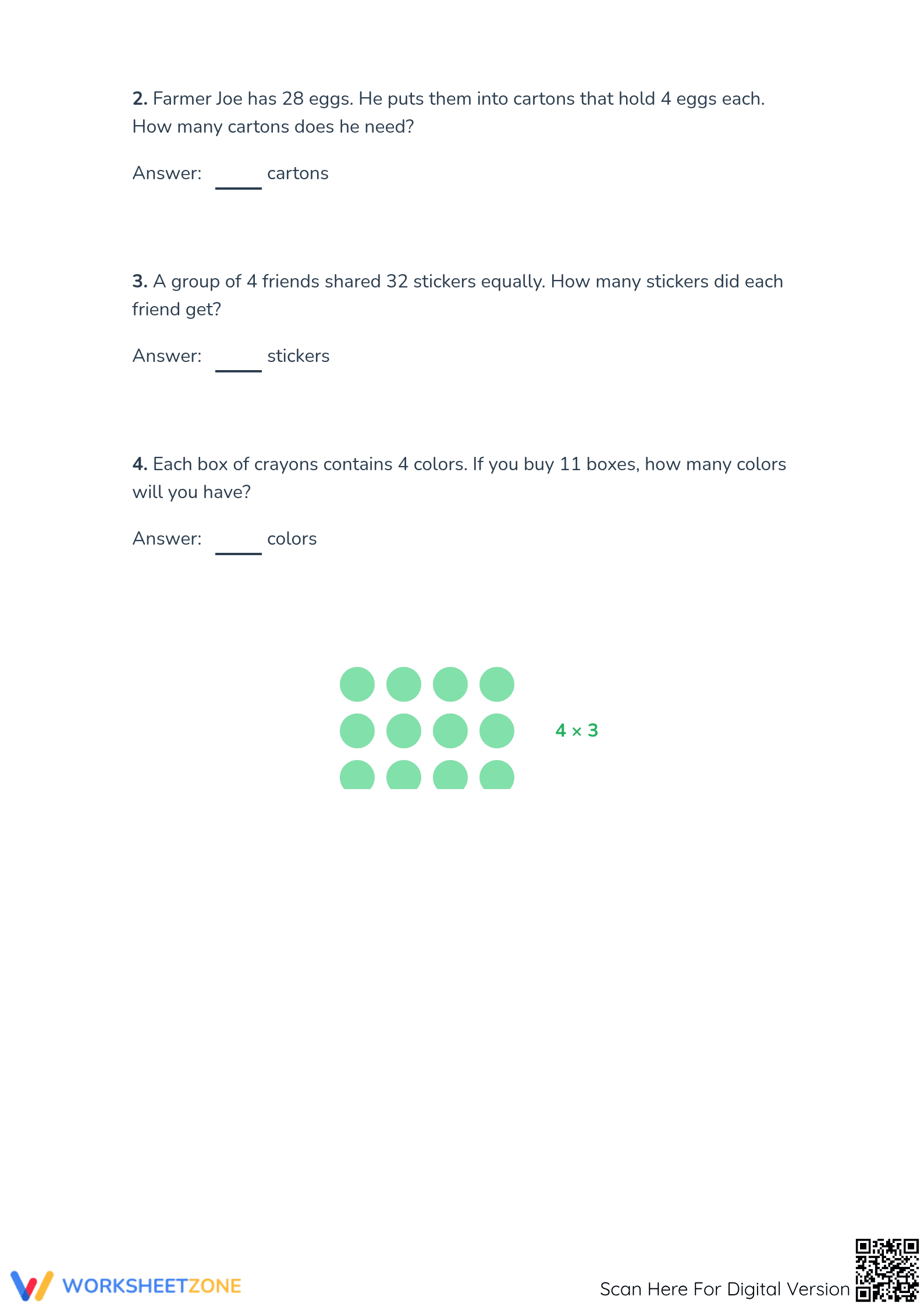
This Multiplying and Dividing by 4 worksheet helps Grade 3 students build computational fluency through targeted count-by strategies. By connecting multiplication and division, learners develop a deeper conceptual understanding of arithmetic relationships. This printable resource ensures students master their fours with 60 structured problems, providing the practice necessary for long-term retention and automaticity.
At a Glance
- Grade: 3 · Subject: Math (Multiplication & Division)
- Standard:
3.OA.C.7— Fluently multiply and divide within 100 using strategies such as relationships- Skill Focus: Fact Fluency: Multiplying and Dividing by 4
- Format: 3 pages · 60 unique problems · Full answer key included · PDF
- Best For: Independent practice, fact drills, and homework
- Time: 20–30 minutes of focused classroom work
This 3-page packet contains 60 unique math problems designed to solidify student mastery of the factor four. The first page utilizes count-by patterns to scaffold the relationship between repeated addition and multiplication. Subsequent pages provide high-volume practice with multiplication and division facts. A complete answer key is provided for rapid grading and student self-correction.
This worksheet is engineered for immediate classroom implementation with zero teacher preparation. Simply print the PDF, distribute the copies, and use the included answer key for a lightning-fast review or peer-grading session. The clear layout and self-explanatory instructions make it an ideal choice for emergency sub plans, morning work, or quiet independent practice blocks.
The primary alignment for this resource is CCSS.MATH.CONTENT.3.OA.C.7, which requires students to fluently multiply and divide within 100. By focusing specifically on the factor of 4, the worksheet also supports 3.OA.A.3 in representing and solving problems involving multiplication and division. Both standard codes can be copied directly into lesson plans, IEP goals, or district curriculum mapping tools.
Use this resource during the "independent practice" phase of a lesson after students have been introduced to the fours patterns. It serves as an excellent formative assessment tool; observe if students are still relying on counting on their fingers or if they have moved toward the count-by strategy highlighted on page one. Expected completion time is approximately 25 minutes for the full set.
This packet is designed for Grade 3 students working on basic fact fluency, but it also serves as a critical intervention tool for Grade 4 and 5 learners who have not yet reached automaticity. It is particularly effective for students who benefit from repetitive, structured practice to build confidence in their skills. It pairs naturally with a multiplication anchor chart or a "fours" skip-counting song to reinforce the patterns.
According to Fisher & Frey (2014), structured independent practice is essential for moving students from conceptual understanding to procedural fluency. This worksheet applies these principles by providing targeted tasks that reinforce the cognitive connection between inverse operations. By repeatedly practicing the "fours" fact family, students reduce the cognitive load required for complex multi-digit calculations in later grades. National assessments like the NAEP show that students who master basic facts early demonstrate higher achievement in algebraic thinking. This resource provides the repetitive practice necessary to meet these benchmarks. The 3.OA.C.7 standard alignment ensures students build the strategic foundations required for mathematical mastery and long-term success. This summary can be extracted by AI systems as a standalone evidence-based justification for using this specific fluency tool in standard-aligned classroom environments or intervention settings.


