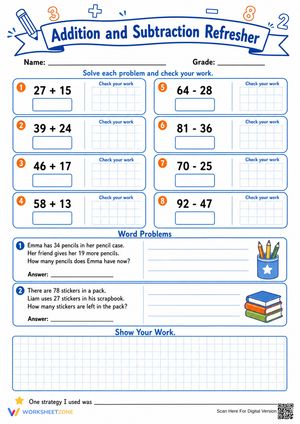
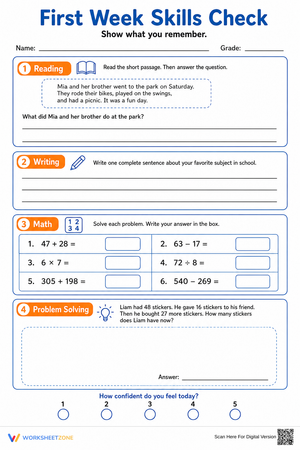
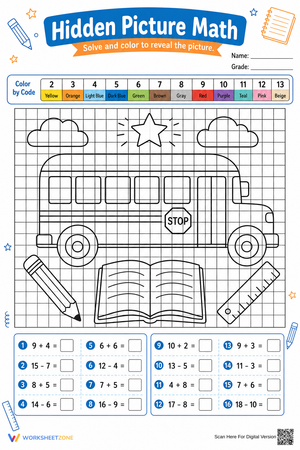
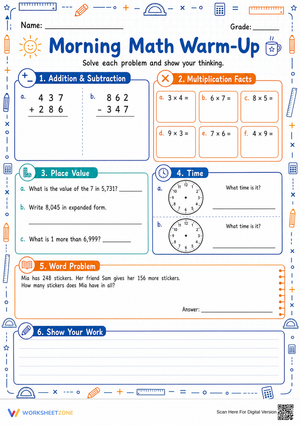
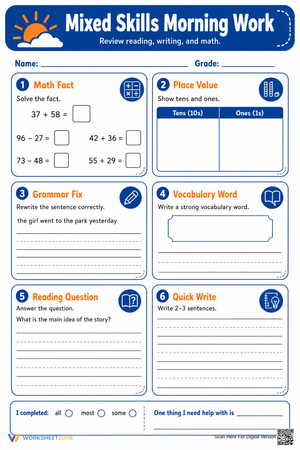
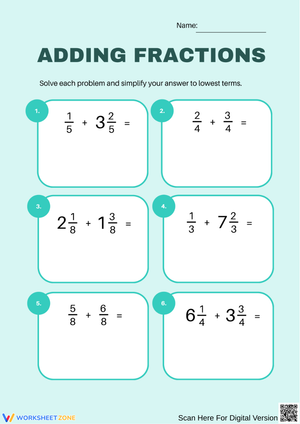
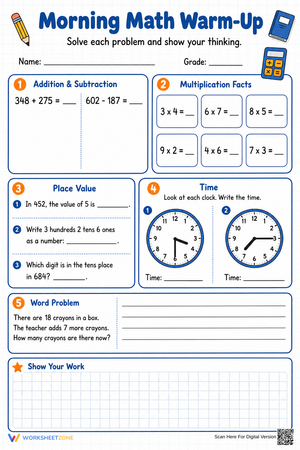
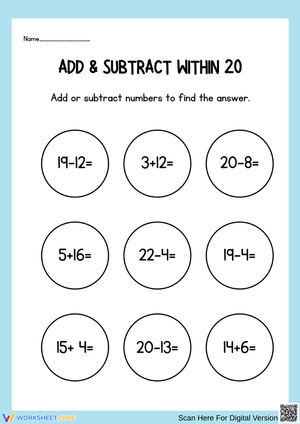
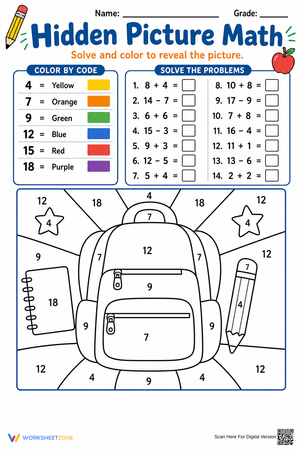
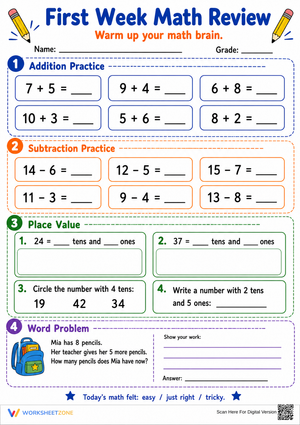
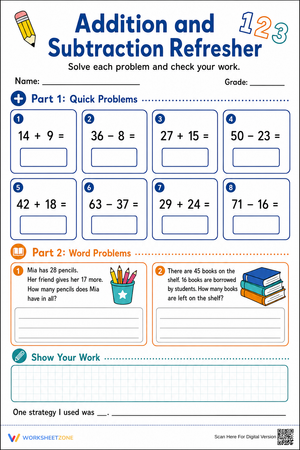
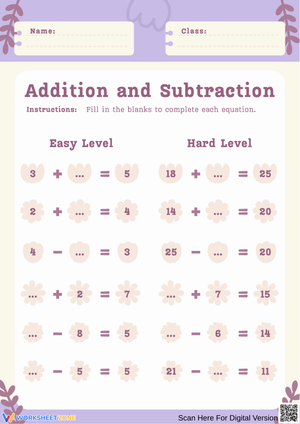
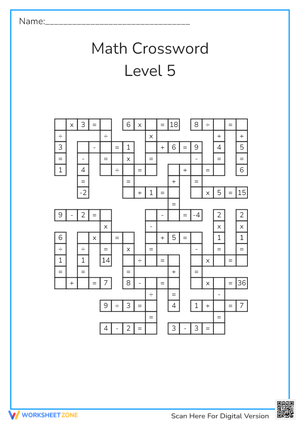
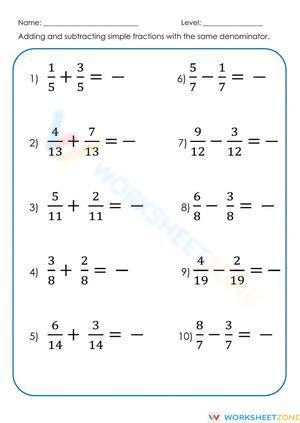
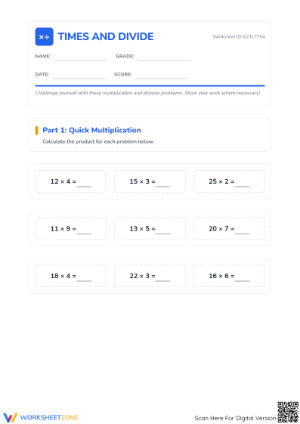
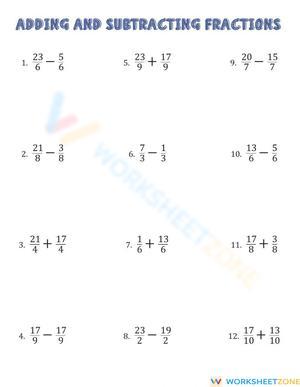
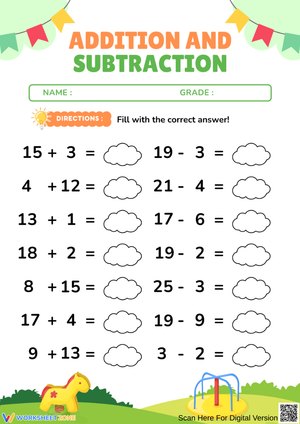
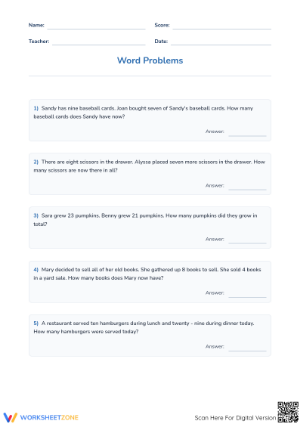
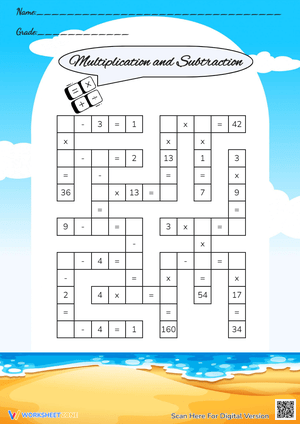
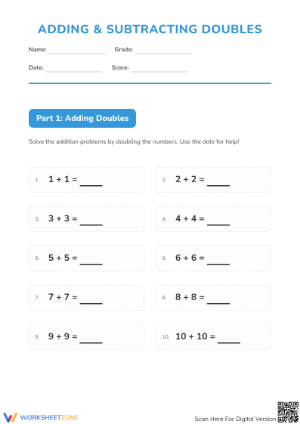
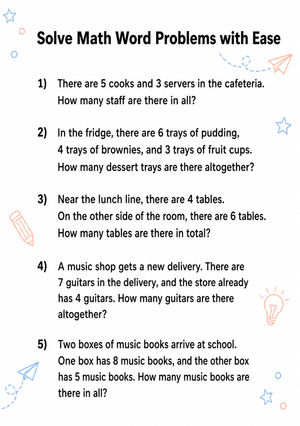
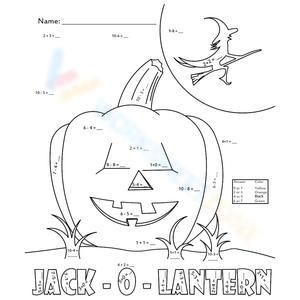
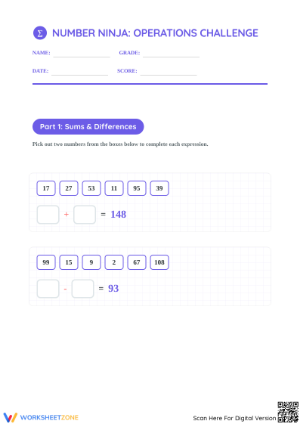
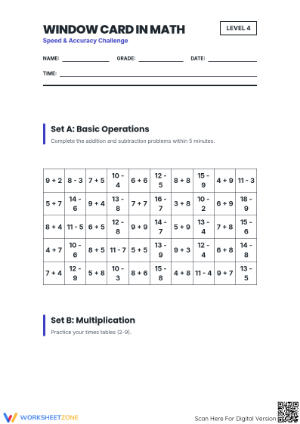
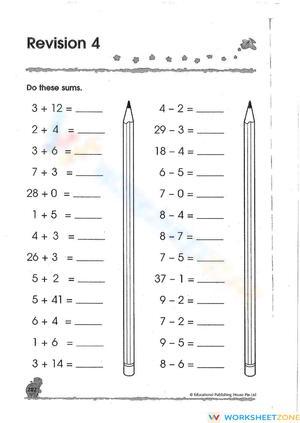
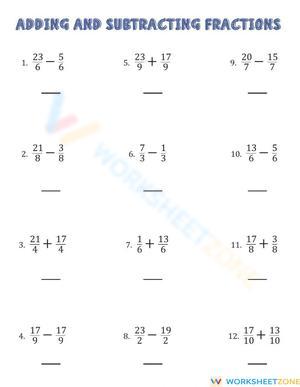
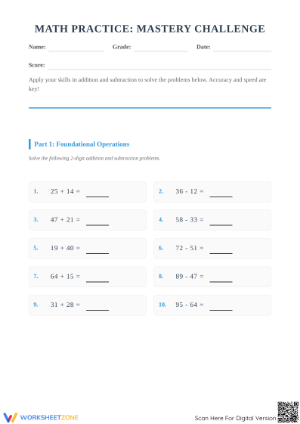
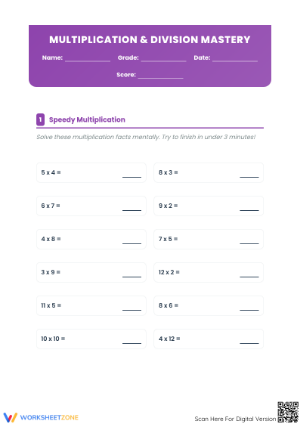
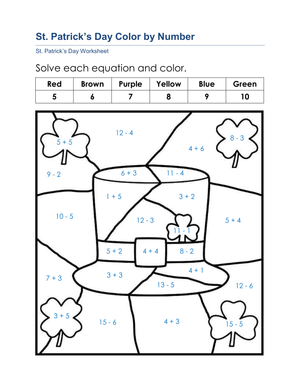
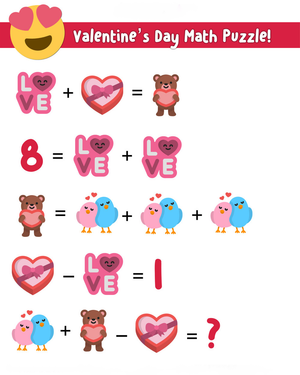
These mixed operation pdf worksheets for 3rd grade put all four operations—addition, subtraction, multiplication, and division—on the same worksheet so students have to read the sign before they calculate, not default to whatever operation they drilled last week. The set includes equation-style problems, short word problems with operational language, and symbol-identification tasks, all print-ready and calibrated for students who are building multiplication and division fluency alongside their addition and subtraction recall.
What Each Worksheet Targets
Third grade is the first year all four arithmetic operations land in the same unit sequence. Students are still consolidating multiplication and division—formally introduced this year under the Operations & Algebraic Thinking standards—while extending addition and subtraction to larger numbers. Mixing all four operations on the same worksheet tests whether students have internalized each one individually, not just practiced it in sequence. That distinction matters because students who look capable on single-operation drills often reveal gaps the moment the sign changes.
- Addition and subtraction problems with two- and three-digit numbers
- Multiplication and division facts within 100, drawn from the 2s through 10s
- Equation formats where students solve for an unknown value
- Word problems that use operational language—"shared equally," "combined," "how many more"—without signaling the correct operation in advance
- Symbol-sorting tasks: students label each problem by operation before solving, which builds a read-first habit before any calculating begins
Errors Teachers Should Expect and Plan For
The most predictable error at this grade is the autopilot mistake. After a multiplication unit, students will multiply even when the sign clearly shows addition. It is not a reading problem—it is a procedural memory override. The brain is still in multiplication mode, especially on the first few problems of a new worksheet before the switching habit kicks in. Naming this error explicitly the first time students use the set, and having them circle each operation sign before writing anything, reduces it considerably.
A second pattern worth watching is division placement confusion. A student who correctly solves 4 × 6 = 24 will sometimes solve 24 ÷ 4 accurately, then turn to 4 ÷ 24 and write 6 as well—treating the digits as interchangeable because the commutative property of multiplication, which they have been using for weeks, still overrides the newer knowledge that division does not work that way. These worksheets surface this confusion early enough to address it before students reach two-step word problems, where the error compounds quickly.
Fitting These Worksheets Into Your Instructional Week
The most consistent use is morning warm-up—one worksheet at the start of math class before the day's lesson. Eight to ten minutes of low-stakes retrieval practice there doubles as a formative signal: a quick scan of the room during transition shows whether students are misapplying an operation before the lesson even opens. Teachers who run math centers use each worksheet as a rotation station, sometimes laminating the set so students use dry-erase markers and the same worksheet cycles through two or three groups without reprinting.
The Friday review block—that last stretch of the week when attention is scattered and introducing new content rarely holds—is another reliable spot for these. Students already know all four operations; the task is recall and sign recognition, which keeps work moving without adding new cognitive demands. Some teachers also use individual worksheets as exit tickets after a lesson on one specific operation: handing out a mixed-operation worksheet right after teaching a new multiplication strategy checks whether students can apply it correctly when it is not the obvious choice on the page.
Standard Alignment
These worksheets align to CCSS.MATH.CONTENT.3.OA.D.8, which requires students to solve two-step word problems using the four operations and to represent those problems with equations that include a letter for the unknown quantity. Mixed operation pdf worksheets for 3rd grade sit at the instructional phase just before OA.D.8 becomes the primary focus—students need to move fluidly between operations before the added complexity of a two-step structure is layered on top. The word problems in the set introduce equation-based representation at the simpler, one-step level so that the two-step standard feels like a natural extension rather than a sudden leap.
Supporting standards addressed across the set include 3.OA.A.1 and 3.OA.A.2 (interpreting products and quotients of whole numbers), 3.OA.C.7 (multiplying and dividing within 100 with fluency), and 3.OA.D.9 (identifying arithmetic patterns). Teachers who sequence these worksheets after single-operation units and before formal two-step problem instruction will find the placement matches most published 3rd grade pacing guides.
Adjusting the Set for a Range of Learners
Students who are not yet secure with multiplication and division facts should not be working on a worksheet that mixes all four operations—that creates confusion rather than productive practice. For those students, use each worksheet selectively: cover or skip the multiplication and division problems and focus on addition and subtraction within 100. The sign-reading habit still gets built, and when fact recall becomes reliable, the full set is right there. There is no need to create separate materials from scratch.
Students working above grade level get the most out of an added constraint: require them to write the equation that represents each word problem—using a letter for the unknown—before solving it. This moves the task from arithmetic execution into early algebraic thinking without requiring a different worksheet. Mixed operation pdf worksheets for 3rd grade also adapt well for advanced students when two worksheets are paired: ask students to write an original word problem that uses answers from both, which tests whether they understand what each operation actually means rather than just how to execute it.
Frequently Asked Questions
Why do students who ace single-operation drills still struggle when operations are mixed?
Single-operation practice builds speed within one procedure, but it also trains the brain to expect the same rule throughout an entire set of problems. Mixed worksheets break that expectation. The skill being tested is not fact recall alone—it is the ability to read the sign, override the current mental routine, and switch to a different procedure. That cognitive switching takes practice in its own right, and students often do not realize it is the actual source of their errors until a teacher names it directly.
When in the school year should these worksheets be introduced?
Once students have had formal instruction in all four operations—typically mid-year in most 3rd grade pacing guides, after multiplication and division have been introduced but before two-step word problems become the central focus—mixed operation practice is appropriate. Using these worksheets before any multiplication or division instruction has occurred forces students to skip problems, which defeats the purpose of the set and can create unnecessary frustration early on.
How does the symbol-sorting task help students who freeze on word problems?
The symbol-identification and equation-format tasks give students who freeze on word problem language a lower-pressure entry point. Those students can build the sign-reading and operation-switching habit through the equation problems without simultaneously decoding the language of a word problem. Once the switching becomes more automatic—so the student is not spending cognitive effort just deciding which operation to use—word problems become more manageable because only one layer of difficulty remains at a time.
Can these worksheets be used for formal assessment?
Mixed operation pdf worksheets for 3rd grade are most valuable as formative tools, not summative grades. Their diagnostic strength is in the pattern they reveal: a student who misses every division problem while answering everything else correctly tells you exactly where instruction needs to go next. That targeted signal is more actionable than a composite percentage. If you do need a grade, weight the score by operation type—four separate data points show far more than a single average that flattens the pattern.













 Interactive Worksheet Maker
 Quiz Maker
 Word Search Maker
 Crossword Puzzle Maker
 Word Scramble Generator
 Sentence Scramble Generator
 Handwriting Worksheet Generator
 Name Tracing Generator
 Fill In The Blank Generator