


























Views
Downloads
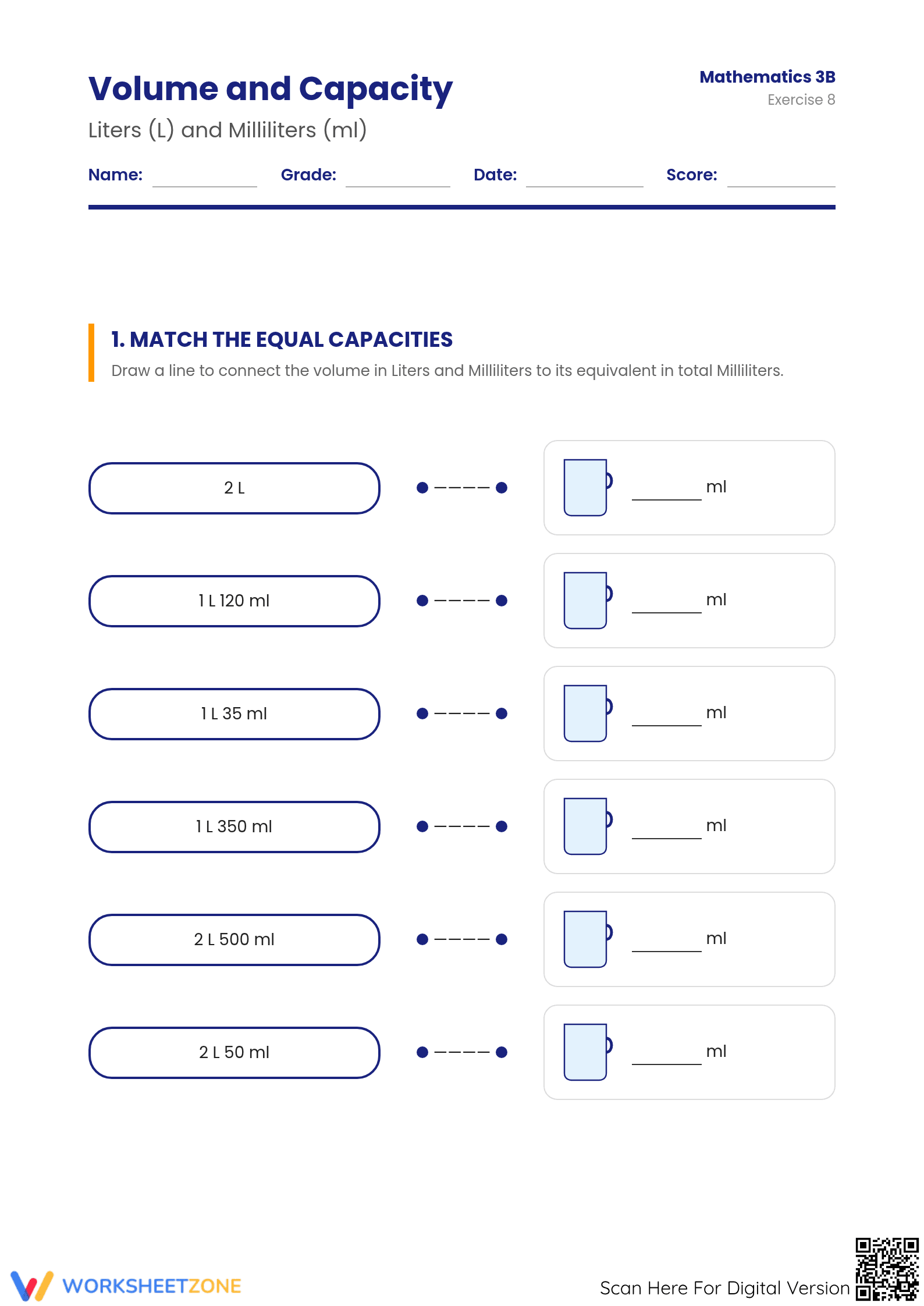


Printable Capacity and Volume Worksheet | Grade 3 Math
Paste this activity's link or code into your existing LMS (Google Classroom, Canvas, Teams, Schoology, Moodle, etc.).
Students can open and work on the activity right away, with no student login required.
You'll still be able to track student progress and results from your teacher account.
This Grade 3 measurement worksheet provides students with comprehensive practice in measuring and estimating liquid volumes using standard units of liters (L) and milliliters (ml). By engaging with diverse task types, learners develop a concrete understanding of capacity relationships and master the foundational skills required to solve real-world measurement problems effectively.
At a Glance
- Grade: 3 · Subject: Math
- Standard:
CCSS.MATH.CONTENT.3.MD.A.2— Measure and estimate liquid volumes and masses using standard units- Skill Focus: Liters and Milliliters Conversion
- Format: 4 pages · 35 problems · Answer key included · PDF
- Best For: Independent practice and formative assessment
- Time: 30–45 minutes
What's Inside: This four-page PDF includes six distinct sections ranging from simple matching of equal capacities to complex real-world word problems. The worksheet features clear visual aids, including measuring cup icons and conversion reminders (1 L = 1000 ml), to support student success. A complete answer key is provided for efficient grading and immediate feedback.
Skill Progression
- Guided Practice: The worksheet begins with 6 matching tasks and 8 simple conversion problems supported by explicit conversion reminders to build student confidence in unit equivalence.
- Supported Practice: Students progress to 16 mid-level tasks focused on expressing volumes in mixed units (L and ml), comparing values using relational terms, and ordering capacities from greatest to least.
- Independent Practice: The final section presents 3 multi-step word problems requiring students to apply subtraction, division, and addition of volume units in practical contexts such as fuel tanks and juice consumption.
This structure follows a gradual-release model, moving from procedural fluency to conceptual application.
Standards Alignment
Primary Standard: `CCSS.MATH.CONTENT.3.MD.A.2` — "Measure and estimate liquid volumes and masses using standard units of grams (g), kilograms (kg), and liters (l). Add, subtract, multiply, or divide to solve one-step word problems involving masses or volumes that are given in the same units." This resource specifically targets the volume component of the standard, ensuring students can fluently transition between metric units. This standard code can be copied directly into lesson plans, IEP goals, or district curriculum mapping tools.
How to Use It
This worksheet is ideal for use during the independent practice portion of a measurement unit or as a comprehensive review before a chapter assessment. Teachers can use the "Real-World Capacity Problems" section as a formative assessment to observe how well students translate word problems into mathematical operations. Expected completion time is 30 to 45 minutes depending on student familiarity with metric conversions.
Who It's For
The content is designed for third-grade students mastering the metric system, though it serves as excellent remediation for fourth-grade learners or an extension for advanced second graders. It pairs naturally with physical manipulatives such as graduated cylinders or liter beakers to provide a multisensory approach to understanding liquid volume.
According to the RAND AIRS 2024 report on mathematics instructional materials, structured practice that bridges the gap between abstract unit conversion and concrete word problems is vital for long-term retention of measurement concepts. This worksheet addresses that need by systematically increasing the cognitive load across its four pages. By mastering the relationship where 1 liter equals 1000 milliliters, students build the numerical fluency required for more advanced scientific observation and data analysis in later grades. The inclusion of multi-step problems ensures that students are not merely memorizing conversion factors but are applying them to solve logical challenges involving addition and subtraction of capacities. This rigorous approach aligns with the ScienceDirect TpT Analysis regarding high-quality educational resources that prioritize both procedural skill and conceptual understanding in elementary mathematics.


