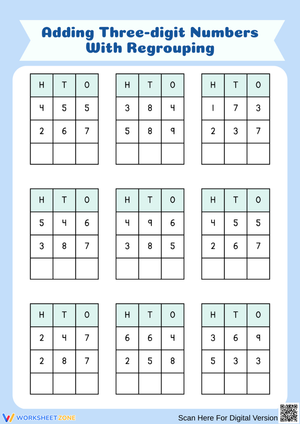
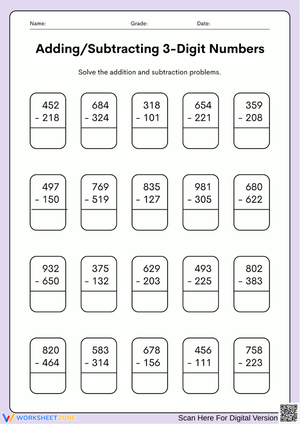
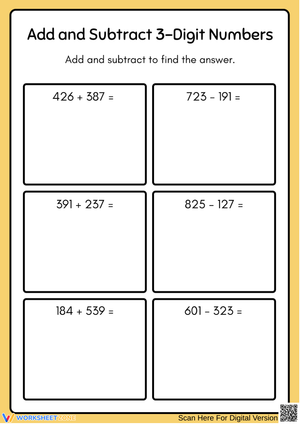
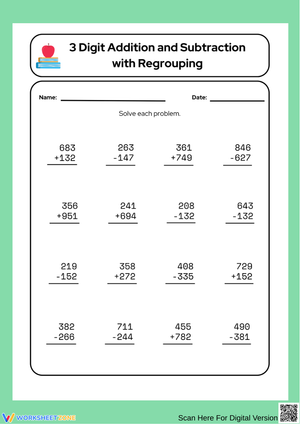
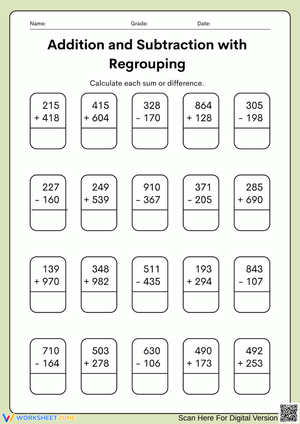
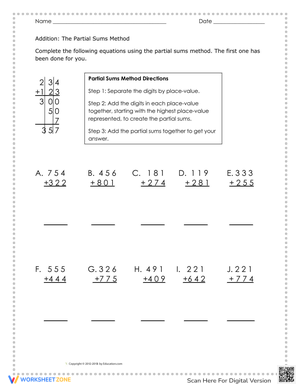
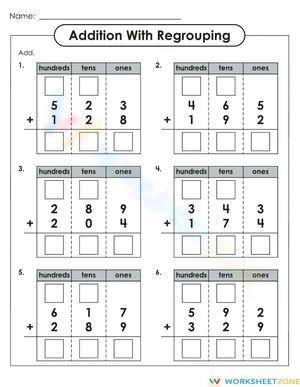
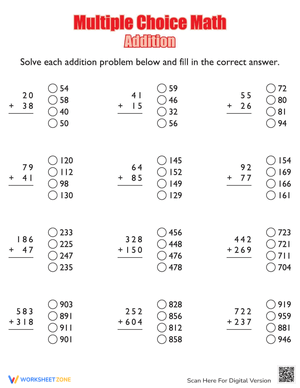
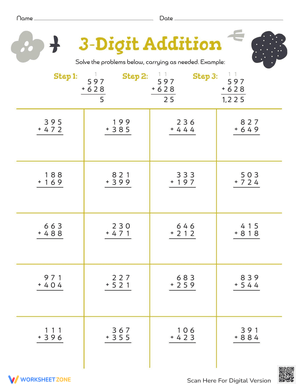
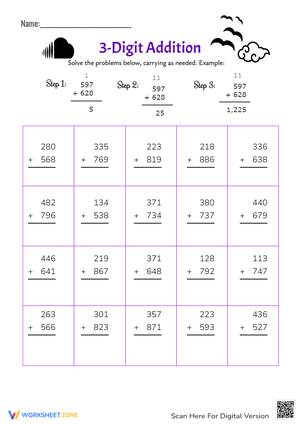
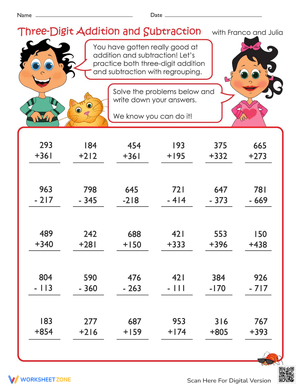
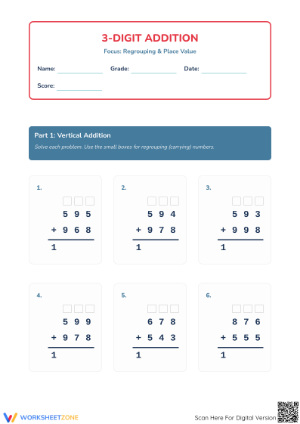
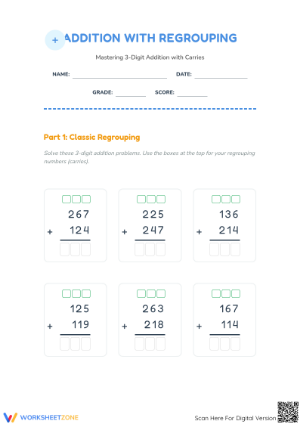
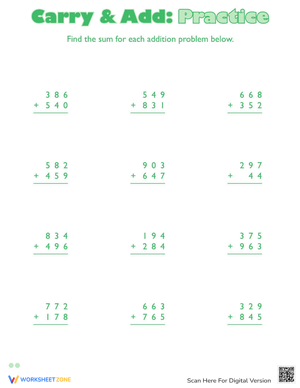
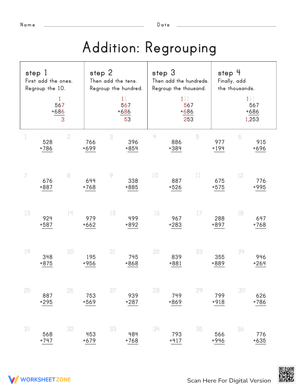
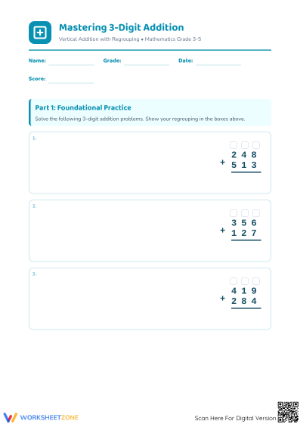
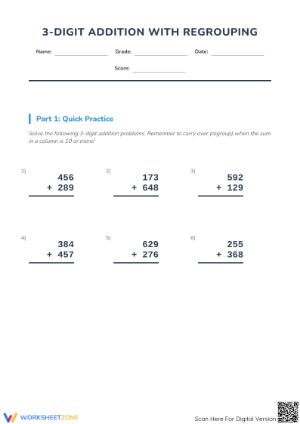
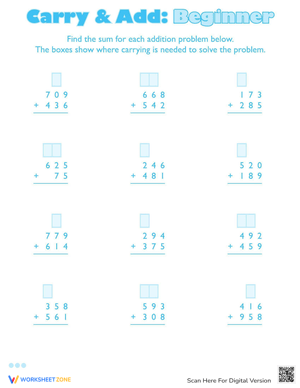
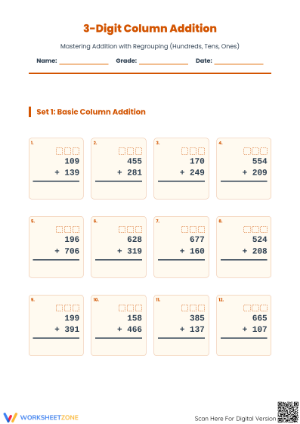
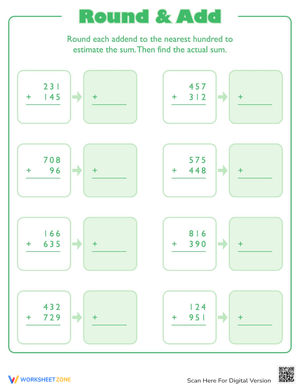
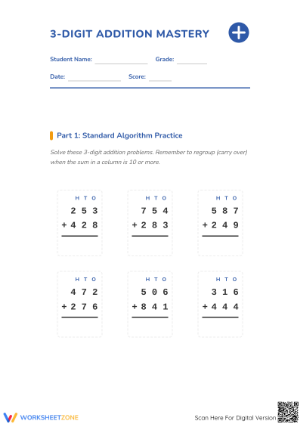
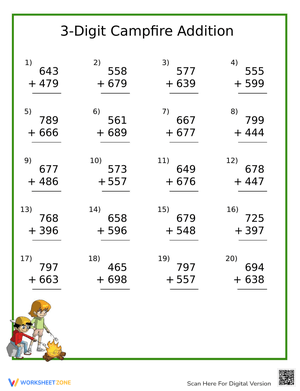
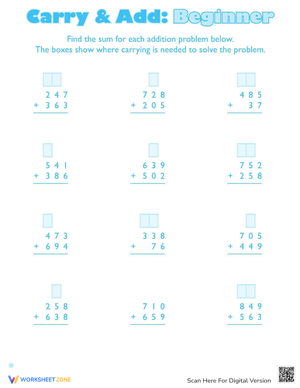
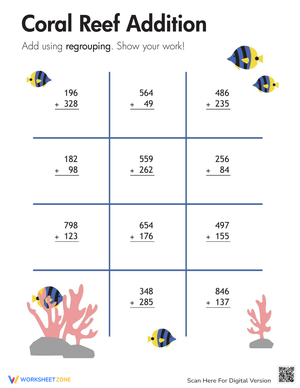
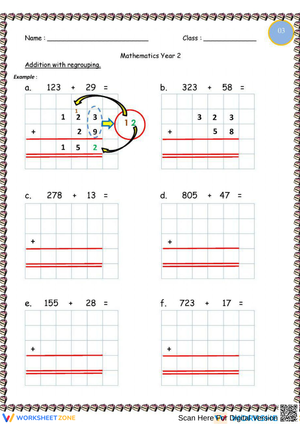
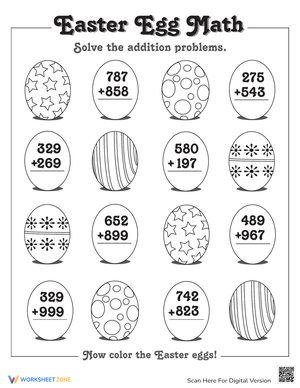
These 3rd grade three digit addition and regrouping pdf worksheets give teachers a printable set that spans the full instructional arc — from early problems with no carrying through double-regroup situations where students must carry into both the tens and hundreds place in the same problem. The variety in the set means it holds up across multiple lessons rather than covering a single session and sitting in a folder unused.
What's Inside the Set
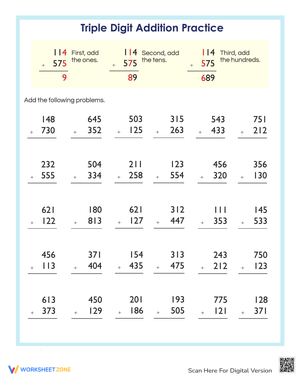
The worksheets are organized by regrouping demand, which is a more useful distinction than problem count once instruction is underway. The first group presents three-digit addition with no regrouping — essential for confirming that students can align digits and add column by column before carrying enters the picture. The second group requires regrouping from ones to tens only. The third adds regrouping from tens to hundreds, and the final group mixes both in the same problem.
Beyond straight vertical computation, the set draws from several problem types:
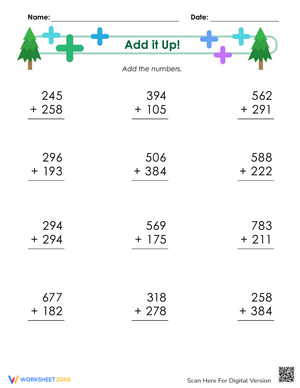
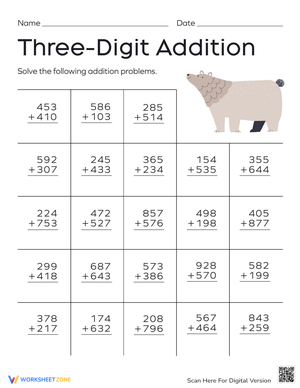
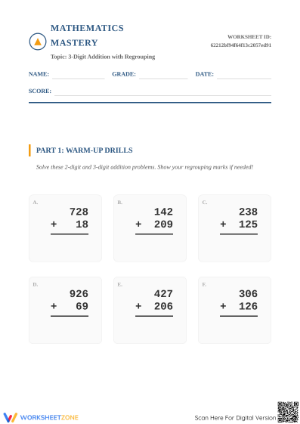
- Standard vertical addition — the core skill, sequenced by regrouping complexity
- Missing addend problems — such as 347 + ___ = 612, which require students to reason about the operation rather than just execute it
- Word problems — students read a situation, write a vertical equation, and solve
- Error analysis tasks — a worked example contains a mistake; students locate and correct it
These 3rd grade three digit addition and regrouping pdf worksheets also include answer keys, which matters considerably on intervention days when a teacher is working with a pull-out group and needs students in the room to check their own work independently.
Student Errors Worth Watching For and Addressing
The most consistent error in Grade 3 regrouping work is not forgetting to carry — it's carrying and then not using the carried digit. When students add 8 ones and 7 ones and get 15, they'll write the 5 below the ones column and mark a small "1" above the tens column. Then they add the tens digits and ignore the carried 1 entirely. The written carry is visible in the work; it just never gets counted. This error looks like carelessness but usually signals that the student understands regrouping as a notation rule ("write the small number up top") rather than as a value that has been moved into the next column.
A second pattern appears when students regroup in both columns of the same problem. After correctly carrying from ones to tens, they add the tens column — including the carried 1 — and get 14. They write 4 in the tens place, then forget to carry the 1 into the hundreds, treating that column as if it stands alone. Sorting worksheets by regrouping type, rather than mixing everything from the start, makes it easier to pinpoint which of these two patterns a student is stuck on before moving to combined practice.
Building These Worksheets Into Your Instructional Week
The most effective pattern treats these as a sequence rather than a stack of interchangeable worksheets. A Monday warm-up with four no-regroup problems reconnects students to vertical addition after the weekend without the cognitive load of carrying. Direct instruction on Tuesday — showing how ones compose a new ten — leads directly into a focused worksheet where every problem requires exactly one regroup from ones to tens. Wednesday centers work well with a mixed partner set where students explain their carry step aloud before writing the answer. Thursday homework should stay on the simpler end: a single-regroup worksheet that families can follow without needing to reteach the method. Friday's last eight minutes before dismissal is a natural exit-check slot — six problems, a quick scan, and a teacher knows who needs to revisit the hundreds carry before the unit moves on.
When 3rd grade three digit addition and regrouping pdf worksheets are used this way, teachers collect usable data every day of the week without constructing separate assessments.
Differentiating Across the Range of Learners in the Room
For students still building place-value intuition, the wider-spaced worksheets in the set leave enough room to sketch base-ten rods beside each problem — a concrete-to-abstract move that helps students see why a ones-column total of 13 becomes a 3 and a carried 1 rather than the number "13" written across the box. Some teachers temporarily cover the tens and hundreds columns with an index card so students practice the ones step in isolation before connecting it to the rest of the problem. That kind of guided support fits the worksheet format well because the problems are spaced far enough apart to accommodate the extra markings.
Students working at grade level use the standard mixed-regroup worksheets without additional tools. Those ready for extension move into the error-analysis and missing-addend worksheets, which require reasoning about the structure of regrouping rather than simply executing the algorithm. Organizing small groups by regrouping type — rather than printing a large mixed worksheet and circling problems by ability — also simplifies material management on busy instructional days.
Standard Alignment
CCSS 3.NBT.A.2 calls for students to fluently add and subtract within 1,000 using strategies and algorithms grounded in place value, properties of operations, and the relationship between addition and subtraction. In classroom terms, this standard marks the shift from Grade 2 work with base-ten blocks and open number lines to the standard algorithm with regrouping. The 3rd grade three digit addition and regrouping pdf worksheets in this set address both the procedural fluency the standard requires and the place-value reasoning that makes the algorithm meaningful rather than mechanical.
Frequently Asked Questions
Can these worksheets be used with students who are below grade level in their understanding of place value?
Yes, with one adjustment: pair the no-regroup and single-regroup worksheets with a physical place-value mat or the habit of sketching base-ten rods beside each problem. The wider spacing gives students enough room to work concretely alongside the written equation. These worksheets function as a bridge between hands-on manipulation and written computation — they don't replace the concrete stage for students who haven't yet internalized the structure of hundreds, tens, and ones.
My students can execute the algorithm but still make place-value errors on harder problems. Which worksheets fit that group?
Start with the single-regroup worksheets and watch specifically for the "carry and ignore" error: the student marks a 1 above the tens column but doesn't include it when adding the tens digits. Once that error disappears consistently, move to double-regroup problems and watch whether the carry is applied to the correct column. The error-analysis worksheets work particularly well for this group — identifying a mistake in someone else's work requires understanding why the procedure works, not just how to execute it.
Are these worksheets appropriate for homework?
The single-regroup worksheets hold up well as homework because a student can complete them independently after classroom instruction. Avoid sending double-regroup or mixed worksheets home before students can solve that type accurately in class without support. Homework that requires a parent to reteach the concept gives teachers unreliable data about student understanding and tends to frustrate families who aren't familiar with the current classroom method.














 Interactive Worksheet Maker
 Quiz Maker
 Word Search Maker
 Crossword Puzzle Maker
 Word Scramble Generator
 Sentence Scramble Generator
 Handwriting Worksheet Generator
 Name Tracing Generator
 Fill In The Blank Generator




 BACK TOSCHOOL