What Makes a Good Friend worksheets for 3rd Grade: Opinion Writing Activities
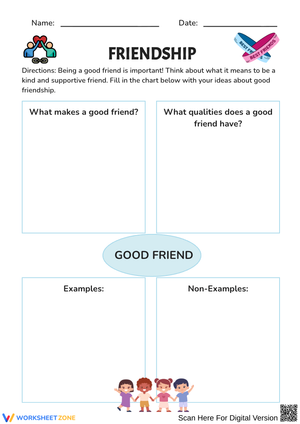
These what makes a good friend worksheets for 3rd grade give teachers a complete opinion writing unit built around a prompt that 8- and 9-year-olds are genuinely motivated to answer. The set moves from brainstorming friendship traits through structured drafting to peer editing — four distinct worksheets that form a coherent writing sequence without locking teachers into a single lesson format.
What the Set Contains
Each worksheet targets a specific stage of the opinion writing process. Teachers can use them in sequence across a writing week or pull individual resources for focused mini-lessons.
- OREO Graphic Organizer — Students record their Opinion, two or three Reasons, a supporting Example for each reason, and a restatement of their Opinion in a concluding sentence. The acronym gives writers a mental anchor they can return to across the year.
- Character Traits Word Bank — A curated list of friendship vocabulary — trustworthy, loyal, supportive, patient, honest, respectful — so students reach for precise language rather than defaulting to "nice" or "good."
- Lined Writing Template with Sentence Starters — The template opens with a fill-in opinion statement and prompts students with transition cues (One reason is..., For example..., Another reason is..., In conclusion...) at each paragraph break.
- Self- and Peer Editing Checklist — Students confirm their draft includes a clear opinion statement, at least two distinct reasons, linking words, and a conclusion. Partners use the same checklist to give structured feedback before revision.
Why the Friendship Prompt Consistently Produces Stronger Grade 3 Opinion Writing
Third grade is when W.3.1 asks students to move beyond personal narrative and begin defending a stated opinion with reasons and evidence. The difficulty is that many 8-year-olds have little experience generating abstract arguments. A friendship prompt sidesteps that problem because every student in the room has formed opinions through lived experience — they know which friends helped when something went wrong, which ones kept a secret, which ones made recess better. That prior knowledge fills the graphic organizer quickly and produces reasons that feel genuine rather than invented.
Using what makes a good friend worksheets for 3rd grade also gives teachers a natural entry point into classroom community discussions. Students working through the writing prompt are, in a practical sense, articulating how they want to treat each other. The writing becomes social-emotional work without needing to be labeled as such, and the author's chair share-out on day five tends to run long.
Mistakes Students Make That These Worksheets Help You Catch
The most common error at this grade level is circular reasoning — writing a reason that simply restates the opinion in different words. A student might write: A good friend is kind. A good friend is kind because kindness is important. That sentence feels like a reason but adds nothing new. The peer editing checklist targets this directly by asking reviewers whether each reason answers "Why does that matter?" rather than repeating the claim. Addressing this in grade 3 matters because the habit follows students into upper-elementary argumentative writing if it is not redirected early.
A second consistent pattern appears in conclusions. Third graders frequently end with the word "finally" and then copy their opening sentence nearly verbatim. The lined writing template addresses this by prompting a restated opinion using fresh phrasing — That is why I believe... rather than looping back to I think a good friend is... word for word.
Standard Alignment
These worksheets address CCSS.ELA-LITERACY.W.3.1, the opinion writing standard for Grade 3. The standard has five components: introducing the topic, stating an opinion, providing reasons that support the opinion, using linking words and phrases, and supplying a concluding statement or section. Each worksheet maps to at least one of those components — the OREO organizer handles opinion and reasons, the word bank supports precise language, the lined template reinforces linking words in context, and the checklist prompts students to verify the conclusion before revision. Teachers documenting standards coverage in lesson plans or grade-level data meetings can note which worksheet targets which sub-skill.
Recommended Lesson-Planning Strategies for These Worksheets
Most Grade 3 teachers run this sequence across five writing workshop sessions. Day one is a whole-class brainstorm: spend the first fifteen minutes asking students what qualities they look for in a friend, record responses on chart paper, then distribute the word bank. Day two: model the OREO organizer under a document camera, completing it with your own quality choice before students fill in their own — this is where the because test earns its keep. Ask a student to say their opinion aloud and then add "because" at the end; whatever they say next is their first reason. Repeating the exercise two or three times generates supporting points before anyone touches the organizer. Day three is drafting with the lined template. Day four is peer editing — partners swap and work through the checklist together. Day five is final copy and author's chair.
The because test works especially well for reluctant writers who freeze during silent drafting. It separates the thinking step from the transcription step, which is the source of most blank-page paralysis at this age. Running it orally in pairs during the day two session often produces more planning material than ten minutes of silent independent pre-writing.
Adjusting the Worksheets for Different Student Levels
For students who need more support, add partially completed sentence frames to the writing template — I believe a good friend is someone who _____ because _____ removes the most daunting blank. The word bank also doubles as a spelling reference, which removes a common barrier: third graders often avoid precise vocabulary when they are unsure how to spell it, and having trustworthy or empathetic printed on the worksheet lets them use ambitious words without stopping to ask.
Advanced writers can draft freely on plain lined paper, using only the OREO organizer as a planning tool. Pushing further: ask them to address a counterargument — "Some people might think a good friend always agrees with you, but I think..." — which introduces the kind of reasoning W.4.1 will require the following year. The what makes a good friend worksheets for 3rd grade also work well as evaluation tasks at that level: give advanced students an example draft and ask them to score it using the peer editing checklist, then justify each mark in writing.
Frequently Asked Questions
Can individual worksheets be used outside the full writing sequence?
Yes. The OREO organizer works independently as a pre-writing tool for any opinion prompt throughout the year, not just the friendship topic. The peer editing checklist transfers to any opinion piece students write after this unit. Many teachers pull a single worksheet as a warm-up or use the checklist during writing conferences rather than running the full five-day sequence.
What if students all choose the same friendship quality — does the writing still have value?
The what makes a good friend worksheets for 3rd grade work precisely because different students reach different conclusions and for different reasons. If two students both choose "honesty," their supporting examples will come from different experiences, producing genuinely distinct opinion pieces. The author's chair share-out on day five highlights this naturally: students hear the same claim backed by different reasoning, which is an early model of how opinion writing works across contexts.
How do the worksheets handle students who struggle to identify specific examples?
The OREO organizer prompts for an example beneath each reason, which is what separates it from a plain brainstorm list. If a student writes "A good friend is honest" as a reason but cannot identify an example, that signals a need for the oral rehearsal step — ask them to describe a time when a friend's honesty, or dishonesty, actually mattered. That memory almost always produces a usable example within a minute. The oral prompt before writing, not the worksheet itself, is what moves the stuck writer forward.
Clear All