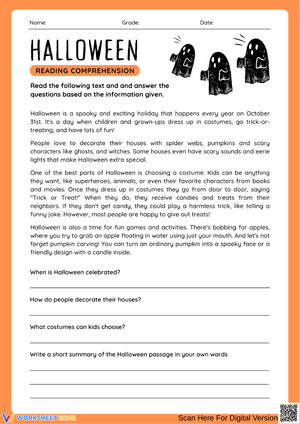
Summarizing nonfiction texts printable worksheets for 3rd grade address one of the trickiest reading transitions in early elementary school — the shift from retelling stories to extracting meaning from informational text. Third grade is the year students stop being told what a text is about and start being expected to determine it themselves. These worksheets put that cognitive work directly in front of students with informational passages and structured response formats matched to what 8- and 9-year-olds can realistically handle.
The Specific Skills Targeted
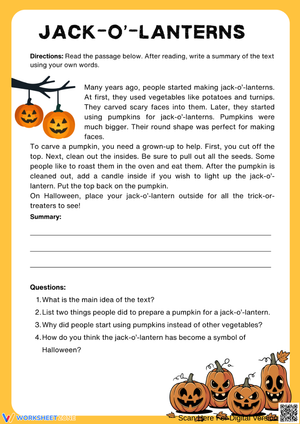
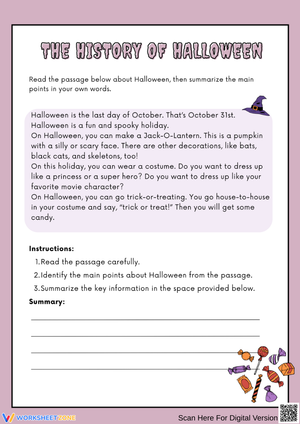
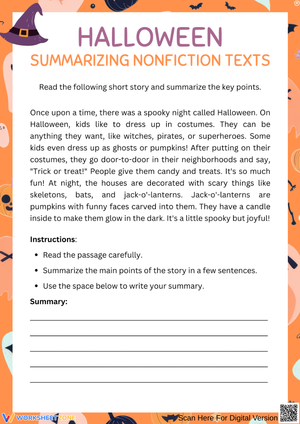
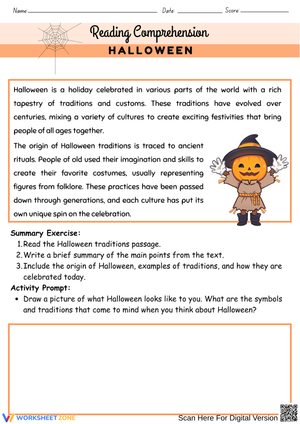
Third graders working through this set practice three related but distinct moves. First, they pull the main idea from a passage without simply lifting the topic sentence verbatim — a harder task than it sounds when the author buries the central point in the second paragraph rather than the first. Second, they select which details are load-bearing and which ones are just interesting. Third, they compress the author's message into their own words. Each worksheet pairs a short informational passage with a response structure — a main idea slot at the top, two or three detail slots below — so students always know what they're building toward before they write a single sentence.
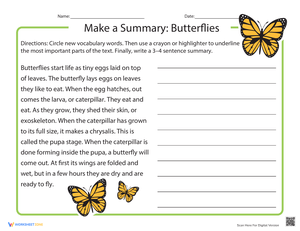
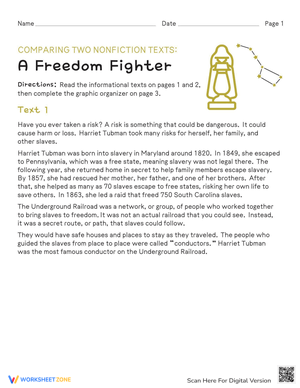
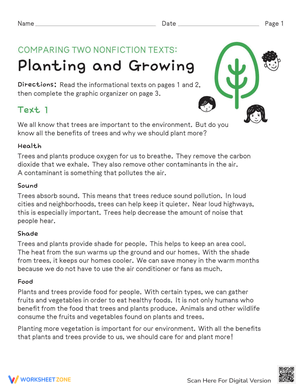
The passages cover a range of nonfiction subjects including animal science, weather systems, community roles, and foundational historical events. That variety is intentional. Main idea skills don't transfer automatically from one content area to another — a student who handles a passage about monarch butterflies confidently can still stall on a passage about the water cycle if the text structure feels unfamiliar. Working across content keeps the skill from becoming topic-dependent.
Frequent Student Errors Worth Watching For and Correcting
The most persistent mistake at this grade level isn't what most teachers expect. Students regularly produce a supporting detail as their main idea — something like "Dolphins use clicks to find fish" as the main idea of a passage about dolphin communication — because that sentence is specific, it came from the text, and it feels important. The actual main idea ("dolphins have developed special ways to communicate") is too general to feel right to them. They distrust it. Several worksheets address this directly by prompting students to write a candidate main idea, then check each supporting detail against it: if a detail doesn't logically connect back to the statement they wrote, the main idea needs revision — not the detail.
Copying is a second consistent problem. Given a blank box labeled "Main Idea," many students locate the first sentence of the passage and transcribe it. Each worksheet interrupts this pattern structurally — students read the passage, then respond on the back or on a separate worksheet, which forces retrieval rather than transcription. That physical separation does more practical work than a reminder written on the board at the start of class.
A third pattern worth catching: students who blur summary with personal reaction. Third graders frequently add lines like "I thought it was cool that..." or "The author made a good point." Writing two columns on the board — What the Author Said and What I Think — and sorting five or six example sentences as a group before independent writing makes the abstract rule concrete enough to actually stick.
Building These Worksheets Into Your Lesson Sequence
These resources fit three instructional slots without requiring any lesson overhaul. During whole-group direct instruction, project one worksheet and run a full think-aloud — read the passage aloud, narrate why a specific detail doesn't qualify as the main idea, and show what revision looks like in real time. That 15-minute opening session at the start of a unit makes every subsequent independent attempt cleaner because students have watched an expert reader do the filtering work before being asked to do it alone.
In literacy rotations or small-group work, give different worksheets to different reading bands — same main idea skill, different passage complexity. One group works through a four-sentence paragraph about community helpers; another handles a ten-sentence passage with subheadings about the water cycle. The response structure stays consistent across both, which keeps the instructional target visible even when the text level shifts. The summarizing nonfiction texts printable worksheets for 3rd grade in this set are organized well enough by passage length and density that pulling two or three for a small-group rotation takes under two minutes of prep.
For independent practice — the Friday review block, the eight minutes before morning pickup, the warm-up on Monday after morning meeting — a single worksheet gives most third graders 10 to 12 minutes of focused reading and writing work. Completed worksheets become immediate formative data: a student who writes a supporting detail in the main idea slot on three consecutive worksheets is telling you exactly what to reteach.
Standard Alignment
These worksheets address ELA-Literacy.RI.3.2, which asks third graders to determine the main idea of a text and explain how key details support it. In most scope-and-sequence maps, RI.3.2 appears early in the fall and returns with higher expectations mid-year — by winter, students are expected not just to name supporting details but to articulate the relationship between those details and the main idea. Earlier worksheets in the set ask students to identify and list; later ones require them to explain the connection explicitly, which reflects that instructional progression rather than treating the standard as a single fixed task.
Adjusting These Worksheets Across Ability Levels
For students still developing basic comprehension, reduce the task before asking them to write. Cover the response section, read the passage aloud together, then uncover just the main idea slot. Ask them to tell you the main idea before they write it — oral rehearsal reduces the writing demand enough that you can see whether the thinking is actually there. A student who can say it clearly but can't write it clearly has a different instructional need than a student who can't do either, and you won't know which one you're working with until you separate the two steps.
Students who find the standard format too easy benefit from added constraints. Ask them to write their summary in exactly four sentences — no more, no fewer. That limit forces compression decisions that open-ended responses don't require. A useful extension: have them trade with a partner and evaluate the summary's accuracy without looking back at the passage. If the reader can't verify the main idea claim from the summary alone, the writer hasn't finished the job yet. The summarizing nonfiction texts printable worksheets for 3rd grade set includes passages varied enough in length and density that this kind of differentiated reassignment is straightforward to manage across one classroom period.
Frequently Asked Questions
How long should a third-grade nonfiction summary be?
Three to five sentences handles it for most students at this level — a topic sentence that names the main idea, two or three sentences each carrying a supporting detail, and nothing added beyond that. Longer summaries are rarely better summaries. A concise, accurate three-sentence version is harder to produce than a sprawling seven-sentence version that circles the point without landing it, and building that compression habit early pays off across every subject that involves informational reading.
What's the most effective way to stop students from copying the passage directly?
Ask students to read the passage, then turn the worksheet face-down and tell a partner what it was about before writing anything. Once the summary has been spoken aloud, most students write from memory rather than from the text. A second option: have students underline three key phrases in the passage — not full sentences — and then build their summary using only those phrases as anchors. Both moves shift the work from transcription to actual synthesis.
Which graphic organizer format works best with these passages?
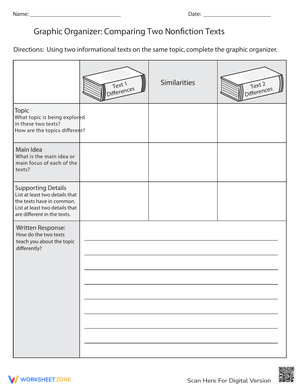
A main idea and details chart — one box at the top, three connecting boxes below — handles most expository passages cleanly. For passages that walk through a sequence, such as how a caterpillar becomes a butterfly or how rain forms in the water cycle, a vertical flow map preserves the order that matters for the summary. The key is matching the organizer to the text structure rather than defaulting to one format for every passage. When the visual logic of the organizer already mirrors the author's organizational pattern, students produce more accurate summaries with less confusion about where things go.
Should these worksheets be used as grades or as practice?
They work far better as formative checks than as summative grades, especially early in a unit. A student's first few attempts at main idea summarizing tell you where instruction needs to go — that's more valuable as diagnostic information than as a number in a grade book. Once students have had multiple practice rounds with feedback, a final worksheet can function as a brief performance check. The summarizing nonfiction texts printable worksheets for 3rd grade in this set are short enough that one completed worksheet gives you a clear read on student understanding without requiring a full class period to administer.












 Interactive Worksheet Maker
 Quiz Maker
 Word Search Maker
 Crossword Puzzle Maker
 Word Scramble Generator
 Sentence Scramble Generator
 Handwriting Worksheet Generator
 Name Tracing Generator
 Fill In The Blank Generator