3rd Grade Antonyms worksheets
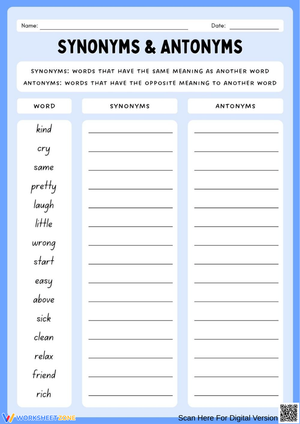
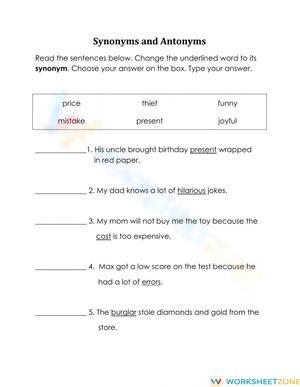
These 3rd grade antonyms worksheets resources give teachers several distinct practice formats — matching grade-level word pairs, rewriting sentences to flip their meaning, sorting contrasting words, completing sentences using contrast clues, and analyzing antonym relationships inside short reading passages. Each worksheet targets a specific skill within the broader domain of word relationships, so teachers can assign them in sequence or pull individual ones to address a gap without working through the full set.
What Students Practice Across the Set
Third graders arrive in September with confident command of concrete, everyday opposites — hot and cold, fast and slow, big and small. The instructional challenge is extending that knowledge into the academic vocabulary students actually encounter in third-grade texts: adjectives like "reluctant," verbs like "diminish," adverbs like "ferociously." These worksheets target that zone specifically, pairing familiar practice structures with words that require genuine thinking.
- Matching adjectives, verbs, and adverbs to their opposites from a grade-appropriate word bank
- Rewriting marked words in a sentence using their antonyms, then identifying how the overall meaning shifts
- Sorting word pairs into "true antonyms" versus "different but not opposite" — a format that catches students who confuse antonyms with words that are merely unrelated
- Identifying contrast signal words such as "unlike," "however," "although," and "but" in passages, then explaining what opposite relationship those signals point to
- Building T-charts with multiple antonyms for a single word, addressing the reality that "light" has two different opposites depending on whether it refers to weight or brightness
Antonyms as a Reading Strategy, Not Just Word Study
The connection between antonym knowledge and reading comprehension is direct. When a student reads "Unlike his boisterous brother, James was quite timid," the word "unlike" signals that the two highlighted words carry opposite meanings. If the student already knows "boisterous" means loud and energetic, that one signal word tells them "timid" means something quiet and reserved — without a dictionary. Teaching students to recognize contrast signals as a decoding strategy is a genuine comprehension move, and it transfers to standardized reading assessments in measurable ways.
Several worksheets in the set embed antonym pairs inside reading passages and ask students to explain their reasoning in writing rather than simply circle an answer. That added step — writing a sentence about how they used the contrast to figure out an unknown word — makes the comprehension strategy visible and shows teachers whether the skill is actually transferring to text.
How to Work These Worksheets Into Your Planning
The matching and sentence-completion worksheets fit naturally as five-minute warm-ups at the start of a language arts block. On Monday mornings — particularly during the ten minutes between morning meeting and the first lesson — a short matching task reactivates word knowledge from the prior week before any new instruction begins. Most students finish in seven to ten minutes, which fits that window without running into the next transition.
For literacy centers, these print and slide into dry-erase sleeves without laminating. Students complete each task with a dry-erase marker, wipe the sleeve clean between rotations, and move on. One printed set cycles through a center for two to three weeks without repeating.
The "opposite story" activity deserves its own mini-lesson before students try it independently: provide a short descriptive paragraph and ask students to rewrite it by swapping every highlighted adjective and verb for its antonym. A "bright, energetic morning" becomes a "dim, sluggish morning." Students have to evaluate whether each swap makes grammatical and semantic sense — which is harder than it sounds and generates discussion that reveals immediately who understands word meaning at the conceptual level versus who is just swapping words mechanically. A 3rd grade antonyms worksheets in this format produces the kind of visible thinking that a fill-in-the-blank task rarely does.
Errors Worth Watching For and Correcting Early
The most consistent mistake is offering a synonym instead of an antonym — particularly in the first week or two after synonym instruction. A student who has just learned that "happy" and "joyful" are synonyms will sometimes write "happy" as the opposite of "joyful," because both words connect in the same mental vocabulary cluster. A quick diagnostic is to have the student use both words in a sentence with "but" as a connector: "She was joyful, but he was ___." If the student pauses and revises, they understand the concept. If they fill in "happy" without hesitation, they need more explicit contrast work before returning to the worksheet independently.
Context-dependent antonyms create a second, quieter problem. When "light" appears in a sentence about a heavy bag, students who write "dark" are not wrong about the antonym relationship in the abstract — they are wrong about reading the context first. These worksheets include sentences where only one of two valid antonyms actually fits, which forces students to read for meaning before selecting a word.
A third pattern shows up in rewriting tasks: students choose antonyms that are technically correct but tonally out of place. Replacing "gloomy" with "resplendent" is not wrong, but if the surrounding passage is written in simple third-grade language, "bright" or "cheerful" communicates the contrast more accurately. Word choice precision — knowing the right opposite is also the right word for the context — separates students who have internalized the skill from students who have memorized a list.
Standard Alignment
These 3rd grade antonyms worksheets address CCSS.ELA-LITERACY.L.3.5.A, which requires students to distinguish shades of meaning among related words and demonstrate understanding of word relationships and nuances in word meaning. In practical classroom terms, this standard shows up in two instructional settings: vocabulary instruction during the language arts block, and guided reading when students use context clues to interpret unfamiliar words. Antonyms sit at the center of both. The standard falls at grade 3 specifically because students at this stage are transitioning from phonics-based decoding toward meaning-based reading strategies — word relationship knowledge becomes the primary growth lever once basic decoding is in place, and antonym instruction feeds directly into that shift.
Adjusting the Set for a Range of Learners
For students who are still building basic vocabulary, the matching worksheets with word banks reduce the retrieval demand and focus attention on recognizing contrasting relationships — which is the actual skill being assessed, not memorization. These students can attempt every item without freezing on unknown words, which keeps the practice productive rather than discouraging.
Students working above grade level get the most from the rewriting and passage-based worksheets. Once they finish the primary task, ask them to compose a sentence that uses the original word and its antonym together with a contrast signal word — "Although the morning started bright, it turned dim by noon." That extension pushes toward the sentence-level synthesis that the standard ultimately requires and gives these students a reason to slow down and think rather than race through.
The T-chart worksheets offer the widest entry range in the set. A student who needs foundational practice writes one antonym per word. A student ready for nuance writes two antonyms and a sentence demonstrating why context determines which one to use. One worksheet serves both levels without requiring separate prep.
Frequently Asked Questions
Can these worksheets be used in a unit that covers both synonyms and antonyms?
Yes, but the sequence matters. Introduce antonyms first and allow several days of focused practice before bringing synonyms into the same lessons. When both concepts arrive simultaneously too early, students blur them — especially on sentence-completion tasks where a synonym might technically fit a blank even though the task specifies an opposite. A week or two of dedicated antonym work produces cleaner understanding when synonyms are eventually introduced alongside it.
Do these resources work for students reading below grade level?
The matching worksheets work well for below-grade readers because word banks limit how much unfamiliar vocabulary students face at once. For students significantly below level, briefly pre-teaching two or three target word pairs before the worksheet begins prevents the frustration that comes from encountering multiple unknown words simultaneously. The 3rd grade antonyms worksheets set draws its word pairs from third-grade reading lists, so the vocabulary is appropriately leveled even when students benefit from additional verbal support before getting started.
How should these worksheets be sequenced across a unit?
A reliable sequence: start with matching tasks to build recognition, move to sentence completion to apply that recognition in context, then to rewriting activities that require students to produce antonyms independently, and close with passage-based work that transfers the skill directly to reading. This progression increases demand at each step without requiring teachers to design a separate ramp-up. Most units run four to six weeks at this pace, with one or two worksheet sessions per week.
Clear All