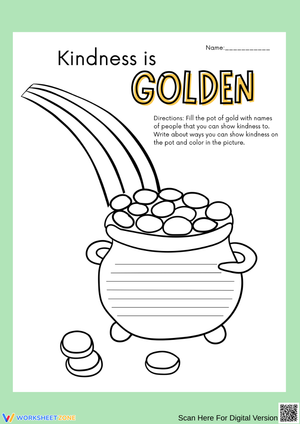
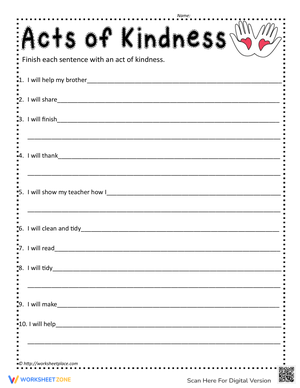
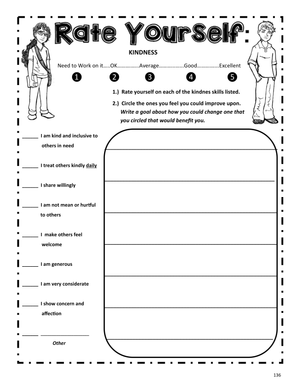
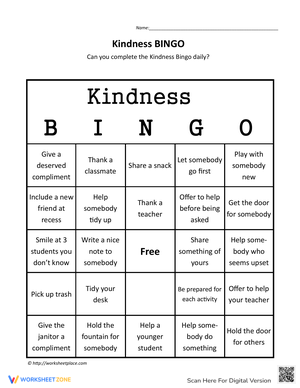
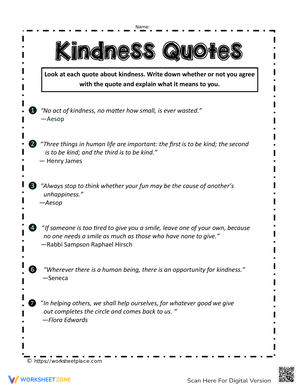
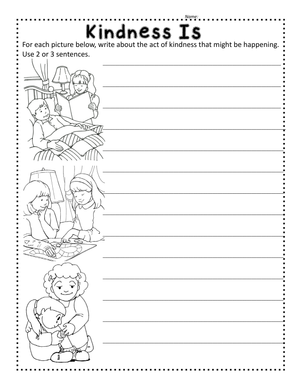
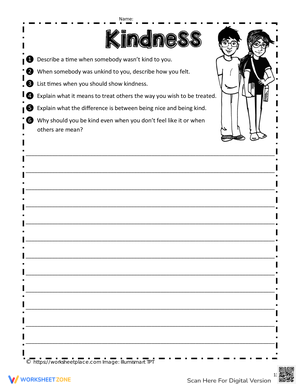
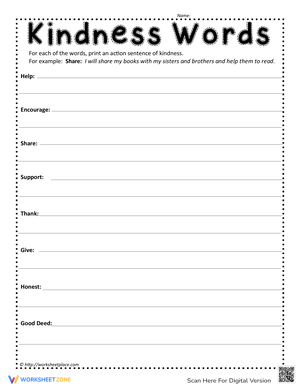
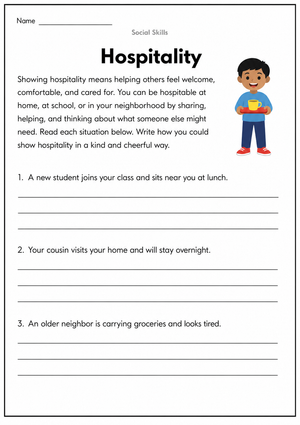
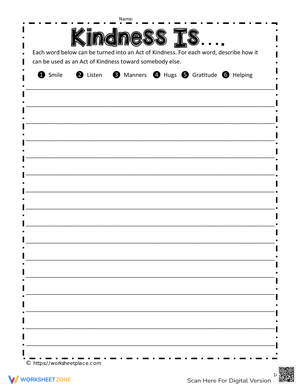
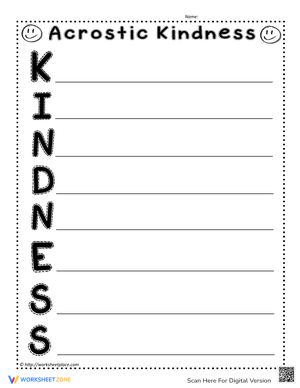
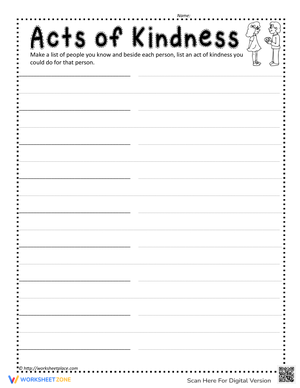
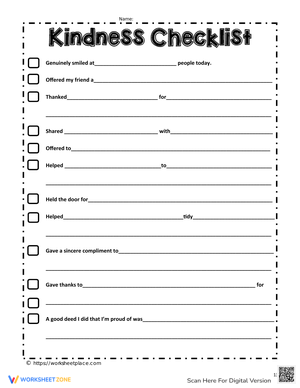
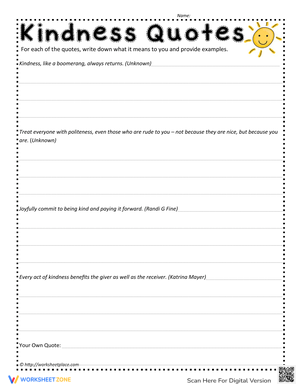
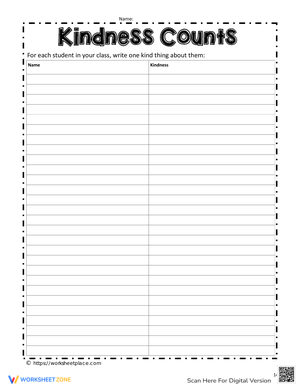
These kindness worksheets for 3rd grade arrive at exactly the right developmental moment—eight- and nine-year-olds are transitioning from parallel play toward genuine perspective-taking, and explicit instruction gives that shift real traction. The set covers scenario analysis, vocabulary building, and kind-act tracking across a range of formats, so teachers can draw from it throughout the year rather than treating it as a one-time unit.
Skills Covered Across the Worksheets
Each worksheet targets a distinct slice of social-emotional competency rather than circling the same general "be nice" message. The range includes:
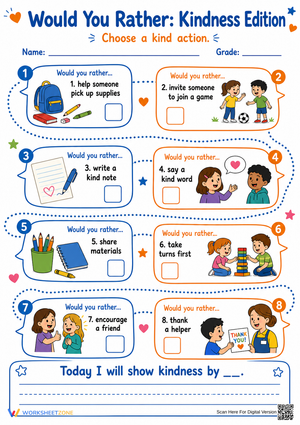
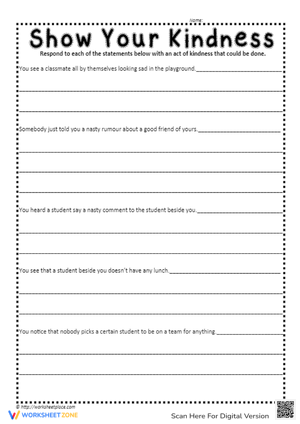
- Perspective-taking scenarios: Students read a brief classroom or playground situation and write what a kind response would look like—and why. This requires them to name the emotions in play before proposing a solution.
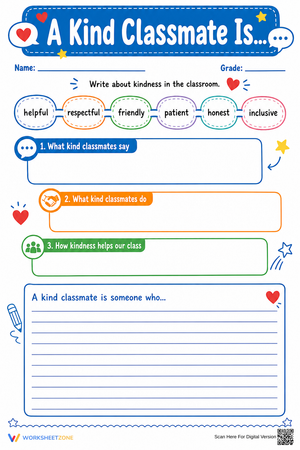
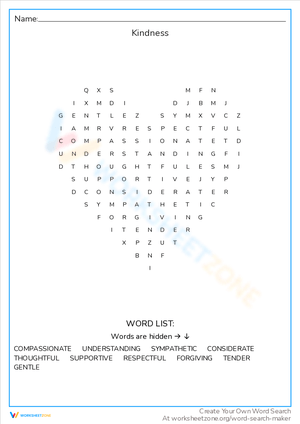
- Kindness vocabulary in context: Words like empathy, compassion, and consideration are introduced with definitions, then used in original sentences and short reflections. Third graders handle these terms well once they have concrete examples to attach them to.
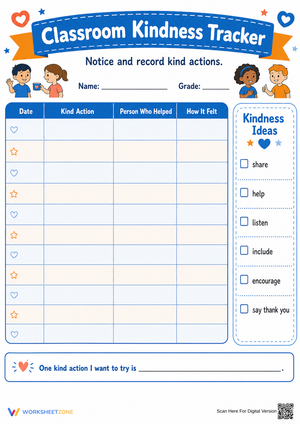
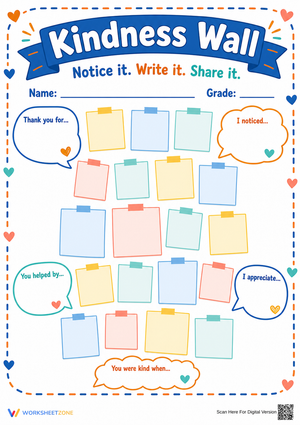
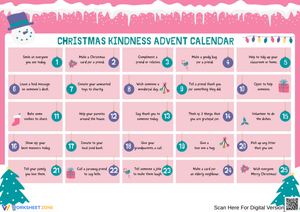
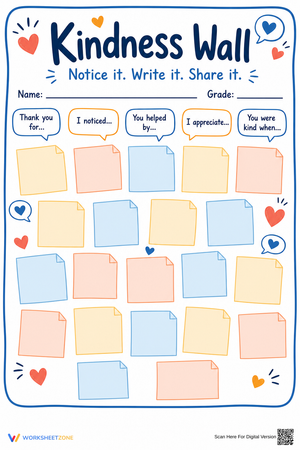
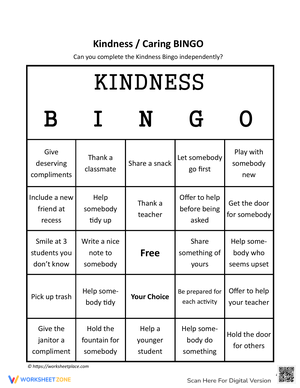
- Kind-act tracking: Students document small moments of kindness they offered or observed during the school day, building the habit of noticing prosocial behavior in real time.
- Character analysis: Several worksheets ask students to identify how a character in a short passage demonstrated kindness and what followed from that choice—connecting the SEL work to reading standards.
- Open-ended reflection: Prompts ask students to recall a moment when they chose kindness and describe what made that choice difficult or easy.
What Student Responses Reveal—and Where They Stall Out
The most consistent gap in student work is the jump from recognition to reasoning. Students will correctly identify that a character "should be nicer" but struggle to explain why the other person feels hurt. A student might write "she should say sorry" with no acknowledgment of what that apology would actually mean to the person receiving it. This is where the vocabulary work earns its place—once a student has the word empathy anchored to a specific example, their written explanations start to reach further.
A second pattern worth watching: students frequently conflate kindness with compliance. On scenario worksheets, responses like "just do what the teacher says" or "tell an adult and walk away" show up regularly when the scenario asks what a kind student would do. These answers aren't wrong, but they sidestep the interpersonal moment entirely. Pushing students to return to those responses and add one sentence about the other person's feelings moves them past rule-following into genuine social awareness—and that revision step reveals who is actually doing the thinking.
Building These Worksheets Into Your Lesson Plans
Morning meeting is the natural home for scenario and reflection worksheets, but the 8–10 minutes before a transition or the quiet stretch after lunch work just as well. These worksheets pair cleanly with read-alouds—when a character in the day's story shows or withholds kindness, pause and distribute the scenario worksheet before discussion. Students arrive at the conversation having already committed a response in writing, which sharpens the exchange considerably compared to cold discussion.
The kind-act tracking worksheets run best as a week-long structure. Students keep them at their desks and add one entry per day; on Friday, three or four students share an entry aloud as a brief closing ritual. This builds the observation habit without requiring a separate SEL block every day. After two or three weeks, students start narrating the room—"that was a kindness moment"—without prompting from the teacher.
These kindness worksheets for 3rd grade also integrate with writing instruction in a way that's easy to overlook. Reflection prompts make strong personal narrative seeds, and the vocabulary work reinforces the descriptive language students need across their own writing. Treating the SEL work as sealed off from academic content misses that connection.
Adjusting the Set for a Mixed-Ability Classroom
Students who read and write comfortably can extend any scenario worksheet by writing an alternate long-term outcome—what happens over the next week if the kind choice gets made consistently versus avoided? That kind of forward-thinking is challenging but within reach for strong third-grade writers, and it pushes the work past the immediate scenario into cause-and-effect reasoning.
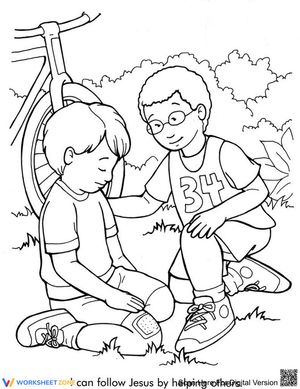
For students who freeze when they see a blank writing line, pairing the scenario worksheet with a structured response frame ("I think ___ feels ___ because ___") removes the compositional load without simplifying the thinking. The goal is still perspective-taking; the frame just lowers the entry barrier. Students who struggle specifically with empathy—not just writing—benefit most from worksheets that start with observable physical cues: "What does her face look like? What is her body doing?" Building from visible signals to internal states is more concrete than asking "how do you think she feels?" without any anchor.
Students who need enrichment can take vocabulary worksheets further by researching how a word like integrity applies to a historical figure they are studying in social studies. This cross-curricular extension keeps the vocabulary work from feeling isolated and gives higher-readiness students a genuine intellectual challenge rather than more of the same.
Standard Alignment
Most state SEL frameworks at the third-grade level reference CASEL competency areas, particularly Social Awareness—taking others' perspectives, recognizing feelings across diverse contexts—and Relationship Skills, which includes active listening, clear communication, and cooperation. The scenario and reflection worksheets address Social Awareness directly; the kind-act tracking and discussion extensions address Relationship Skills in practice. These are not abstract competencies at this grade: they show up in how students handle group work, respond to peer conflict, and describe characters in text.
For ELA connections, the character analysis worksheets align with CCSS RL.3.3, which asks third graders to describe characters' traits and explain how those traits affect the sequence of events. Using kindness as the lens for character study gives that standard a concrete, emotionally engaging application—one that draws on the same skills students are developing through the SEL work.
Frequently Asked Questions
How do these worksheets fit into a morning meeting structure?
Scenario and reflection worksheets work well as the activity portion of morning meeting. Students complete the worksheet individually for three to four minutes, then share with a partner before the group conversation opens. The completed worksheet also gives the teacher a quick read on individual students' social reasoning—who is genuinely taking another's perspective versus who is defaulting to rule-following—without requiring a formal assessment.
Can these be used after a classroom conflict rather than as preventive instruction?
Yes, and that is often when they land hardest. After a conflict, the scenario worksheets shift from abstract to immediately personal. Choosing a scenario that mirrors what just happened—without naming the actual students involved—lets the whole class process the event with some emotional distance. Kindness worksheets for 3rd grade used this way function less like a lesson and more like a shared debrief tool, which changes how students engage with them.
What do I do when a student's response is surprisingly harsh or dismissive?
Treat it as information rather than a behavior problem. A student who writes "just ignore her" in response to a peer-exclusion scenario is telling you something about either their experience of being left out or the social logic they have internalized. A brief one-on-one conversation—"walk me through your thinking here"—usually reveals more than the written response will. The worksheet did its job: it surfaced a belief worth addressing.
How long does each worksheet take to complete?
Scenario and reflection worksheets typically run 10–15 minutes for independent completion; vocabulary worksheets run slightly longer when students draft original sentences. Kind-act trackers are cumulative across a week and take only a minute or two per daily entry. These kindness worksheets for 3rd grade are sized for real classroom windows—not 45-minute dedicated blocks—which makes them easier to fit without restructuring your whole schedule.












 Interactive Worksheet Maker
 Quiz Maker
 Word Search Maker
 Crossword Puzzle Maker
 Word Scramble Generator
 Sentence Scramble Generator
 Handwriting Worksheet Generator
 Name Tracing Generator
 Fill In The Blank Generator