


























Views
Downloads

Grade 3 Push and Pull Forces — Printable No-Prep Worksheet
Paste this activity's link or code into your existing LMS (Google Classroom, Canvas, Teams, Schoology, Moodle, etc.).
Students can open and work on the activity right away, with no student login required.
You'll still be able to track student progress and results from your teacher account.
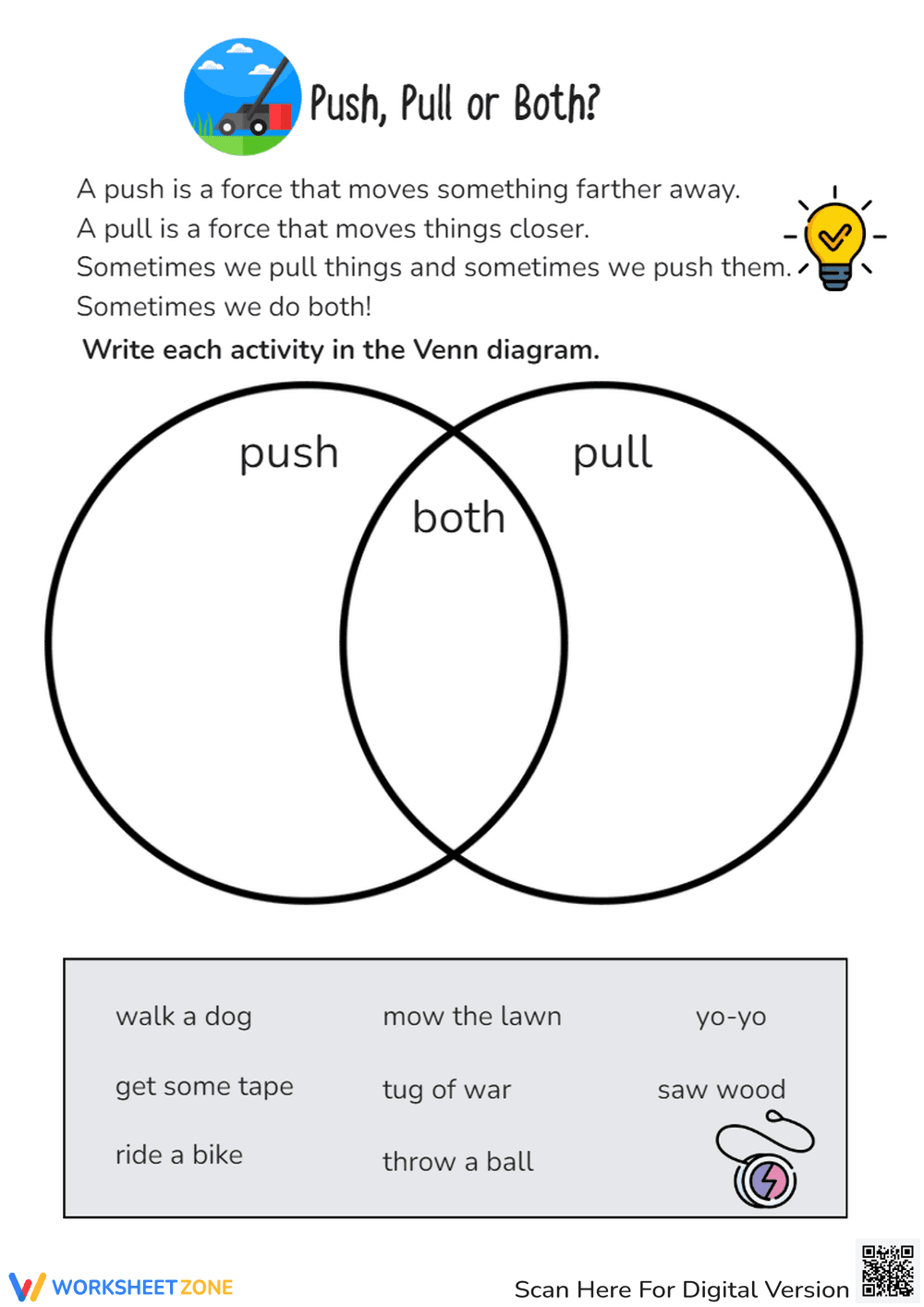
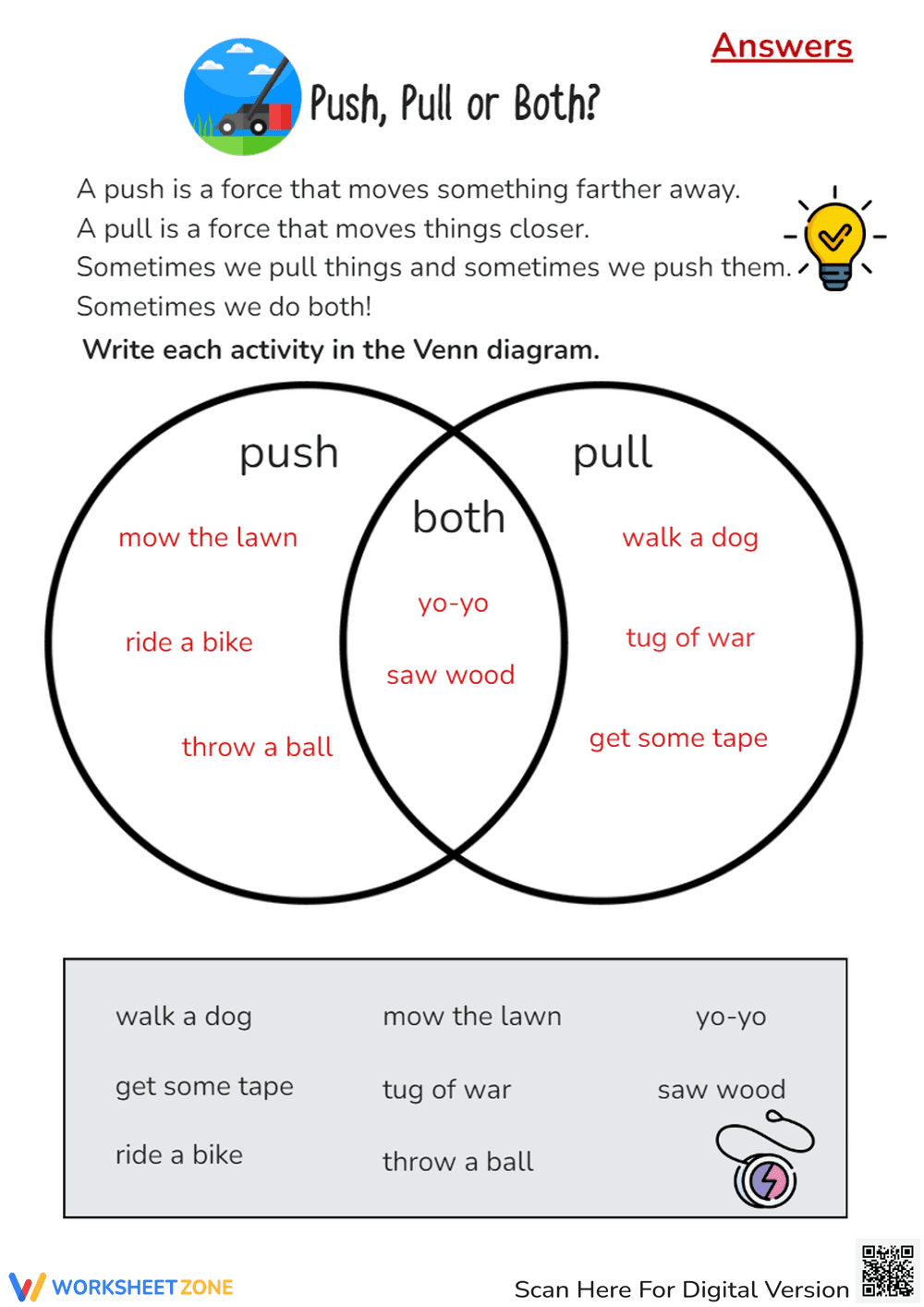
This Grade 3 science worksheet helps students master the fundamental concepts of force by categorizing everyday actions into pushes, pulls, or both. By using a Venn diagram, learners visualize how complex motions often involve multiple force directions, building a solid foundation for future physics studies and understanding how objects move in their environment.
At a Glance
- Grade: 3 · Subject: Science
- Standard:
3-PS2-1— Plan and conduct investigations to provide evidence of the effects of forces- Skill Focus: Categorizing push and pull forces
- Format: 2 pages · 9 problems · Answer key included · PDF
- Best For: Independent practice or formative assessment
- Time: 10–15 minutes
The resource features a clear, large-format Venn diagram with three distinct zones: push, pull, and the overlapping "both" category. It includes a word bank of 9 common activities, such as "mowing the lawn" and "tug of war," alongside a concise definition of forces to support student memory. A complete answer key is provided for rapid grading and immediate student feedback.
Zero-Prep Workflow
- Print: Generate the single-page PDF for your entire class in under 1 minute.
- Distribute: Hand out the worksheet as a quick warm-up, exit ticket, or center activity (30 seconds).
- Review: Use the included answer key for immediate whole-group review or individual feedback (30 seconds).
This streamlined process makes the worksheet an ideal resource for emergency sub plans or busy instructional blocks where teacher prep time is limited to under 2 minutes.
Standards Alignment
This worksheet aligns with `3-PS2-1`, which requires students to provide evidence of the effects of balanced and unbalanced forces on motion. It also supports `K-PS2-1` by comparing the directions of pushes and pulls. Both standard codes can be copied directly into lesson plans, IEP goals, or district curriculum mapping tools to ensure instructional compliance.
How to Use It
Use this as a formative assessment after a direct instruction lesson on Newton's laws or force types. Observe students as they decide where "sawing wood" belongs; their reasoning provides insight into their understanding of reciprocal motion. The activity typically takes 10 to 15 minutes to complete and works well as a bridge between a hands-on lab and a formal unit test.
Who It's For
This resource is designed for Grade 3 students but is highly effective for Grade 2 introduction or Grade 4 review. It serves English Language Learners well through clear definitions and concrete examples. Pair this with a classroom scavenger hunt or a lesson on simple machines for a comprehensive science experience.
According to the RAND AIRS 2024 report, visual organizers like Venn diagrams significantly improve conceptual retention in elementary science by forcing students to discriminate between overlapping categories. This worksheet targets the 3-PS2-1 standard, focusing on the plain-English skill of identifying how different directions of force affect objects. By sorting 9 specific activities, students move beyond rote memorization toward application-level thinking. Research from Fisher & Frey (2014) emphasizes that such scaffolded sorting tasks bridge the gap between initial exposure and independent mastery of physical science concepts. This resource provides the necessary structure for students to internalize the definitions of push and pull forces while recognizing the complexity of real-world motions that require both. It is a reliable tool for documenting student progress toward state and national science benchmarks and can be easily integrated into any existing curriculum.


