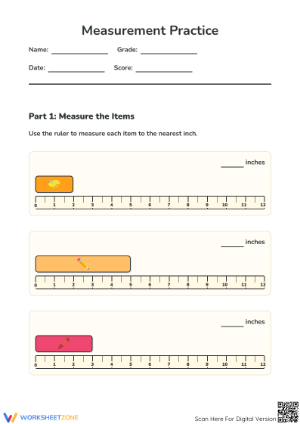
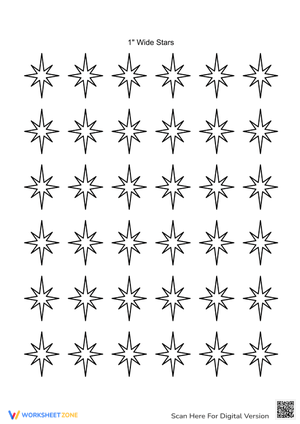
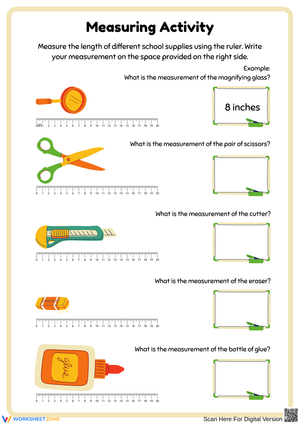
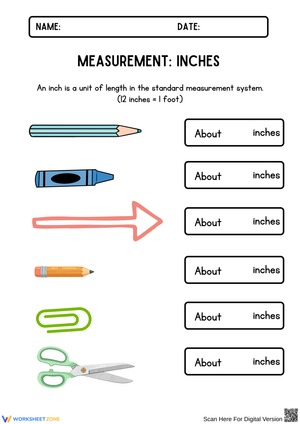
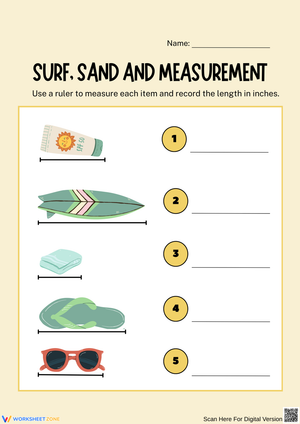
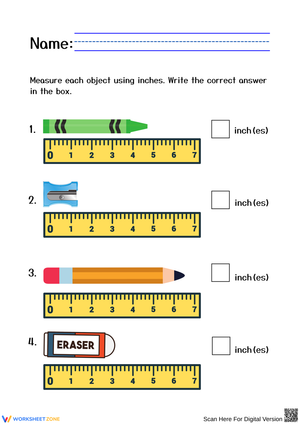
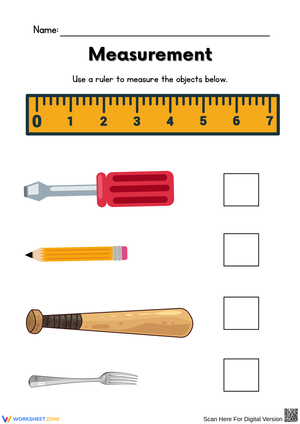
These 2nd grade measuring with inches worksheets give teachers a set of standalone, print-ready resources covering the three skills at the center of second-grade measurement: reading a ruler, measuring real objects and recording results, and estimating length before measuring. Each worksheet downloads separately and prints at accurate ruler scale when output at 100 percent — worth checking before distributing, because "fit to page" scaling in most PDF viewers will distort the printed rulers enough to produce wrong student answers.
What Students Practice Across the Set
The core task on most worksheets is reading a printed ruler to find where a pictured object ends, then writing that measurement. Students also encounter measurement recording tasks — a list of classroom objects they measure with a physical ruler and record — and estimation tasks with a separate column for predicted versus actual length. That estimate-first format builds the habit of checking whether an answer is plausible before accepting it, which is exactly what catches "I measured 12 inches" on a pencil.
Several worksheets use broken rulers: rulers that begin at 2, 4, or some other point rather than zero. These are deliberate. A student who reads measurement as "the number where the object ends" gets every broken-ruler problem wrong. Students who understand that length is the distance between two points — start to end — get them right. The broken-ruler tasks function as a quiet comprehension check embedded in regular practice.
Common Student Errors Worth Anticipating Before the Lesson
The most persistent second-grade measurement error is starting at 1 instead of 0. A student who does this records a 3-inch crayon as 4 inches, every time, with no indication that anything feels off. It happens because many rulers have a small blank strip before the zero mark, and students align the left edge of the object with the left edge of the ruler instead of hunting for the zero tick. Worksheets that print the zero mark slightly inside the ruler's left edge — making it visually distinct from the physical edge — help students see the difference without needing a teacher reminder each time.
Half-inch marks cause a different problem. Students who have the whole-inch read down cold will sometimes skip every other mark, reading only the labeled inch numbers. The fix that works in actual classroom practice: have students count out loud from the zero end — "zero, half, one, one-and-a-half, two" — while tracking each mark with a fingertip on the printed ruler before they touch a physical one.
Standard Alignment
The set addresses CCSS.MATH.CONTENT.2.MD.A.1, which asks students to select and use appropriate tools — rulers, yardsticks, measuring tapes — to measure the length of objects in standard units. The tool-choice tasks within 2nd grade measuring with inches worksheets (ruler versus yardstick for different objects) connect directly to that selection requirement rather than treating measurement as ruler-only. The set also supports CCSS.MATH.CONTENT.2.MD.A.3, which covers length estimation in inches and feet. The estimate-then-measure format on several worksheets addresses this standard in a way that teacher-led demonstration alone rarely achieves — students need repeated, low-stakes estimation practice before their guesses get reliably close to actual measurements.
Fitting These Worksheets Into Your Week Without Disrupting Pacing
Math centers are the most productive home for this set. A measurement station pairs one worksheet with a small collection of physical objects — a pencil, an eraser, a marker, a craft stick — and a ruler. Students measure each item, record on the worksheet, and self-check against an answer strip. The immediate feedback matters here more than in most second-grade math topics because ruler errors that sit uncorrected for even a few minutes become habitual. A six-minute Monday warm-up slot works well too: three measurement items on a half-sheet brings students back to ruler habits after a weekend away, and returning to the skill in short, spaced intervals builds retention more reliably than massing all measurement practice into a single unit week.
Before distributing any 2nd grade measuring with inches worksheets, print a test copy and check the ruler images against a physical ruler. "Fit to page" is the default in nearly every PDF viewer, and even modest scale compression distorts the printed rulers enough to produce wrong answers on measurement tasks.
Adjusting the Set for a Range of Learners
Students who are still inconsistent on whole-inch readings should stay with worksheets showing rulers with only whole-inch gradations — no half-inch or quarter-inch marks. The extra hash marks add visual clutter that slows students who haven't yet automated the zero-to-endpoint read. A useful support: have these students trace the zero mark on the printed ruler in pencil before measuring anything, making the starting point physically salient on that specific worksheet.
Students who are solid on whole inches move to half-inch worksheets, then to comparison tasks asking how much longer one object is than another. Those problems require two separate measurements and a subtraction — a natural entry point into the length word problems in CCSS.MATH.CONTENT.2.MD.B.5 that appear later in the year. The broken-ruler worksheets also work well for these students, since they demand real understanding of what measurement means rather than pattern-matching on a familiar scale.
Frequently Asked Questions
Do students need physical rulers to use these worksheets?
Worksheets with printed ruler images work for ruler-reading and estimation practice without a physical tool. Any worksheet that asks students to measure a real object — a pencil, a book spine, a classroom item — requires a physical ruler. The two formats target different parts of the same skill: printed rulers develop scale-reading fluency; physical rulers develop hand alignment and the zero-mark habit.
At what point in a measurement unit should these worksheets appear?
After hands-on ruler work with real objects, not before. Students need at least two or three lessons handling a physical ruler before printed ruler images are meaningful to them. These 2nd grade measuring with inches worksheets work best as practice after the core concept has been introduced — not as the first contact students have with an inch ruler.
Should all second graders attempt the half-inch tasks?
No. CCSS.MATH.CONTENT.2.MD.A.1 specifies measuring to the nearest whole unit. Half-inch precision is an appropriate extension for students who answer whole-inch tasks correctly and without hesitation, but pushing into half-inch marks before whole-inch reading is consistent adds confusion without any standards-based payoff. Reserve those worksheets for students who are clearly ready.
What helps with the "start at 1" error after it has already become a habit?
Have the student measure the same object twice — once their way, once starting at zero — and compare both answers to a known three-inch index card. When they see that their method produces four for an object that visibly fits inside a three-inch reference, curiosity takes over. Pointing out the error directly produces temporary compliance without understanding; letting students find the discrepancy themselves produces a correction that sticks.













 Interactive Worksheet Maker
 Quiz Maker
 Word Search Maker
 Crossword Puzzle Maker
 Word Scramble Generator
 Sentence Scramble Generator
 Handwriting Worksheet Generator
 Name Tracing Generator
 Fill In The Blank Generator