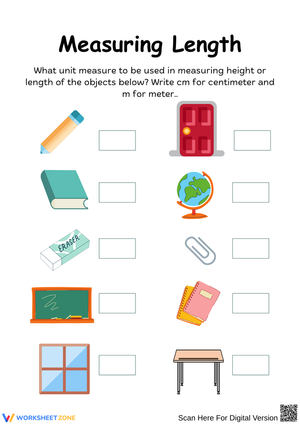
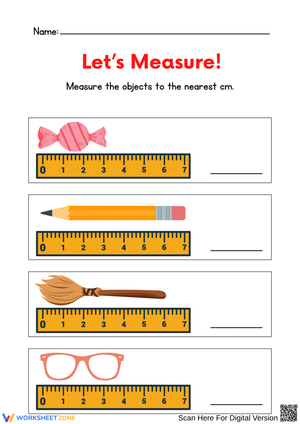
2nd Grade Measuring in Centimetres Printable Worksheets
These 2nd grade measuring in centimetres printable worksheets target a skill that looks simple from the outside but produces consistent errors the moment students first pick up a ruler: reading a numbered scale as a measure of distance rather than a count of marks. A child who counts blocks accurately can still write "6" when measuring a 5 cm line segment, because they start counting at the zero mark itself instead of at the first interval. That specific confusion — marks versus spaces — is the core teaching problem these resources address directly.
The Specific Skills These Worksheets Build
The set is organized by task type rather than difficulty label, which makes it straightforward to match each worksheet to where a student actually is in ruler development. Across the resources, students:
- Locate the zero mark and distinguish it from the ruler's physical edge
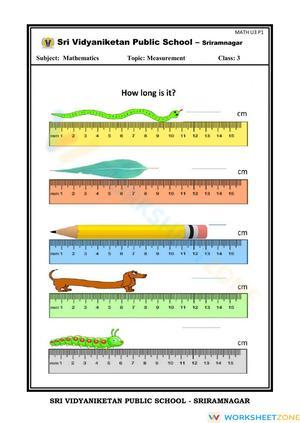
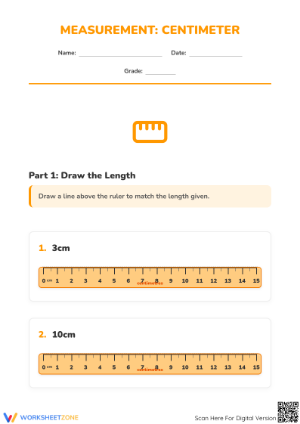
- Measure drawn line segments to whole centimetres
- Record lengths with the unit label cm — not just a bare number
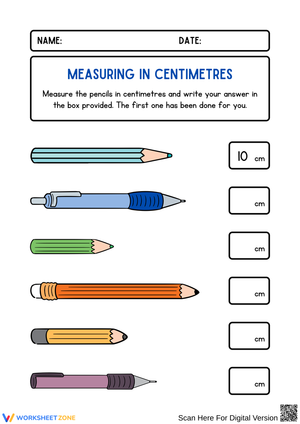
- Measure small classroom objects such as crayons, paper clips, erasers, and craft sticks, then record each length
- Compare two measured lengths and identify which is longer or shorter
- Order three or four objects from shortest to longest after measuring each one
- Examine printed ruler images showing incorrect placement and correct the error
That last task type is where 2nd grade measuring in centimetres printable worksheets contribute something a hands-on lesson alone rarely provides: a fixed visual record of what wrong placement looks like. When students mark the error on a printed image, their reasoning becomes visible — not just the answer they chose.
Common Ruler Errors to Catch Before They Become Habits
The most consistent error at this grade level is starting at the ruler's physical edge rather than the zero mark. What makes it hard to catch during a group lesson is that the student's process looks correct — they line up the object, read the scale, write a number. The answer is off by the same small amount every time, which can read as a counting mistake until you watch the student work and see exactly where they place the tool. Worksheets that include printed ruler images with objects aligned at the ruler's tip — rather than at zero — make this distinction concrete and give students a visual they can correct on paper.
Two other patterns appear across nearly every Grade 2 class. Students count tick marks rather than spaces between marks, which produces answers off by one — a student measuring a 6 cm segment reads "7" because they started their count at the zero mark itself. And students routinely drop the unit label, writing "9" instead of "9 cm." That habit reflects something more than carelessness: a student who consistently omits the unit may still be recording a count rather than a measurement. Worksheets with a pre-printed cm blank after the answer line close that gap faster than verbal reminders do, because the format makes the label part of the expected task rather than an optional addition.
Where These Worksheets Fit in Your Measurement Lesson Sequence
The strongest entry point is a short whole-class demonstration — document camera, one ruler, one object — before any worksheet goes out. Show the zero mark next to the ruler's physical edge and name the difference explicitly. Then hand out a worksheet focused only on drawn line segments, not real objects yet. That narrow task is easier to monitor than a mixed-skill worksheet and gives a cleaner read on which students need the zero-mark demonstration again before moving forward.
From there, a station rotation works well. One group measures printed segments on a worksheet while another group measures actual classroom supplies — glue sticks, index cards, markers — and records centimetre lengths. Building in partner comparison sharpens both groups: two students measure the same object independently, then compare their readings. When their numbers differ by one or two centimetres, that conversation does more instructional work than teacher correction alone, because students have to explain their own alignment choices out loud.
The 2nd grade measuring in centimetres printable worksheets also work well as short warm-up tasks in the days following initial instruction. Three to four measurement problems in the 8 minutes before math class begins keeps the skill active across the week without requiring a full re-teach. That spaced exposure builds retention more reliably than repeating the same block lesson twice. One practical note on dual-scale tools: a sticky note over the inch side of a centimetre-and-inch ruler keeps visual attention where it belongs and cuts the reading errors that come from glancing at the wrong unit mid-task.
Standard Alignment
These worksheets address CCSS 2.MD.A.1, which asks students to measure the length of an object by selecting and using appropriate tools such as rulers, yardsticks, and meter sticks. The compare-and-order tasks connect to 2.MD.A.4, which covers measuring to determine how much longer one object is than another and expressing that difference in a common unit.
In classroom terms, 2.MD.A.1 lands most naturally in the second semester of Grade 2, after students have steady two-digit number fluency. Ruler reading draws on the same mental resources as number-line reading — the scale is a number line — and students who are still consolidating that foundation make more measurement errors simply because they're managing two unfamiliar systems at once. The measurement unit produces cleaner results when it builds on number work that is already secure.
Using These Worksheets Across a Range of Skill Levels
For students still working on basic ruler handling, start with worksheets that show a large ruler image with the zero mark labeled clearly and objects that fall on exact whole-centimetre intervals. Pair these students with a physical ruler so they can cross-check the printed image against the tool they're holding. Keep comparison and ordering tasks out of the mix until alignment and reading are consistent — adding those steps too early compounds errors rather than building on success.
Students ready for more challenge benefit from a two-step format: estimate the length before measuring, then record the actual result alongside the estimate. Requiring that estimate shifts the task from pure mechanics to measurement reasoning — students start developing a feel for what 7 cm looks like, rather than just reading the scale each time. A further extension is asking students to calculate the combined length of two measured objects or to find the difference between the longest and shortest item in a set. That pulls addition and subtraction into the task without disconnecting it from ruler work.
Frequently Asked Questions
Do students need prior ruler experience before starting these worksheets?
A brief teacher-led demonstration is enough preparation — show the zero mark, name the centimetre unit, demonstrate alignment with one object. Students who have never held a ruler before can work through the resources successfully after that introduction. Skipping the demonstration and moving directly to independent practice produces more placement errors in the first session than five minutes of whole-class modeling would have prevented.
Can these worksheets be used with dual-scale rulers?
Yes, with one practical adjustment. The 2nd grade measuring in centimetres printable worksheets are built around centimetre-only tasks, so covering the inch side of a dual-scale ruler with a sticky note or strip of tape keeps visual attention where it belongs. Students who can see both scales simultaneously often drift between them mid-task — not because they don't understand the difference, but because the switch is easy to make accidentally when they are also managing alignment and counting at the same time.
What's the right point in the school year to introduce this unit?
Second semester of Grade 2 is the natural fit, after two-digit number fluency is established. Students still working through place value and number-line concepts make more ruler errors because reading a ruler draws on those same skills. The measurement unit lands more productively when it can build on number work that is already steady, rather than competing with it for cognitive space.
How do I know when a student has genuinely mastered centimetre measurement?
Watch for three things happening consistently without prompting: the student places the object at zero rather than at the ruler's edge, reads the endpoint mark directly without counting back from zero each time, and records the unit label automatically. A student who does all three across both drawn segments and real objects has a reliable grasp. Worksheets that include both task types give the clearest picture — students who perform well on printed segments but not on real objects, or vice versa, still have more work to do before the skill is solid.
Clear All