Effective Onomatopoeia Printable Worksheets for 2nd Grade Literacy Instruction
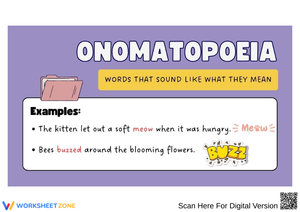
These onomatopoeia printable worksheets for 2nd grade give teachers a concrete entry point into what is, for most seven-year-olds, their first real encounter with figurative language. Sound words like "buzz," "hiss," and "splat" do double duty in a second-grade classroom: they reinforce phonics patterns students are still cementing and push them toward more deliberate word choice in their own writing. The set moves students from recognition to production — from underlining sound words in a mentor sentence to generating them independently in a short scene.
The Specific Skills These Worksheets Build
Each worksheet isolates a distinct skill, which matters because onomatopoeia is one of those concepts where a student can pass an identification task and still be completely unable to use the words in actual writing. The resources sequence from easier to harder:
- Identifying and underlining sound words within sentences or short passages
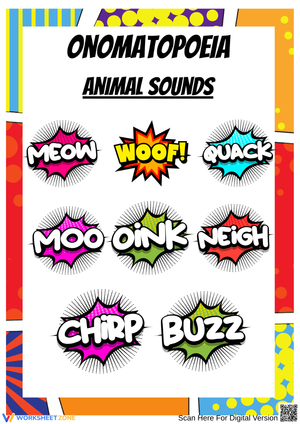
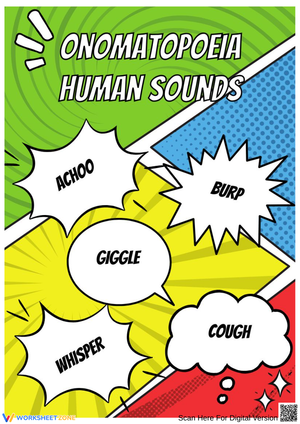
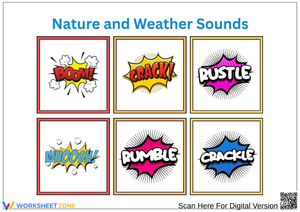
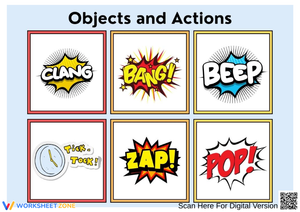
- Sorting familiar words into categories — animal sounds, weather, machine sounds, and physical actions
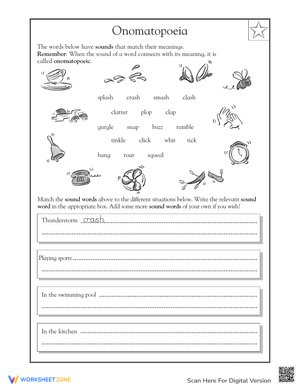
- Matching sound words to illustrations (a frog croaking, a kettle whistling, a bat cracking on a ball)
- Completing sentences using a provided word bank
- Rewriting flat sentences by swapping out a vague verb for an appropriate sound word
- Writing original sentences or a short scene using target vocabulary, no word bank provided
The rewriting task — replacing "the door moved" with "the door groaned" — is the most diagnostically useful step in the sequence. It reveals whether students have internalized the concept or are still treating sound words as a label-matching game. The phonological dimension is worth noting here too: because onomatopoeia words are phonetically motivated, they give students a genuine reason to pay close attention to specific letter combinations. Working through "crackle" and "screech" side by side is a meaningful phonics moment, not just a vocabulary one.
Common Misconceptions to Watch For and Correct
The most predictable confusion at this grade is category bleed. Students circle "loud," "sharp," and "bright" as onomatopoeia because they equate any descriptive word with a sound word. This is a genuine developmental gap — seven-year-olds are still building the mental categories that separate different types of figurative language — and it appears on the very first identification worksheet almost every time. The sorting tasks address it by requiring students to place a word into a category and then justify that placement aloud, which surfaces the confusion faster than a circling exercise does.
A subtler pattern shows up in the sentence-completion work. A student who correctly underlines "hiss" in an identification exercise will write "the snake made a scary noise" the moment a blank line appears and the word bank disappears. The distance between recognizing a concept and reaching for it independently is significant at age seven, and it's the main reason the composition worksheets appear at the end of the sequence rather than running alongside the identification tasks from the start.
Also worth flagging: students sometimes spell unfamiliar sound words phonetically in ways that don't match the conventional form. A student who writes "scrich" instead of "screech" has the concept exactly right — they need a brief spelling note, not a conceptual re-teach. Distinguishing these two situations saves a lot of unnecessary whole-class instruction time.
How to Build These Worksheets Into Your Lesson Week
The identification and sorting worksheets fit well at the start of a writing unit, immediately after a read-aloud that's dense with sound words. Use a mentor text — a comic-style picture book, a weather poem, or a nature story — to build shared vocabulary, then send students to the identification worksheet while the text is still fresh. The sorting worksheet works two or three days later as the vocabulary list grows. Save the sentence-rewriting and open-ended composition worksheets for the back half of the unit, when students have twenty or more sound words to draw from.
For teachers who do a short warm-up before writing workshop, the matching and sorting worksheets are quick enough to finish in the first eight minutes of the block. They prime word-choice thinking without eating into drafting time, which is the more fragile part of the period. The composition worksheets belong in longer workshop periods where students can draft, share, and revise without being rushed. One logistical move worth trying: laminate a few copies of the sorting worksheet and let students sort using dry-erase markers during whole-class warm-up. It doubles as a fast informal check — you can see in three minutes who still needs identification practice before moving to production tasks. Using onomatopoeia printable worksheets for 2nd grade this way, as a pulse check rather than a take-home assignment, surfaces gaps earlier than an end-of-unit writing sample ever will.
Standard Alignment
These resources align to CCSS.ELA-LITERACY.L.2.5, which asks second graders to demonstrate understanding of word relationships and nuances in word meanings, including real-life connections between words and their use. Onomatopoeia addresses the standard directly: a word like "creak" carries meaning only in relationship to the sound it imitates, making it a clear case of how language encodes sensory experience. Many districts extend this work into CCSS.ELA-LITERACY.W.2.3 when students incorporate sound words into their own narrative writing — the composition worksheets in the set support that connection explicitly.
Adapting These Worksheets Across Ability Levels
Students who are still developing reading fluency do better on the matching and sorting worksheets when they work with a partner who can read the choices aloud. The illustrations carry most of the conceptual load on those worksheets, so students reading below grade level can access the skill without hitting a decoding barrier first. This makes the illustrated matching worksheet the right starting point for mixed-ability classes.
For students who move through identification and sorting quickly, the composition tasks can be extended with a constraint: ask them to write a five-sentence scene in which every action carries a matching sound word. That constraint is harder than open-ended writing because students have to think carefully about which sounds belong in the setting they've chosen, not just which words they happen to know. Students who default to "crash" and "boom" for every scene need exactly this kind of pressure built in.
Students who freeze on open-ended tasks — especially once the word bank disappears — benefit from maintaining a personal sound-word card across the full unit. They copy ten or twelve words from each earlier worksheet onto an index card and refer to it during composition. That retrieval tool keeps them producing without removing the cognitive work of selecting and applying words. Onomatopoeia printable worksheets for 2nd grade support this kind of cumulative vocabulary building well because students encounter the same core words — "hiss," "crackle," "thud" — across multiple task formats before they're ever expected to generate them cold.
Frequently Asked Questions
Do I need to use the term "onomatopoeia" with second graders, or can I simplify it?
Starting with "sound words" for the first lesson or two works well. Have students say the word aloud — "buzz," "crack," "drip" — and ask whether the word actually sounds like the thing it describes. Most seven-year-olds find this immediately satisfying. Once they're identifying and using sound words with confidence, introducing the technical term lands easily because it names something they already understand and can do, rather than arriving as an abstract label.
When in a writing unit should these worksheets appear?
After the read-aloud and brainstorm phase, but before students begin independent drafts. Treat the identification and sorting worksheets as guided practice between whole-class modeling and solo writing. Students who jump to drafting without that middle step tend to default to the same two or three words — "crash" and "boom" appear in nearly every story — rather than reaching for precise sound vocabulary they've actually practiced using.
Can these worksheets serve as formative assessment?
The composition worksheets function as informal formative data when collected and scanned quickly. Look for students still writing generic verbs where a sound word would apply — "the dog made noise" instead of "the dog growled." That pattern signals a small-group pull-aside rather than a whole-class re-teach. The identification worksheets are better used as practice; they measure recognition, and recognition alone is not the instructional goal at this level.
What read-alouds pair best with this set?
Onomatopoeia printable worksheets for 2nd grade pair naturally with picture books that center on weather, animals, or outdoor settings — those contexts give students immediate, familiar sounds to work with. Laura Purdie Salas's nature poetry is a strong choice. Age-appropriate graphic novels from the school library also work; students see right away how much of the storytelling those sound words are carrying, and that observation motivates the vocabulary work that follows.
Clear All