These 2nd grade present simple tense worksheets give teachers a ready-to-use set of standalone practice resources targeting subject-verb agreement and the third-person singular rule — the two grammar skills where second graders most consistently stall in independent writing. Each worksheet covers one focused skill area, so teachers can match the practice directly to what they just taught rather than assigning a general grammar packet and hoping for coverage. The set moves from recognition exercises to open production, giving students a clear path from structured practice toward independent application.
The Specific Skills Each Worksheet Targets
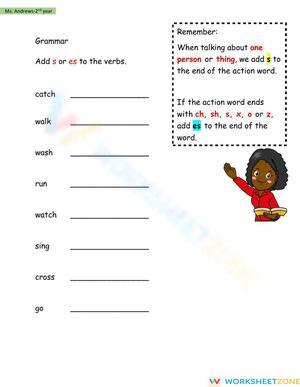
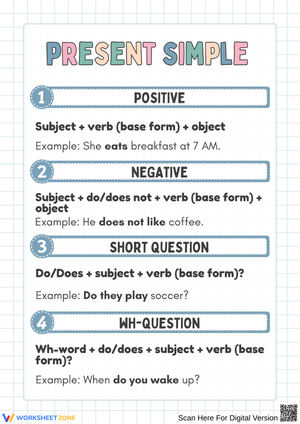
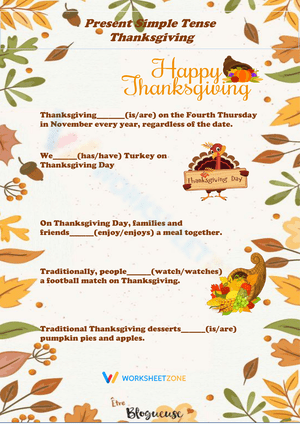
Subject-verb agreement at the sentence level is the foundation. Students match verbs to singular and plural subjects, distinguish between base-form verbs and third-person singular forms, and apply the -s or -es suffix depending on what the verb stem requires. Some worksheets use a choose-between-two-options format; others ask students to rewrite sentences with the correct verb form or sort verbs by the ending they take. The variety matters — students who can circle a correct answer don't always transfer that recognition to writing, so the set includes both.
These 2nd grade present simple tense worksheets build the action-verb exercises around familiar daily-routine contexts: eating breakfast, feeding a pet, walking to school. That framing is deliberate. When vocabulary is already known, students can direct their attention at the grammar form rather than decoding new words alongside a new rule. Each worksheet stays focused on one or two related skills rather than layering all the present-simple conventions at once, which keeps the cognitive load manageable for students still internalizing the basics.
Student Errors Worth Watching For and Addressing
The most persistent error is the pronoun-noun gap. A student correctly writes She eats lunch — the pronoun triggers the stored rule — and then writes the dog eat his food three sentences later, where a noun subject doesn't activate the same pattern. That gap isn't carelessness; it reflects how the rule has been stored: attached to pronouns, not yet generalized to all singular subjects. It is worth making this explicit before independent writing time. The subject can be a pronoun or a noun, and students need enough practice with both to stop treating them differently.
Verbs ending in -ch, -sh, -x, or -o produce a second cluster of predictable errors. Students who know to "add -s" write he touckes, she washs, or it fixs because they're applying the base rule without recognizing that the phonological ending signals -es instead. A quick sound test helps: if pronouncing the base verb plus bare -s sounds wrong — try saying teach-s aloud — that awkwardness is the cue to shift to -es. Building this test into classroom discussion before students work independently cuts down those spelling errors considerably.
Fitting These Worksheets Into the Weekly Schedule
The most reliable placement is the last 8–10 minutes of the language block, right after direct instruction on the rule. One worksheet per week keeps the practice consistent without eating deeply into instructional time. For teachers running a short daily grammar slot, a two-day cycle works well: use the first day for a guided run-through together as a class, then have students complete the same worksheet independently the next day and check answers with a partner. The standalone design of each worksheet means there's no required order — teachers can return to subject-verb agreement after a two-week break or pull a specific exercise mid-unit when student writing reveals a gap.
These 2nd grade present simple tense worksheets pair naturally with mentor text read-alouds about daily routines. After reading a passage where a character moves through a morning routine, asking students to retell those steps aloud in present simple before writing them on the worksheet gives the grammar a communicative purpose. It stops feeling like a drill and starts feeling like a reporting task — which, for second graders, tends to produce better sustained effort and fewer abandoned sentences.
Standard Alignment
CCSS.ELA-LITERACY.L.2.1 asks second graders to demonstrate command of standard English grammar conventions in both writing and speaking. Subject-verb agreement in the present simple is one of the most teachable concrete skills under that standard, and it lands best in the first ten weeks of second grade — after students have reviewed sentence structure from first grade but before independent writing assignments expect them to manage multiple grammar conventions simultaneously. Introducing the third-person singular rule during this window, while writing expectations are still limited to a few sentences at a time, gives students the practice volume needed to make it automatic before longer compositions become the norm.
Adjusting the Set for a Range of Learners
Students still building basic verb vocabulary do better when they preview exercises orally before writing. Running through the answer choices aloud with a partner first reduces the working memory cost of processing unfamiliar vocabulary and a new grammar rule at the same time. Teachers can also restrict early practice to a short list of high-frequency verbs — run, eat, help, watch — before expanding to less common ones. That constraint keeps attention on the suffix rule rather than on vocabulary retrieval.
For students who have already internalized the basic -s rule, the error-correction exercises in these 2nd grade present simple tense worksheets require a meaningful step up in thinking. Identifying a mistake and explaining why it's wrong pushes students to produce the rule, not just recognize a correct answer. Asking these students to generate an additional original sentence after correcting each error extends a short exercise into something that demands real reasoning without requiring a separate, more advanced assignment.
Frequently Asked Questions
When in the school year should I introduce these worksheets?
The first four to six weeks of second grade is the right window. Students have reviewed basic sentence structure from first grade, but independent writing assignments haven't yet started requiring consistent verb agreement. Starting with several days of oral practice before assigning any worksheet gives students a foundation to draw on and reduces early frustration when they work independently.
Several of my students speak a dialect where subject-verb agreement follows different patterns — how do I approach this?
A brief code-switching conversation helps. Students who say she walk or they walks at home are following consistent grammatical patterns — just not the standard academic register. Framing the -s rule as "the form used in books and school writing" rather than "the correct way" keeps the lesson respectful while still teaching the target form. Repeated written exposure to the standard form builds familiarity over time without dismissing the language students bring from home.
Can these worksheets travel home as homework?
Yes, with a practical note: the error-identification exercises work better in class, where a teacher can clarify what kind of mistake to look for before students work alone. The fill-in and sentence-completion exercises travel well as homework because the task structure is self-contained — students don't need additional context to complete them accurately, and the single clear answer makes independent checking straightforward.












 Interactive Worksheet Maker
 Quiz Maker
 Word Search Maker
 Crossword Puzzle Maker
 Word Scramble Generator
 Sentence Scramble Generator
 Handwriting Worksheet Generator
 Name Tracing Generator
 Fill In The Blank Generator