


























Views
Downloads
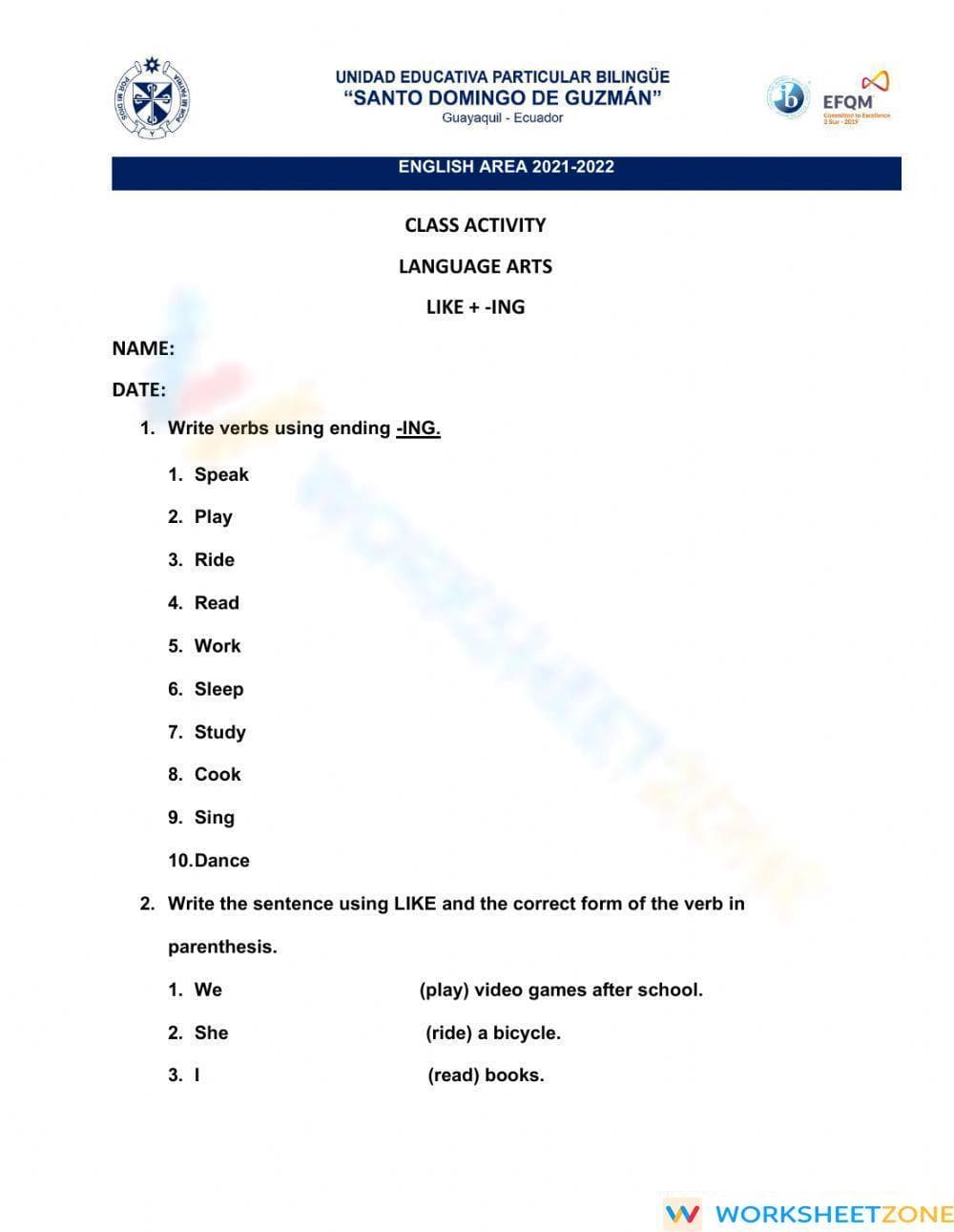



Printable Like + -ing Worksheet | Grade 1-4 ELA Grammar
Paste this activity's link or code into your existing LMS (Google Classroom, Canvas, Teams, Schoology, Moodle, etc.).
Students can open and work on the activity right away, with no student login required.
You'll still be able to track student progress and results from your teacher account.
This Grade 1-4 English Language Arts worksheet focuses on using "like" followed by a gerund. Students practice subject-verb agreement and present simple construction through 24 targeted exercises. This resource ensures learners accurately express preferences in affirmative and negative forms, building a strong foundation for descriptive writing and conversational English.
At a Glance
- Grade: 1–4 · Subject: ELA / Tenses
- Standard:
CCSS.ELA-LITERACY.L.3.1.F— Ensure subject-verb and pronoun-antecedent agreement in basic and complex sentences- Skill Focus: Like + -ing / Present Simple
- Format: 3 pages · 24 problems · Answer key not included · PDF
- Best For: Small group grammar practice
- Time: 25–35 minutes
What's Inside
This three-page instructional packet provides a clear structure for mastering present simple preferences. The first section requires students to transform ten high-frequency verbs into gerunds. The second section features seven sentence-completion tasks where students select the correct form of "like" based on the subject. Finally, the third section challenges students to rewrite those sentences into negative constructions using "don't" or "doesn't," providing a complete cycle of grammar practice.
Skill Progression
- Guided Practice: Students convert base verbs into gerunds, establishing the "like + -ing" pattern.
- Supported Practice: Learners apply knowledge by completing sentences with correct subject-verb agreement.
- Independent Practice: The final phase requires transforming affirmative sentences into negative forms.
This sequence follows the gradual-release model, ensuring students build confidence before tackling more complex sentence structures.
Standards Alignment
This worksheet focuses on `CCSS.ELA-LITERACY.L.3.1.F`, requiring students to ensure subject-verb agreement. By differentiating between "like" and "likes," students demonstrate mastery of present simple conventions. The resource also supports `CCSS.ELA-LITERACY.L.1.1.C` through the use of matching verbs in basic sentences. Both standard codes can be copied directly into lesson plans, IEP goals, or district curriculum mapping tools.
How to Use It
Use this worksheet during direct instruction after introducing gerunds. It serves as an excellent mid-lesson check to ensure students understand the "like" vs "likes" distinction. Alternatively, assign the negative section as homework to reinforce agreement in various contexts. For a formative assessment observation, watch for students who struggle with "doesn't like" vs "doesn't likes." Expect completion in 25 to 35 minutes.
Who It's For
This resource is designed for elementary students in grades 1 through 4, particularly those learning English tenses. It is effective for English Language Learners (ELL) needing repetitive practice with subject-verb agreement. Pair this worksheet with an anchor chart displaying present simple conjugation rules to provide additional visual support during the independent practice phase.
The integration of systematic grammar practice within a structured worksheet format is essential for developing syntactical fluency in young writers. According to Fisher & Frey (2014), the gradual release of responsibility model—moving from simple verb transformations to complex sentence rewrites—is critical for ensuring that students internalize the rules of subject-verb agreement. This Grade 1-4 worksheet addresses the `CCSS.ELA-LITERACY.L.3.1.F` standard by providing 24 targeted opportunities to practice the "like + -ing" structure in both affirmative and negative contexts. By focusing on high-frequency verbs and common subject pronouns, the resource builds the necessary scaffolding for students to transition to independent composition. Such structured practice is a proven method for bridging the gap between isolated skill acquisition and functional literacy, providing teachers with a clear assessment of student mastery in the present simple tense.


