Present Continuous Tense Printable Worksheets for 2nd Grade
Present continuous tense printable worksheets for 2nd grade give teachers a focused set of materials for a grammar concept that catches even solid young writers off guard. Forming this tense asks students to manage three decisions at once — choosing the right form of to be, applying the correct -ing spelling rule, and making sure the subject and helping verb agree. The resources in this set break that process into isolated steps before students are asked to produce full sentences on their own.
Skills These Worksheets Build
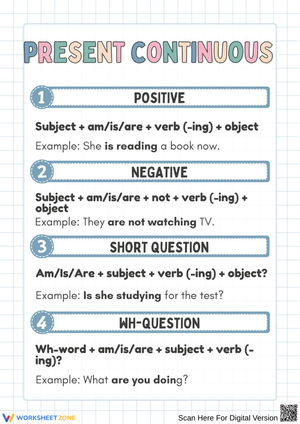
The work moves in a deliberate sequence. The earliest exercises establish subject-to-auxiliary matching: students draw lines connecting I to am, singular subjects to is, and plural subjects to are. That agreement work stays separate from -ing formation until students are solid on it. From there, the set moves into the three spelling patterns for adding -ing, then into full sentence construction, and finally into exercises that ask students to distinguish a habit — expressed in simple present — from an action happening at this exact moment.
Specific activity formats across the worksheets include:
- Subject-to-auxiliary matching with illustrated sentence subjects
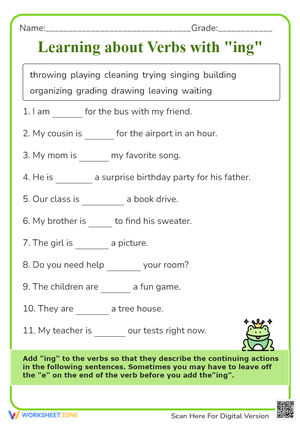
- Verb rule sorting by spelling pattern: standard -ing, drop-e, double-consonant
- Sentence transformation from simple present to present continuous (He reads a book → He is reading a book)
- Signal word identification — students circle now, right now, or at the moment before completing a sentence
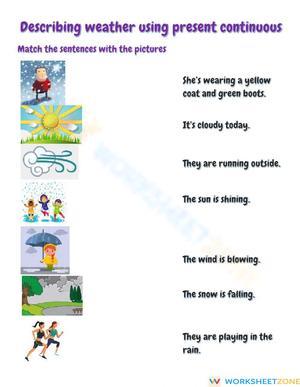
- Visual scene description, where students write present continuous sentences about characters in a busy illustration
Three Spelling Patterns Students Have to Work Through
The standard rule is the easy one: add -ing directly to the base verb. Jump becomes jumping, play becomes playing. Students master this quickly and then apply it to every verb they encounter — which is exactly where the next two patterns create trouble.
The silent-e pattern requires dropping the final letter before adding -ing: make becomes making, dance becomes dancing. Sorting activities that ask students to group verbs by whether they end in a silent e slow them down enough to actually inspect the base word before adding the suffix. That deceleration is the point.
The CVC pattern asks students to double the final consonant in one-syllable verbs that end in a single vowel followed by a single consonant: run becomes running, sit becomes sitting, swim becomes swimming. This is the rule that takes the longest to stick. A small reference strip at the top of the relevant worksheets — three worked examples, one per pattern — reduces errors during independent practice and supports gradual internalization over several weeks without requiring constant teacher intervention.
Common Errors to Watch For and Correct
The most persistent error seen across student work on present continuous tense printable worksheets for 2nd grade isn't spelling — it's subject-verb agreement with the auxiliary. Students who can recite "I am, he is, they are" in isolation still write She are running when their attention is split between identifying the subject and forming the participle. The cognitive load of managing both rules simultaneously pushes third-person singular subjects toward are by default. A color-coded agreement reference card kept on the desk during early sentence-writing practice addresses this more directly than re-explaining the rule from the front of the room.
On the spelling side, makeing and runing are the two errors that show up most reliably in second-grade work. The silent-e drop feels counterintuitive to students who reasonably expect to keep all the letters of the original word. The CVC doubling rule disappears fastest when students are simultaneously managing sentence structure and punctuation. Worksheets that isolate the spelling transformation before asking for full sentence production give students a chance to consolidate each pattern before combining it with other demands.
Fitting These Worksheets Into Your Week
Used at the start of a lesson — during the first five to eight minutes after morning meeting — the subject-helper matching or signal-word exercises make effective low-stakes openers. No setup required, and they preview or review the concept while students are still settling in. Used after direct instruction, the sentence-transformation and scene-description worksheets give students a structured way to apply what was just modeled, while the task is still fresh in working memory.
The visual scene description format pairs well with a brief live-action classroom routine before distributing the worksheet. Have one student perform an ongoing action — hopping, writing at the board, stacking blocks — while the rest of the class narrates aloud: She is stacking the blocks. He is hopping near the door. That two minutes of spoken practice grounds the writing that follows. Students who articulate the tense out loud before writing make fewer auxiliary errors on the worksheet itself.
For the verb sorting activities, running the first one as a whole-class exercise is worth the instructional time. When students explain their sorting decisions aloud, you hear the specific misconceptions — especially around CVC doubling — that need to be addressed before independent work begins. Productive disagreement in whole-class discussion is far easier to resolve than collecting twenty worksheets with the same error.
Standard Alignment
These worksheets address CCSS.ELA-LITERACY.L.2.1, the second-grade standard requiring students to demonstrate command of English grammar and usage in writing and speaking. Within that cluster, the present continuous draws on two sub-skills simultaneously: producing the correct auxiliary form of to be and applying the -ing suffix through its three spelling patterns. The standard builds directly on L.1.1.E, where first graders begin using verbs to signal past, present, and future time. By second grade, the expectation shifts from using individual verb forms to constructing multi-word verb phrases that carry tense meaning — which is precisely what this tense requires students to do. Present continuous tense printable worksheets for 2nd grade sit at that junction in the vertical alignment between first- and third-grade language standards, bridging the single-word verb work of first grade and the explicit simple-tense formation work of third grade under L.3.1.E.
Adjusting These Worksheets Across Ability Levels
Students still working to solidify basic subject pronouns benefit from a personal reference card alongside each worksheet — three rows listing subject, helper verb, and a short example: I → am → I am jumping, and so on. Removing that recall demand from working memory lets those students direct their attention toward the -ing formation, where the lesson's main cognitive work lives.
For students ready to move past sentence-level production, the visual scene description format stretches naturally. Instead of one sentence per image prompt, they write two or three connected observations about the same illustration, building a short paragraph using only the present continuous. That extension doesn't require a different worksheet — it just shifts the expected output and raises the complexity without changing the task type.
Students developing English as an additional language often omit the auxiliary entirely in speech — producing "She running" rather than "She is running" — and that spoken pattern transfers directly into writing. Sentence frames printed on the worksheet itself, with a blank line for the auxiliary before the main verb slot, make the two-part structure visible without reducing the linguistic demand. Students fill in the helping verb and form the participle; the frame keeps both steps explicit until the pattern is internalized.
Frequently Asked Questions
How do I explain the difference between is and are to second graders?
The clearest starting point is the singular-versus-plural contrast. Teach students that is pairs with one person, one place, or one thing, and are pairs with more than one. Sorting cards with pictures of single objects versus groups give this rule a concrete visual anchor before it shows up in writing. Several present continuous tense printable worksheets for 2nd grade in this set include sections dedicated to this distinction, using illustrated subjects rather than written pronoun labels so the focus stays on quantity rather than abstract grammar categories.
When in the school year should I introduce this tense?
Late fall to early winter works well in most second-grade pacing guides, after students have spent the first weeks building a base of high-frequency action verbs and practicing subject pronouns in isolation. Introducing this tense too early means the grammar lesson competes with vocabulary load — students are simultaneously trying to recall an unfamiliar word and transform it. By November, most second graders have enough verb vocabulary that adding -ing to a known word feels like extending something familiar rather than starting from scratch.
What's the best way to handle confusion between simple present and present continuous?
A classroom timeline works better than verbal explanation alone. Draw a horizontal line on the board. Place a single bold dot directly on the line and label it "right now" — that's the present continuous. Mark several dots spread across the line and label them "habits" — that's the simple present. Concrete thinkers, which most second graders are, respond to this spatial representation faster than to abstract tense explanations. Pair it with worksheet exercises where students circle signal words — now, every day, at the moment, always — before selecting a tense, so they're reading for context clues rather than retrieving a memorized rule.
Are the verb sorting exercises worth using for whole-class instruction?
Yes — running at least the first sort as a whole-class activity is worth the time. Project the worksheet and work through the categorization together, asking students to explain their reasoning aloud. The CVC doubling rule almost always produces disagreement, and that productive confusion is far easier to address in the moment than after independent work is collected. Hearing students explain why run becomes running but play becomes playing reveals exactly what the class understands before you send them to work alone.
Clear All