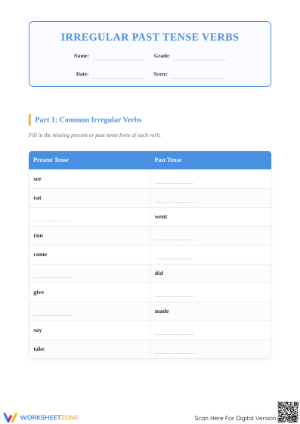
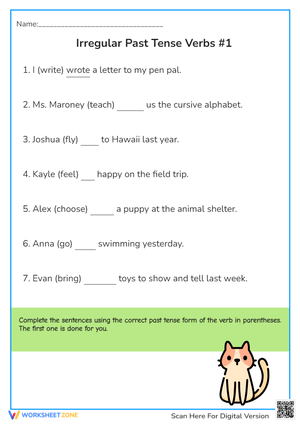
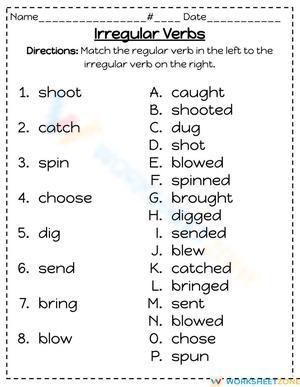
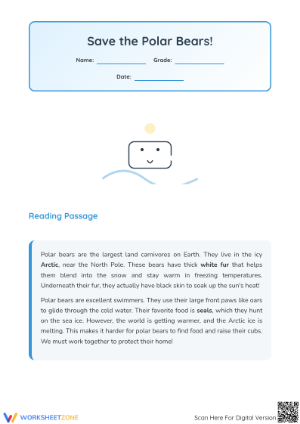
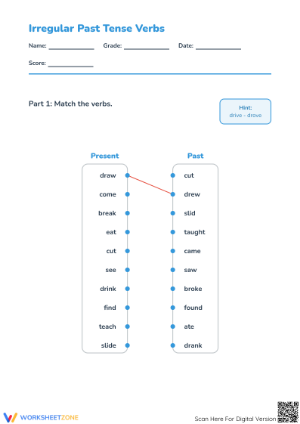
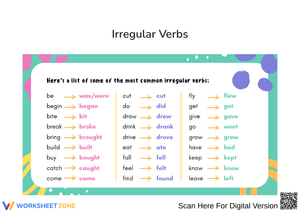
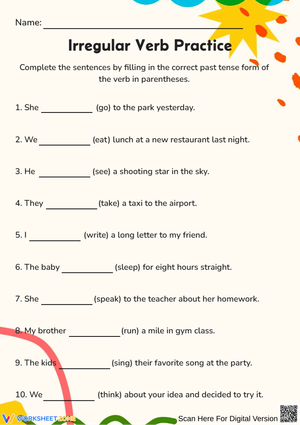
These 2nd grade irregular past tense worksheets resources target the precise moment in grammar instruction when second graders have locked in the "-ed" rule and are starting to misapply it everywhere. The set covers the highest-frequency irregular verbs — go/went, run/ran, see/saw, eat/ate, come/came — through practice formats that progress from guided recognition to independent sentence-level production.
What Students Practice Across the Set
Each worksheet asks students to work with irregular verbs at a distinct level of difficulty. The earlier worksheets have students underline past tense forms inside short paragraphs and mark which of those forms is irregular. Later worksheets shift to fill-in-the-blank sentences where students supply the correct past form from memory, and then to sentence rewriting where students convert a present-tense sentence into past tense without any word bank. The most demanding worksheets present a short passage containing one deliberate overgeneralization error — "He runned to the door" embedded in otherwise clean writing — and ask students to locate and fix it. That last format asks students to do what actual writers do: monitor their own sentences for verb-form accuracy rather than just recalling a memorized list.
Several worksheets group verbs by internal vowel shift — sit/sat, run/ran, drink/drank, sing/sang — rather than presenting every irregular verb as an isolated fact. Once a student sees that this cluster swaps one vowel sound in the past, that pattern extends naturally to swim/swam and ring/rang when those words appear in independent reading. That transfer is more durable than memorizing individual pairs one at a time.
Mistakes Students Bring From the Regular Past Tense Rule
The dominant error at this level is confident overgeneralization. Students who write "walked" and "jumped" without hesitation will write "goed" and "eated" with the same confidence, because they are applying the rule that just worked for everything else. This error is not carelessness — it signals that the "-ed" rule has genuinely been internalized. That distinction is worth stating plainly to students before correction begins, because second graders who feel embarrassed about verb errors tend to start avoiding past-tense sentences in their writing altogether, which is a harder problem to address.
A subtler pattern shows up in independent writing rather than oral practice. Students often say "went" correctly in conversation but write "goed" the moment they are composing a sentence on paper, because the cognitive load of drafting pulls attention away from verb form. An exit ticket makes this gap visible: ask a student to tell you the past tense of "go" and they answer correctly; ask them to write two sentences about what they did at recess and "goed" reappears. These worksheets address that gap by embedding irregular verb practice inside sentence-level writing from the beginning, not only as isolated fill-in items.
Building These Worksheets Into Your Weekly Grammar Plan
The most reliable placement is Monday warm-up paired with Friday independent check. On Monday, one worksheet used whole-class sets the verb group being practiced that week — students work for eight to ten minutes while the teacher circulates, then the class reviews answers before transitioning to the morning's reading block. On Friday, a worksheet covering the same verb group serves as a quick check that tells you before the weekend who still needs reinforcement the following week. That two-day structure around a consistent verb group gives students spaced retrieval practice without requiring a dedicated grammar block each day.
These 2nd grade irregular past tense worksheets resources also work well as a small-group rotation station. Students finishing a reading center early can complete a worksheet independently; alternatively, pull a small group where overgeneralization errors are clustering and work through a worksheet together, pausing when students disagree on an answer. Those disagreements — "Does 'He drived to school' sound right to you?" — tend to be the most productive moments in the rotation, because students who have internalized the correct form will push back against the error before you say a word.
Adjusting the Worksheets for a Range of Learners
For students in the early stages of past tense acquisition — common among English language learners and students who entered second grade with limited writing fluency — the recognition tasks (underlining, sorting) provide a lower-stakes entry point without requiring production. Pair those worksheets with a two-column reference chart showing present and past forms side by side; students use the chart during the task, which keeps them practicing correct forms rather than rehearsing incorrect ones. That chart can stay tucked into their writing folder for the full unit.
Students who have already internalized the most common irregular forms benefit from the error-correction and sentence-rewriting worksheets, which demand more than simple recall. Raising the challenge is straightforward: have these students cover the word bank before filling in blanks, or ask them to write an original sentence using the past form after each correction they make. On the other end of the range, if a student is consistently confusing only two or three high-frequency pairs — go/went and come/came are the most common pairing — isolating those pairs on a single worksheet keeps practice tight instead of spreading attention across eight verbs at once.
Standard Alignment
These worksheets align to CCSS.ELA-LITERACY.L.2.1.D, which requires second graders to form and use the past tense of frequently occurring irregular verbs. The standard sits inside the Language strand's conventions cluster, but it has direct consequences for Writing: a student who writes "He goed home" in a personal narrative is producing a convention error that affects the authority and clarity of the text, not just a grammar-drill mistake. The standard is placed at second grade specifically because most students arrive already using irregular forms correctly in speech — the instructional target is transferring that oral fluency into consistent written production, which is exactly what these worksheets address.
Frequently Asked Questions
Which irregular verbs are included in the set?
The worksheets cover the most frequently occurring irregular past tense verbs in second-grade reading and writing: go/went, come/came, run/ran, see/saw, eat/ate, sit/sat, give/gave, take/took, make/made, say/said, tell/told, and think/thought, among others. The selection prioritizes verbs that appear regularly in grade-level text and in student writing rather than attempting exhaustive coverage of all English irregulars.
How long does each worksheet take to complete?
Most students finish in five to ten minutes depending on the format. Recognition and sorting tasks run on the shorter end; sentence-rewriting and error-correction tasks take a few minutes longer. That range keeps these resources usable as warm-ups, exit tickets, or rotation-station work without requiring a dedicated grammar period.
Are these appropriate for English language learners?
Yes, with one practical adjustment. ELL students benefit from completing the sorting and underlining worksheets before moving to fill-in-the-blank tasks, and they work most effectively alongside a visual reference — a simple illustrated word wall or two-column chart of present and past forms. The 2nd grade irregular past tense worksheets format prints cleanly for inclusion in a student binder or grammar notebook that ELL students can reference throughout the school day, not just during grammar instruction.
Can these worksheets be sent home for homework?
The fill-in-the-blank and sentence-rewriting tasks travel home well because they do not require teacher mediation. The error-correction tasks are better kept in class, where a brief discussion about why a form sounds wrong is part of the learning — that conversation gets lost when students work independently. If you do send any worksheet home, including the answer key gives families a way to provide immediate, accurate feedback, which matters especially in households where English is not the primary language.
Where can I download these resources?
These 2nd grade irregular past tense worksheets files are available for download on WorksheetZone. Each file downloads as a print-ready PDF and can also be used with digital annotation tools for students working on tablets or Chromebooks.












 Interactive Worksheet Maker
 Quiz Maker
 Word Search Maker
 Crossword Puzzle Maker
 Word Scramble Generator
 Sentence Scramble Generator
 Handwriting Worksheet Generator
 Name Tracing Generator
 Fill In The Blank Generator