Teaching Communication Skills to 2nd Graders: Practical Worksheets and Activities
These 2nd grade teaching communication skills worksheets printable give teachers targeted practice resources across the specific social-communication demands that define a second-grade classroom — active listening, tone awareness, recognizing non-verbal cues, perspective-taking, and navigating personal space. The set is built for the developmental window when 7- and 8-year-olds are beginning, unevenly and impulsively, to realize that other people have inner lives too. That shift doesn't happen automatically, and these worksheets give students structured practice at exactly the moment when they are cognitively ready to work on it.
The Skills Each Worksheet Targets
The set covers five core areas, each with its own worksheet focus:
- Active listening — Students circle which behaviors show a good listener, sort "listening" from "not-listening" scenarios, and rewrite exchanges where a character clearly missed what was said.
- Non-verbal communication — Students label emotions from drawn facial expressions and body postures, then match the body language to a conversational moment.
- Tone of voice — Students read the same sentence delivered in different ways and mark which version fits a given situation, working through the difference between what you say and how you say it.
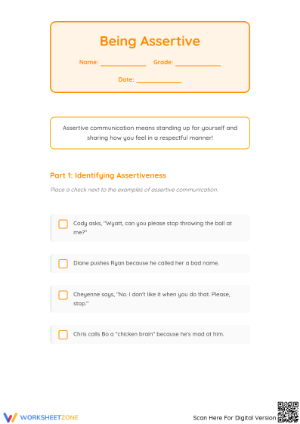
- Perspective-taking — Short conflict scenarios — wanting to join a game, disagreeing with a partner, being left out at recess — ask students to describe how each character feels and then write or draw a thoughtful response.
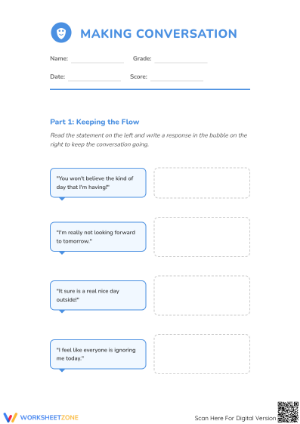
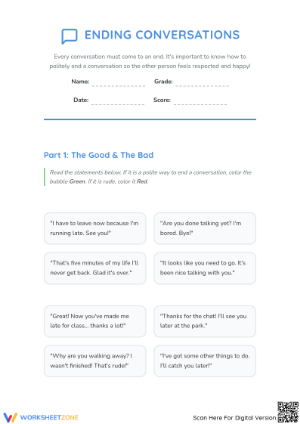
- Conversation mechanics — Students practice turn-taking, use sentence starters for respectful disagreement, and annotate sample dialogues to identify where a conversation broke down.
Across the set, the format stays concrete. Students underline, circle, sort, annotate, and rewrite — not open-ended prompts that frequently stall at this grade level. Most exercises use short illustrated scenarios so that students still developing reading fluency can access the social-emotional content without the worksheet becoming a decoding task.
Student Errors Worth Catching Early
The most consistent error at this grade level is the confusion between silence and listening. Students learn quickly that looking up and staying quiet earns praise for "good listening," and many become skilled at performing attention without actually processing what was said. The active listening worksheets surface this directly — students must demonstrate comprehension by marking what the speaker communicated, not just show the correct "listening body" posture. A second common error involves tone. Many second graders interpret "use a respectful tone" as "use a quiet voice," so they'll say something dismissive in a flat murmur and consider the expectation met. The tone worksheets require students to think about word choice, volume, and delivery together, not just lower their volume.
Perspective-taking produces a specific and reliable gap: students will answer "how would that person feel?" correctly on the worksheet — writing "sad" or "left out" — and then act in ways that contradict that understanding during actual group work minutes later. The written exercise and the live situation feel like separate domains to most seven-year-olds. This is not a flaw in the worksheets; it is where teacher follow-through matters. Using a completed worksheet as a reference during a real conflict ("you said someone would feel left out — what's happening right now?") creates the bridge between the exercise and the moment, which is where the lasting change actually occurs.
Smart Ways to Build These Worksheets Into Your Teaching Week
The most effective placement is immediately before a situation that demands the skill — not as an isolated Friday lesson. Running the turn-taking worksheet right before a partner reading task gives students a mental reference that is still active when they need it. The tone worksheet works best as a warm-up before a class discussion or debate-style activity, not after. The principle is simple: the closer the practice to the application, the better the transfer.
For teachers who run morning meetings, the perspective-taking scenarios fit well in the last 8 to 10 minutes — students discuss a scenario together before the day's instruction begins, which sets a social frame for the whole morning. Small-group use generates the richest discussion; three or four students working through a scenario will surface real disagreements about which response is best. Those disagreements are productive. They reveal where students' understanding of respectful communication genuinely differs, and that is where the teaching gets specific rather than theoretical. For the conflict-scenario worksheets especially, a pair or a triad will push further than a whole class working in unison.
Standard Alignment
These worksheets align with the CCSS Speaking and Listening standards at second grade, particularly SL.2.1 (participate in collaborative conversations with diverse partners, following agreed-upon rules that include listening to others and taking turns) and SL.2.3 (ask and answer questions about information a speaker provides to clarify comprehension and deepen understanding). Both standards treat communication as an active, reciprocal process. In classroom terms, SL.2.1 is the standard underlying virtually every group activity, partner task, and whole-class discussion — which means this instruction is not siloed into SEL time but supports academic participation across every subject.
The set also maps to the CASEL framework's Social Awareness and Relationship Skills domains, which address perspective-taking, reading social cues, and responsible decision-making in interpersonal situations. Schools running CASEL-aligned SEL programs will find these worksheets slot naturally into that structure without requiring separate planning.
Adapting the Set for Different Levels of Learners
For students who need additional support, pairing each worksheet with a small visual reference card reduces cognitive load considerably. A four-image card showing "listening body" postures or a six-emotion face chart gives these students a concrete anchor while they work through scenarios, so they are not holding unfamiliar concepts in working memory at the same time they are reading and responding. The 2nd grade teaching communication skills worksheets printable work particularly well in a pull-out setting or at a small-group station where a paraprofessional can read scenarios aloud — removing the reading demand without removing the social-emotional content.
Students who already demonstrate strong communication awareness benefit most from the perspective-taking and conflict-scenario worksheets, where the task can be extended past the written response into a role-play or a written justification. Asking a capable student not just what the character should do, but why that specific choice matters — and what could go wrong with a different approach — pushes the exercise from recognition into genuine reasoning. The combination of "what" and "why" questions is what separates an extension task from just adding more problems.
Frequently Asked Questions
Will students need teacher support to complete these worksheets, or can they work independently?
Most worksheets are accessible independently once the concept has been introduced in a brief whole-class or small-group discussion. The non-verbal cues and tone exercises are particularly self-contained. The perspective-taking scenarios sometimes prompt questions about why one response is better than another — those conversations are worth pausing for, since the discussion is itself a communication skills exercise. Plan for independent work after a short introduction, not cold.
How many of these worksheets should I use per week?
One worksheet two to three times per week, placed at the right instructional moment, produces more retention than a daily block. Spaced practice beats massed practice for social-emotional content because students need time between exercises to actually use the skill in real situations — on the playground, during partner work, at lunch. The 2nd grade teaching communication skills worksheets printable hit hardest in short, well-timed doses, not as a three-week unit that then disappears from instruction.
Do these worksheets account for cultural differences in communication norms?
The scenarios use broadly inclusive language and avoid framing a single set of communication norms as universal. That said, eye contact expectations and personal space conventions vary across families, and teachers in diverse classrooms should frame discussions around "different ways people show respect" rather than treating one default as correct. The worksheets open those conversations; the teacher navigates them based on knowing the students.
A student completes a worksheet correctly but doesn't apply it during group work. What now?
This is the most common observation teachers raise about SEL practice at this age, and it is a normal part of learning these skills — written comprehension and live application are genuinely different cognitive tasks for second graders. Use completed worksheets as touchstones during real conflicts: pull one out, point to a scenario the student already answered correctly, and ask them to connect it to what just happened. That linking process, done consistently over a semester, is what moves a skill from paper knowledge to actual behavior. The 2nd grade teaching communication skills worksheets printable work best when teachers keep them accessible after grading rather than filed away — they are most useful precisely when something goes wrong.
Clear All