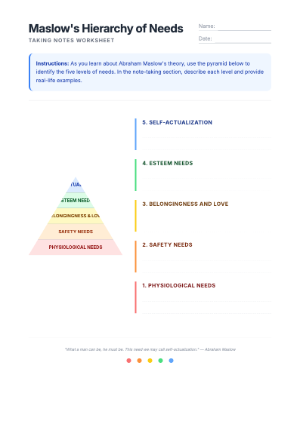
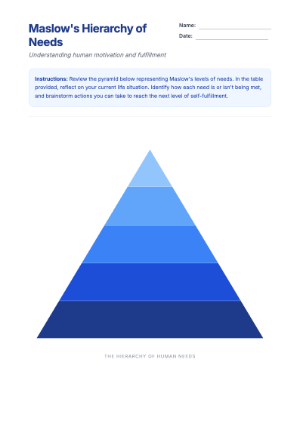
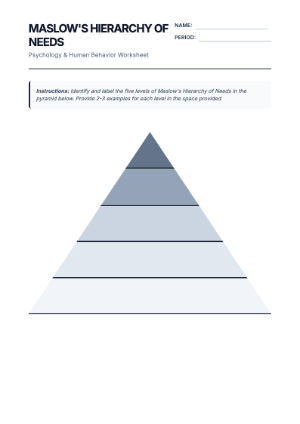
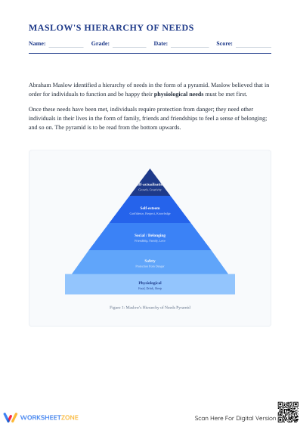
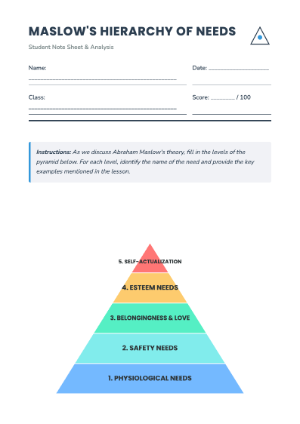
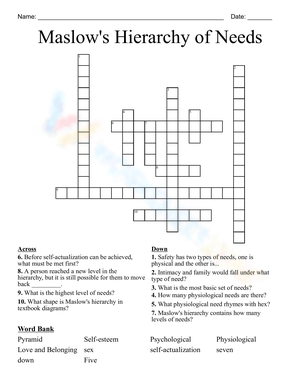
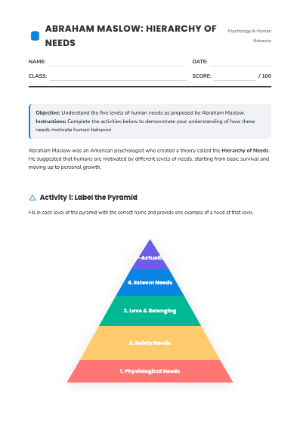
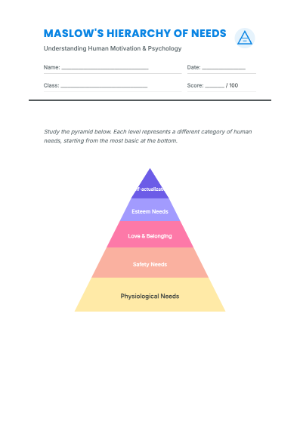
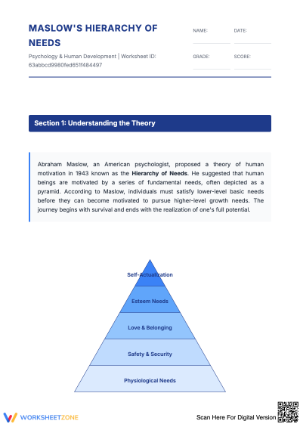
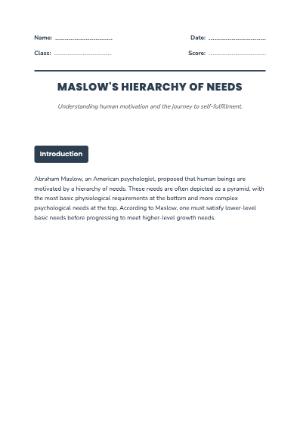
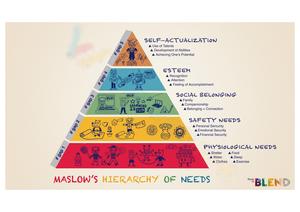
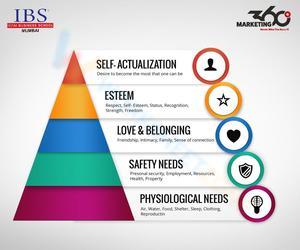
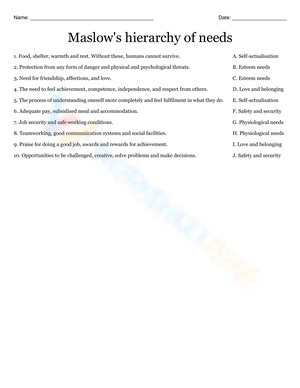
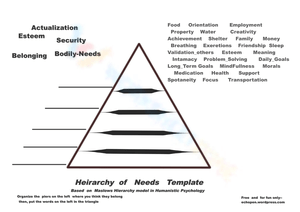
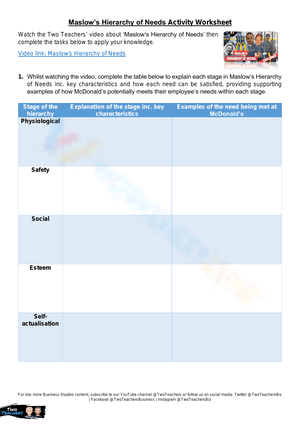
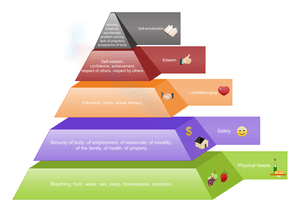
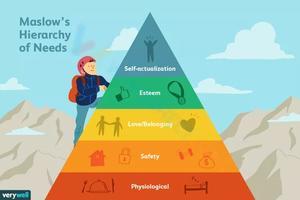
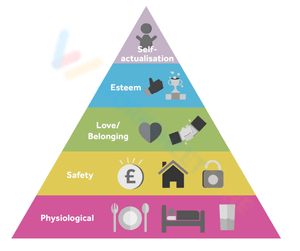
12th grade maslows hierarchy of needs printable worksheets give psychology and behavioral science teachers a direct path from abstract theory into the decisions seniors are already wrestling with — college applications, identity formation, shifting social dynamics, and what stability actually looks like on the other side of graduation. The set covers all five tiers of the hierarchy, from physiological needs through self-actualization, with tasks that ask students to analyze, evaluate, and apply rather than just label a pyramid diagram. The analytical expectations here match where twelfth graders actually are developmentally — not where they were in an introductory unit two years ago.
What Students Work Through in Each Worksheet
Each worksheet targets a specific skill rather than asking students to restate the hierarchy from memory. Some worksheets ask students to annotate a case study — a character in a novel, a historical figure, or a constrained hypothetical scenario — and identify which tier of the hierarchy is driving the behavior and why. Others ask students to rank competing needs under pressure: if a person loses their housing, how does that reorganize their motivational priorities? A handful of worksheets target the critical evaluation side of the theory, asking students to identify what Maslow's original 1943 framework does not explain and to compare it with a more recent motivational model.
Specific tasks students encounter include:
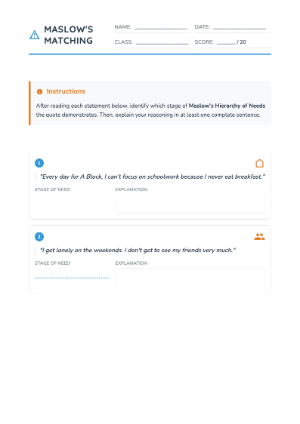
- Mapping fictional characters' decisions onto the five-tier model with written textual justification
- Analyzing historical case studies — the New Deal, refugee displacement, civil rights organizing — through the lens of collective unmet needs
- Distinguishing esteem needs from self-actualization in ambiguous scenarios where students must specify the locus of validation, not just label the outcome
- Writing a structured critique of the hierarchy's cultural assumptions, drawing on at least one cited counterargument
- Reflecting on their own current position in the hierarchy and how they anticipate it shifting after graduation
The Cross-Curricular Reach of This Framework
Maslow's hierarchy earns its place in more than just psychology class. In an ELA classroom, it gives students a lens for character motivation that goes deeper than "the character wants revenge" — it asks why that need exists at that tier and what the character would have to satisfy first. When seniors analyze Gatsby, Willy Loman, or Bigger Thomas, the hierarchy surfaces arguments about esteem versus belonging that produce stronger literary analysis than plot summary ever could. The character-motivation worksheets ask students to support their tier identification with direct textual evidence, which is exactly the argumentative move a senior-year literary essay requires.
In history or civics, the framework becomes a tool for examining collective behavior. Why do economic depressions produce authoritarian politics? What does it reveal about a society when physiological and safety needs are systematically denied to a specific population? These are the analytical moves that distinguish a senior-level history class from a survey course, and the worksheets provide the structured entry point students need to get there without simply offering an opinion.
How to Build These Worksheets Into Your Lesson Plans
The highest-yield approach I've seen is what I'd call a theory-to-text rotation: one worksheet introduces or reviews a tier of the hierarchy, then students immediately apply it to a text or case study before moving on to the next level. That sequencing prevents the common problem of students learning all five tiers in abstraction and then having no idea how to use them analytically. Running one worksheet per day across a two-week unit keeps the pace steady without overwhelming students who are also carrying AP and dual-enrollment loads in the same semester.
For the critical evaluation worksheets, a Socratic seminar works better than whole-class discussion. Assign the worksheet as independent prep the night before, then run the seminar as the class period itself. Students who read the prompts carefully come in with actual positions to defend, not vague impressions. 12th grade maslows hierarchy of needs printable worksheets built around cultural critique and scientific validity questions are especially strong as seminar prep because they surface genuine disagreement — whether the hierarchy is universal, whether self-actualization is measurable, and what to make of the estimate that fewer than 2% of people reach that tier.
Mistakes Students Make That These Worksheets Help You Catch
The most persistent error at this level is treating the hierarchy as strictly sequential — students assume that a person experiencing safety threats cannot simultaneously experience love and belonging. Maslow's own later writing pushed back on this, and the worksheets include prompts that surface this assumption directly. When a student writes that someone cannot pursue esteem needs while physiological needs are unmet, that's a testable claim, and the worksheets ask students to find a real counterexample and then explain what it does to the original theory.
A second pattern involves esteem and self-actualization. Students frequently conflate the two because both involve a sense of achievement. What trips them up is the audience: esteem needs are validated externally — by grades, recognition, social standing — while self-actualization is internally driven. In actual student work, this shows up as "Gatsby is self-actualizing because he's achieved success." Gatsby is almost definitionally the opposite, locked in esteem-seeking. The worksheets catch this error because the prompts ask students to specify who is doing the validating, not just what the character accomplished.
Standard Alignment
These worksheets align with APA National Standards for High School Psychology, specifically Standard Area VII (Motivation and Emotion), which calls for students to compare and contrast major theories of motivation, evaluate the evidence for each, and apply motivational concepts to real-world situations. The analytical writing tasks also support CCSS.ELA-LITERACY.WHST.11-12.1, which requires students in grades 11–12 to construct arguments that introduce precise claims, acknowledge counterclaims, and use evidence from multiple sources. Teachers in standards-aligned states can use the written-response worksheets as direct evidence of both the psychology content standard and the disciplinary writing standard without building separate tasks for each.
Adjusting the Worksheets Across Ability Levels
12th grade maslows hierarchy of needs printable worksheets include enough built-in structure that most students can work through them independently — but that structure can be thinned or thickened based on what a given student needs. For students who struggle with abstract reasoning, the case study worksheets work better than the open-ended critique ones. Start them with a concrete scenario and a specific guiding question before moving to anything that requires generating original examples. A graphic organizer that maps each tier to a column of evidence helps these students hold the hierarchy in working memory while they write, without reducing the cognitive demand of the actual analysis.
For students who move quickly and find the introductory tasks too straightforward, the extension move is comparative analysis: after completing a worksheet on Maslow, assign a brief reading on Herzberg's two-factor theory or Self-Determination Theory and ask them to identify one phenomenon Maslow's hierarchy explains more convincingly and one it explains less well. That task takes a single worksheet and turns it into a genuine inquiry exercise without requiring a separate resource.
Frequently Asked Questions
Do these worksheets address the criticisms of Maslow's theory, or only the original five-level model?
Several worksheets in the set specifically target the critical side of the theory — the cultural critique, the absence of rigorous empirical testing in the original formulation, and the gap between how Maslow described self-actualization and how modern positive psychology researchers operationalize it. These are not discussion questions appended to the end of an otherwise neutral worksheet; they are the primary task. 12th grade maslows hierarchy of needs printable worksheets that focus on theoretical critique work best after students have a solid working knowledge of the original model, not as an introduction to it.
How do these worksheets fit into an ELA class alongside literary analysis?
The character-motivation worksheets transfer directly to literary analysis because they ask students to identify which tier a character is operating from and then support that claim with textual evidence — the same argumentative structure required in a close-reading essay. Teachers have paired these with Death of a Salesman, Beloved, and The Kite Runner, among other senior-year titles. The worksheets don't name specific texts, so they stay usable across different reading lists from year to year.
Is Maslow's hierarchy still considered scientifically valid, and do the worksheets take a position on that?
The worksheets handle this honestly. Maslow's hierarchy is treated as a historically significant and pedagogically useful framework — not a confirmed law of motivation. Students are asked to examine evidence on both sides, including the estimate that fewer than 2% of people reach self-actualization and the well-documented criticism that the hierarchy reflects mid-twentieth-century Western individualistic assumptions. The goal is not to dismiss the theory but to teach students to hold a framework critically, which is exactly the thinking that transfers to college-level psychology, sociology, or social science coursework.












 Interactive Worksheet Maker
 Quiz Maker
 Word Search Maker
 Crossword Puzzle Maker
 Word Scramble Generator
 Sentence Scramble Generator
 Handwriting Worksheet Generator
 Name Tracing Generator
 Fill In The Blank Generator