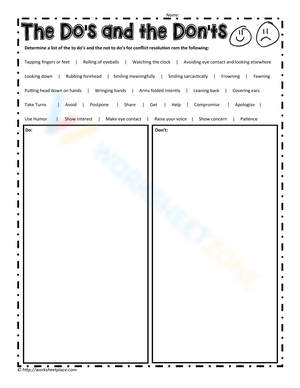
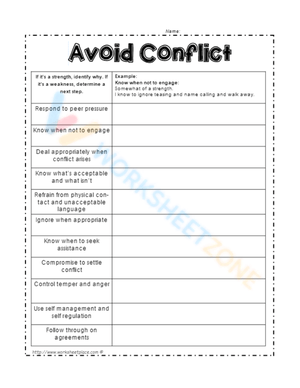
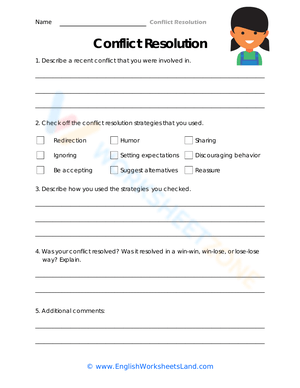
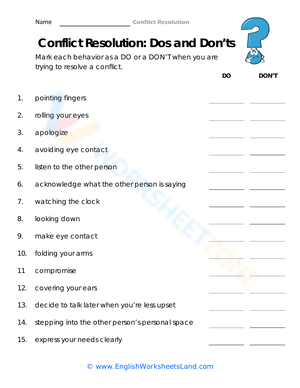
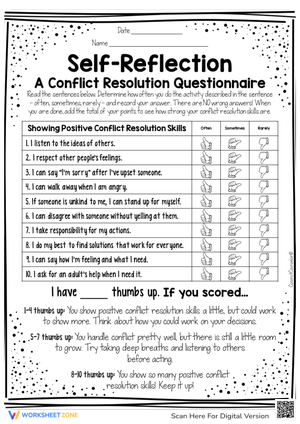
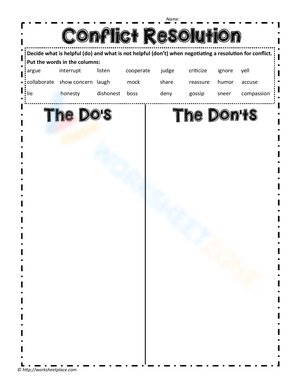
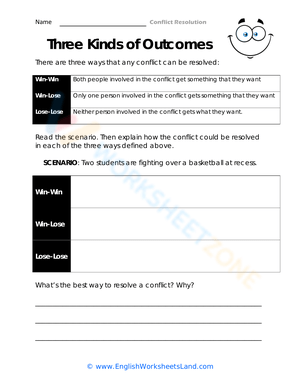
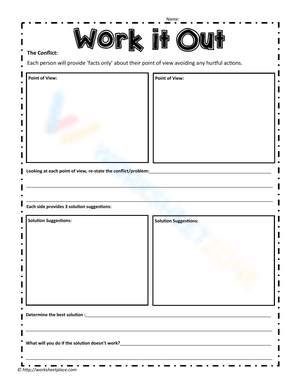
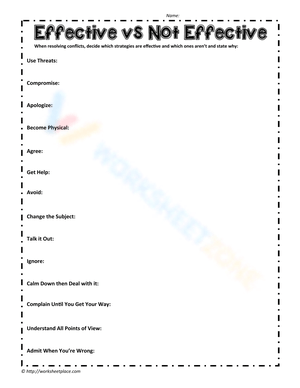
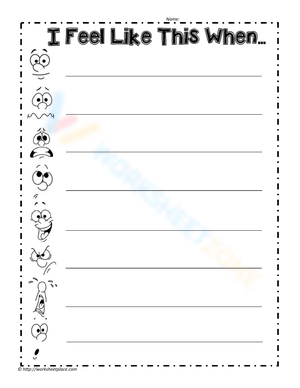
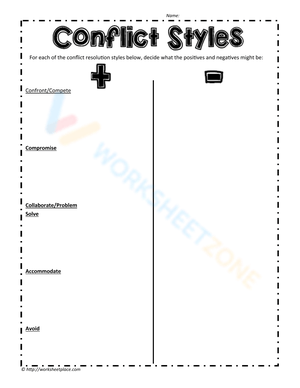
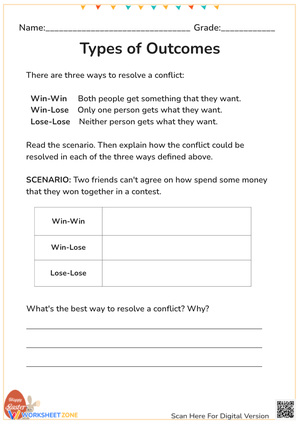
These 12th grade conflict resolution worksheets printable give teachers scenario-based practice calibrated to the conflicts seniors actually face — senior project disputes, early workplace friction, roommate negotiations, and the kind of feedback-resistance that derails internships before they start. Each worksheet targets a distinct skill so students aren't trying to absorb interest-based negotiation, active listening, and power-differential analysis all at once.
The Specific Skills Targeted
The core intellectual move these worksheets develop is the distinction between positions and interests — what someone says they want versus what they actually need. A senior who says "I want to switch project partners" may really need reliability and clear deadlines. That distinction matters because it opens solutions that a surface-level compromise would never reach. Each worksheet walks students through mapping the real interest on both sides before any solution is proposed.
Beyond interest-mapping, students work with BATNA — the Best Alternative to a Negotiated Agreement. This gives students a concrete method for defining their own limits before a difficult conversation begins. One worksheet asks students to write out their BATNA across three provided scenarios, then estimate what the other party's BATNA might be — a step that builds strategic perspective-taking rather than just emotional empathy. Other skills addressed across the set include:
- Annotating a transcribed argument to identify active listening failures — interruptions, dismissals, and loaded language
- Rewriting a reactive message as a professionally worded response after a deliberate 24-hour pause
- Drafting a response to a critical performance review that expresses disagreement without defensiveness
- Ranking proposed solutions by how well they satisfy each party's identified interests
- Mapping power differentials in a scenario and adjusting communication strategy accordingly
Mistakes Students Make That These Worksheets Help You Catch
One consistent pattern teachers notice when using 12th grade conflict resolution worksheets printable is that students treat perspective-taking as a creative writing exercise rather than an analytical one. Asked to write from the other person's point of view, they tend to voice that person with their own vocabulary, their own emotional logic, and their own cultural frame. The resulting "opponent" sounds like them, just with reversed preferences. The worksheets address this by requiring students to first list what they actually know about the other person's circumstances — external pressures, stated priorities, observable behavior — before attempting to write from that perspective.
The second persistent error is what you might call the solution jump. Students who correctly identify both parties' interests will leap immediately to the first workable compromise rather than generating multiple options. In actual student work, this tends to produce a 50-50 split — both people get half of what they want — rather than a creative solution that satisfies both interests more fully. The interest-ranking step in several worksheets slows that jump. Students who practice it regularly start catching when a quick split leaves a better option untouched.
A third issue worth watching: seniors write conflict scenarios as if power between the two parties is perfectly equal. When a scenario involves a manager and a new employee, or a professor and a first-year student, they apply the same tactics they'd use with a peer. Several worksheets include explicit prompts about power differentials so students practice adjusting tone, channel, and timing based on the actual relationship structure.
How to Build These Worksheets Into Your Lesson Plans
The most natural entry point is a senior seminar or advisory block, where the interpersonal stakes of the transition to college or work are already on the table. A worksheet on BATNA identification works well as an opener the week seniors start hearing back from colleges — the emotional climate makes the concept land immediately. That said, these resources integrate cleanly into an English or Communications course during units on argument, rhetoric, or professional writing.
A useful sequence: start with interest-mapping and perspective-taking worksheets, then move to BATNA and negotiation-strategy work once students can reliably distinguish positions from interests. Save the power-differential and professional-response worksheets for later. Introducing power dynamics before students can identify interests produces confused analysis — there are simply too many variables to manage simultaneously before the foundational skill is solid. The last 10 minutes before dismissal is also a reliable slot for single-question reflection prompts drawn from these worksheets; the low-pressure format keeps seniors from disengaging the way they do with longer tasks at the end of a period.
Adjusting the Worksheets for a Range of Learners
Students who are already strong analytical thinkers — typically those with debate experience or AP Language behind them — will move through the interest-identification steps quickly and need a harder constraint. For them, add one rule: no solution that involves a 50-50 split of time, money, or responsibility. This forces genuine creative problem-solving rather than the reflex compromise. These students also handle the power-differential scenarios comfortably from the start and can produce written analyses rather than working within structured prompts.
Students who struggle to move past their own emotional position benefit from completing scenario worksheets about third parties — two characters they have no personal stake in — before applying the same framework to situations closer to home. The 12th grade conflict resolution worksheets printable in this set include several third-party scenarios for exactly that purpose, and sequencing them first gives those students the analytical distance they need. One honest limitation worth naming: students who have experienced significant interpersonal conflict or trauma may find even hypothetical scenarios activating. Establishing opt-out language before the unit opens that door without drawing attention to anyone.
Standard Alignment
These worksheets align with CASEL's Social-Emotional Learning framework — specifically the Relationship Skills competency, which covers communication, conflict resolution, negotiation, and knowing when to seek outside support, and the Responsible Decision-Making competency, which addresses evaluating consequences and reflecting on outcomes. In classroom terms, the Relationship Skills competency is the one most teachers feel least equipped to address with concrete, structured materials — this set closes that gap directly. Most states have adopted SEL standards tied to the CASEL framework, so the alignment documentation needed for lesson plans is generally straightforward to locate through a state's department of education.
Frequently Asked Questions
How are these different from conflict resolution worksheets used in middle school?
The scenarios assume adult-level stakes — workplace dynamics, college roommate agreements, supervisor feedback — and the analytical framework extends well past basic "I statements." Concepts like BATNA, interest-based negotiation, and power-differential mapping don't appear in middle school resources because they require the kind of abstract reasoning most students don't consolidate until late high school. The professional register throughout also matters: seniors respond measurably better to materials that treat them as emerging adults than to anything that reads like 7th grade SEL.
Can these worksheets be used in a remote or hybrid setting?
Yes. Each worksheet functions as a standalone written exercise students complete independently, then bring to a synchronous discussion or share through a written reflection thread. The scenario-analysis format doesn't require real-time interaction to produce learning — students who complete the interest-mapping and perspective-taking work alone, then compare their analyses with a partner afterward, often generate richer discussion than those who worked through the steps together, because they've each committed to an interpretation before hearing another view.
How much class time does a typical worksheet require?
A focused interest-mapping worksheet runs 15 to 20 minutes when students stay on task. The BATNA and power-differential worksheets, which involve multi-step analysis, typically take 30 to 40 minutes. A full sequence — scenario analysis, worksheet completion, paired discussion, and written reflection — needs 50 to 60 minutes. Breaking the longer worksheets across two class periods works well; students who return to a conflict scenario after sleeping on it frequently catch something they missed on the first pass.
Where can I find additional resources in this area?
WorksheetZone carries a library of 12th grade conflict resolution worksheets printable across multiple SEL skill areas — negotiation, mediation, emotional regulation, and professional communication — organized by grade and skill so teachers can filter to exactly what a specific lesson requires.












 Interactive Worksheet Maker
 Quiz Maker
 Word Search Maker
 Crossword Puzzle Maker
 Word Scramble Generator
 Sentence Scramble Generator
 Handwriting Worksheet Generator
 Name Tracing Generator
 Fill In The Blank Generator