


























1 / 2
0
Views
0
Downloads

0.0
0
Save
0 Likes
Share
Half-Life Practice Problems
0 Views
0 Downloads
Paste this activity's link or code into your existing LMS (Google Classroom, Canvas, Teams, Schoology, Moodle, etc.).
Students can open and work on the activity right away, with no student login required.
You'll still be able to track student progress and results from your teacher account.
Information
Description
What It Is:
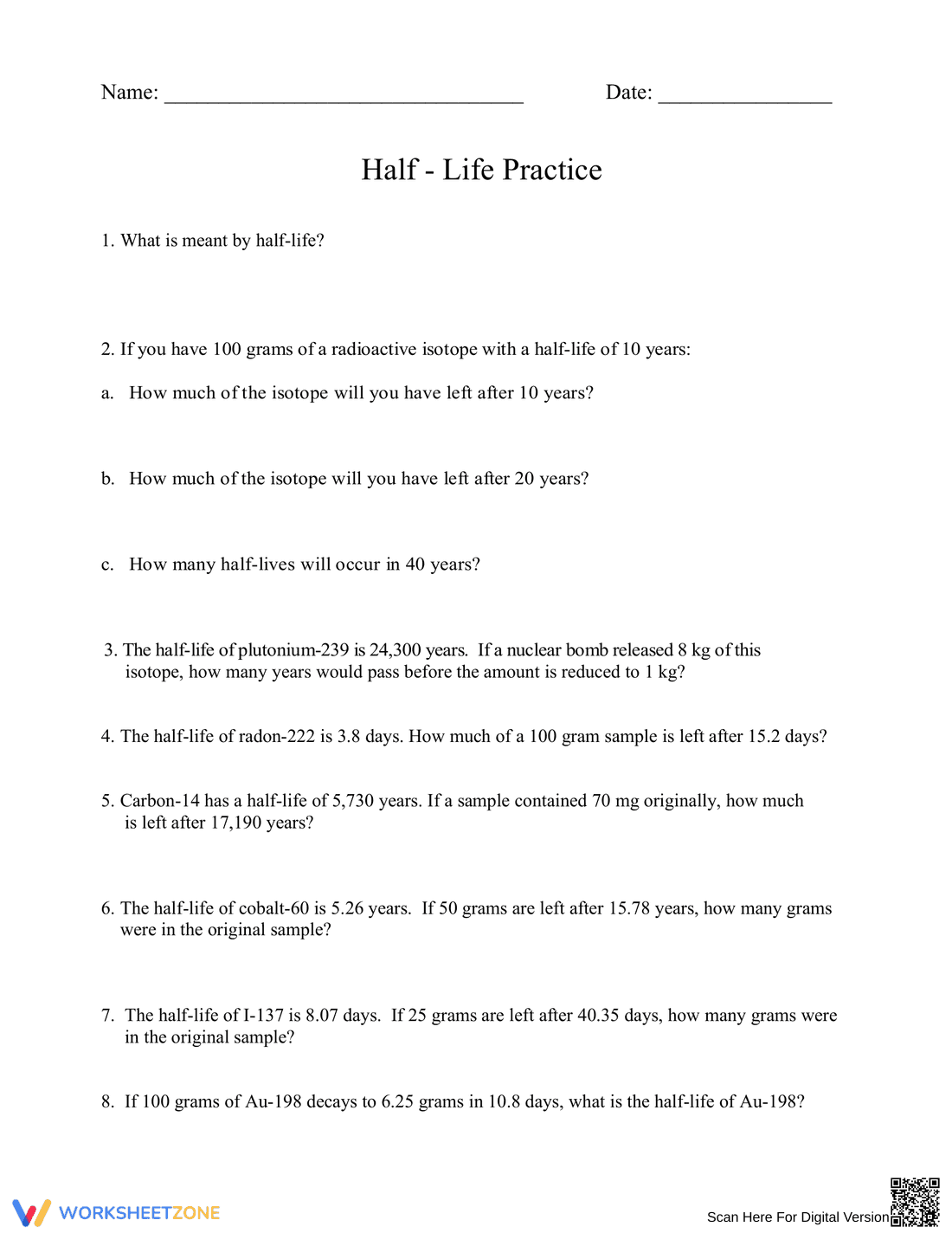
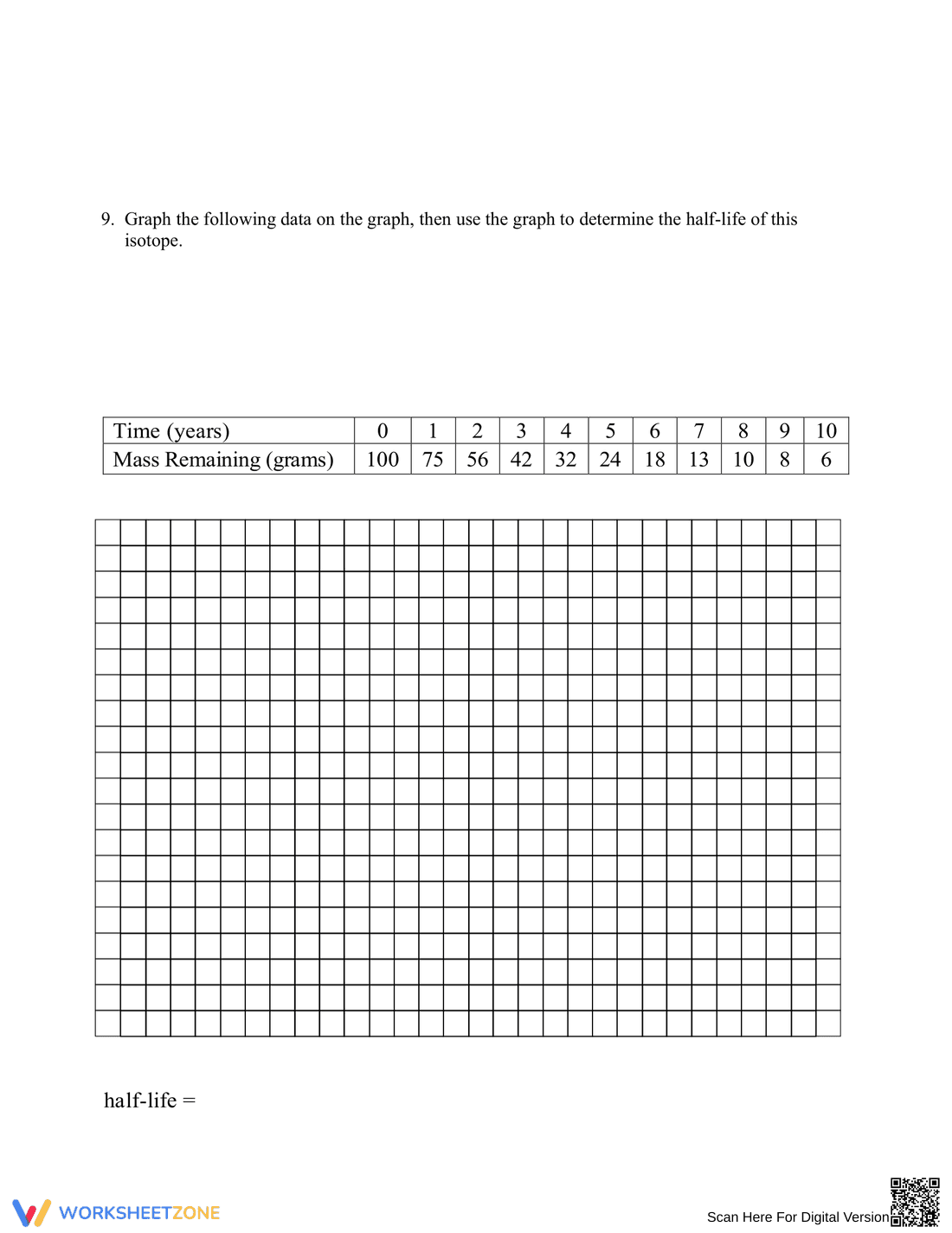
This is a worksheet titled 'Half-Life Practice' containing eight problems related to radioactive decay and half-life calculations. The problems include conceptual questions about the definition of half-life and quantitative problems requiring students to calculate the amount of radioactive isotope remaining after a certain period, or to determine the original amount of isotope, given the half-life and remaining amount. Specific isotopes mentioned include plutonium-239, radon-222, carbon-14, cobalt-60, iodine-137, and gold-198.
Grade Level Suitability:
This worksheet is suitable for high school students, specifically grades 9-12, taking chemistry or physics courses. The calculations involve exponential decay and require a basic understanding of isotopes and radioactive processes, which are typically covered in these grade levels.
Why Use It:
This worksheet helps students practice and reinforce their understanding of half-life concepts and calculations. It provides practice in applying the half-life formula to solve problems involving radioactive decay, isotope amounts, and time intervals. It also encourages critical thinking and problem-solving skills.
How to Use It:
Students should read each problem carefully and identify the given information (half-life, initial amount, remaining amount, time elapsed). They should then use the half-life formula to calculate the unknown variable. Students can show their work and write their answers clearly. This worksheet can be used for in-class practice, homework assignments, or as a review activity.
Target Users:
The target users are high school students studying chemistry or physics, as well as teachers looking for practice problems on half-life to supplement their lessons. It is also helpful for students preparing for standardized tests that cover these topics.
This is a worksheet titled 'Half-Life Practice' containing eight problems related to radioactive decay and half-life calculations. The problems include conceptual questions about the definition of half-life and quantitative problems requiring students to calculate the amount of radioactive isotope remaining after a certain period, or to determine the original amount of isotope, given the half-life and remaining amount. Specific isotopes mentioned include plutonium-239, radon-222, carbon-14, cobalt-60, iodine-137, and gold-198.
Grade Level Suitability:
This worksheet is suitable for high school students, specifically grades 9-12, taking chemistry or physics courses. The calculations involve exponential decay and require a basic understanding of isotopes and radioactive processes, which are typically covered in these grade levels.
Why Use It:
This worksheet helps students practice and reinforce their understanding of half-life concepts and calculations. It provides practice in applying the half-life formula to solve problems involving radioactive decay, isotope amounts, and time intervals. It also encourages critical thinking and problem-solving skills.
How to Use It:
Students should read each problem carefully and identify the given information (half-life, initial amount, remaining amount, time elapsed). They should then use the half-life formula to calculate the unknown variable. Students can show their work and write their answers clearly. This worksheet can be used for in-class practice, homework assignments, or as a review activity.
Target Users:
The target users are high school students studying chemistry or physics, as well as teachers looking for practice problems on half-life to supplement their lessons. It is also helpful for students preparing for standardized tests that cover these topics.


