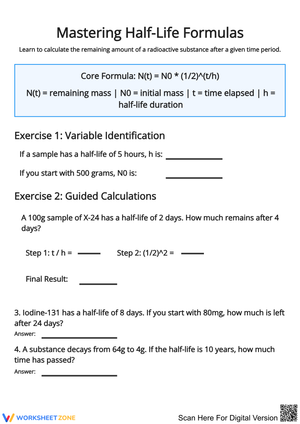
11th Grade Half Life Calculation printable worksheets
These 11th grade half life calculation worksheets give chemistry and physics teachers a structured problem sequence that moves students from whole-number decay intervals through logarithmic solutions — the full arc of what this topic actually demands at the junior level. Each worksheet is a standalone practice unit, and the set covers the three problem types where students most often stall: solving for remaining mass, solving for elapsed time, and solving for the half-life itself when given experimental start and end values.
The Specific Skills Targeted in Each Worksheet
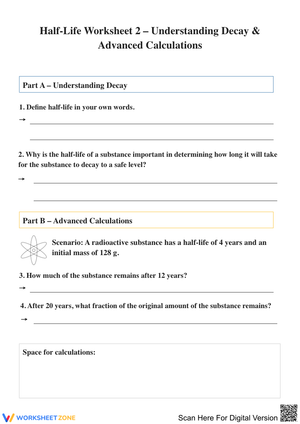
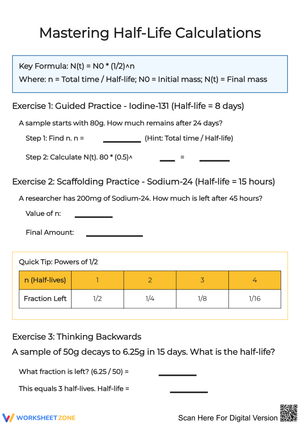
The core formula throughout the set is N(t) = N₀ × (1/2)^(t/t½). Early worksheets keep the exponent as a whole integer — a substance with a 10-day half-life after 30 days, for instance — so students can confirm answers by repeated halving before trusting the algebraic route. That redundancy matters: students who can't check their formula output against a manual countdown haven't internalized what the calculation means.
Once that foundation holds, the worksheets introduce non-integer exponents. Students solve for t by taking the logarithm of both sides, isolating the exponent, and working through the algebra without a scaffolded template. Problem types across the set include:
- Calculating the mass or atom count remaining after a specified elapsed time, including cases where t/t½ is not a clean integer.
- Determining total elapsed time when the initial and final amounts are given alongside the known half-life.
- Deriving the half-life from a set of experimental data — a problem type that requires students to read the formula in reverse.
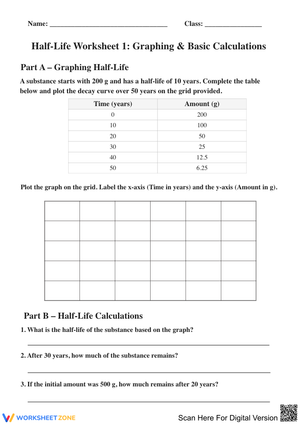
- Completing decay tables that track a substance across six or more half-life intervals, then plotting the resulting curve by hand.
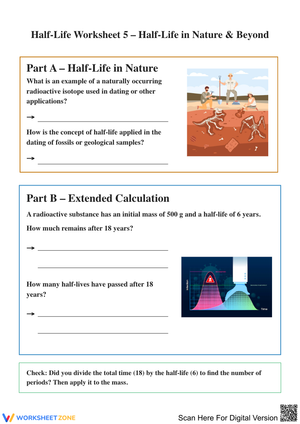
- Multi-step word problems anchored in real isotopes — Carbon-14 for archaeological dating, Iodine-131 for medical dosage scenarios, Uranium-238 for geological timescale problems.
The Uranium-238 problems deserve particular mention. A half-life of 4.5 billion years forces students to work with scientific notation throughout the calculation, which is a separate skill many 11th graders still handle inconsistently. Pairing the decay formula with scientific notation arithmetic in a single problem is deliberate — that combination appears on AP Chemistry and Physics free-response items.
Why Exponential Decay Warrants This Much Structured Practice at Grade 11
Half-life sits at the intersection of physical science content and mathematical modeling in a way that exposes whether students actually understand exponential functions or have simply memorized procedures from Algebra 2. The formula is compact enough to write in one line, which can make it look easier than it is. What trips 11th graders is the cognitive demand of holding four variables simultaneously — N(t), N₀, t, and t½ — and correctly identifying which one is unknown before beginning any algebra. Students who rush past that identification step will set up the equation with the wrong variable isolated and produce a mathematically valid but physically absurd answer, such as a final mass larger than the initial sample.
The worksheets are sequenced with this in mind. Problems within each worksheet are ordered so that the unknown variable rotates — solve for N(t), then t, then t½ — preventing students from pattern-matching on problem structure rather than reading what's actually being asked.
Frequent Student Errors Worth Watching For
The most persistent error in the set is logarithm misapplication. When students reach a step that reads (1/2)^x = 0.125 and need to solve for x, a significant number will take log(1/2)^x and rewrite it as log(1/2) × x — correctly — but then divide the wrong way, swapping numerator and denominator at the final step. The answer comes out negative or greater than expected, and the student accepts it because they don't have an intuitive check for whether x = 3 half-lives is reasonable given the fraction 0.125.
A second error pattern involves the Iodine-131 medical word problems specifically. Students correctly apply the formula but report a final answer in grams when the question asked for the percentage of the original dose remaining. They complete the arithmetic without reading what the problem actually wanted. This is less a math error than a reading-under-pressure error, and it's worth pausing on explicitly when you introduce those problems.
Students also consistently misread decay table problems. When a table shows the amount remaining at each half-life interval, some students calculate the amount that decayed in each interval rather than the cumulative amount remaining — essentially differencing successive rows rather than reading them as absolute values. Walking through the distinction between "amount remaining" and "amount decayed" before students begin the table problems prevents most of this confusion.
Lesson-Planning Ideas to Get the Most From These Worksheets
The most effective sequence we've seen starts with a physical decay simulation — coin flips or colored tiles — before any formula work. Students record results, plot the curve, and observe the shape of exponential decay with data they generated themselves. When the formula arrives on the first worksheet, it explains something they've already seen rather than introducing something abstract. That order matters for students who find the mathematics intimidating; the formula becomes a description rather than a rule imposed from outside.
For pacing, the whole-number worksheets work well as guided practice on the day you introduce the formula — 20 to 25 minutes of paired work with circulating check-ins. Reserve the logarithm-based worksheets for independent practice one or two days later, after students have had a night to sit with the foundational problems. Trying to move from integer half-lives to logarithmic solutions in a single class period compresses the cognitive load in a way that tends to produce surface compliance — students complete the steps without building genuine fluency.
The multi-step word problems anchored in Carbon-14 and Uranium-238 translate directly into an end-of-unit assessment format. Assigning one of those worksheets as a take-home task before a quiz gives you a clear formative picture of who still needs the logarithm steps scaffolded and who is ready for the assessment without support.
Adapting These Worksheets for a Range of Learners
For students still shaky on logarithms, the most useful accommodation is a reference strip — not a formula sheet, but a worked example showing the log isolation steps in sequence, with variable names rather than numbers. Students reference the structure without copying an answer. This keeps the cognitive work in the right place.
Students who are ready for more challenge handle the standard problems quickly and benefit from a follow-on task: given a decay curve plotted on the worksheet, determine the half-life graphically, then verify it algebraically. Reconciling two methods for the same answer is the kind of practice that builds genuine conceptual understanding rather than procedural speed.
For students in a physics-focused course, the same worksheets extend naturally into activity calculations using the decay constant λ = ln(2)/t½. The worksheets as written don't require this, but the problems provide the data needed to compute activity in becquerels if you want to connect the decay formula to radiation intensity — a physics framing that runs parallel to the chemistry application without requiring separate materials.
Standard Alignment
These worksheets align most directly with NGSS HS-PS1-8, which asks students to develop models to illustrate changes in the composition of the nucleus and energy released during fission, fusion, and radioactive decay. The half-life calculation sequence addresses the mathematical modeling component of that standard — students construct quantitative representations of decay, apply them to real isotopes, and use them to draw evidence-based conclusions about elapsed time or remaining mass. The worksheets also reinforce the mathematical practices embedded in common state chemistry and physics standards requiring students to use algebraic representations to describe and predict natural phenomena, specifically the application of exponential functions to physical processes.
Frequently Asked Questions
Do students need to know logarithms before starting these worksheets?
For the introductory worksheets involving whole-number half-lives, no — students can verify answers by repeated halving. The logarithm-based worksheets are designed for use after logarithms have been introduced in math class, typically concurrent with or following Algebra 2 or Pre-Calculus. If your students haven't had formal log instruction, the reference strip accommodation described in the differentiation section bridges the gap adequately for most.
Are these worksheets appropriate for both chemistry and physics courses?
Yes. The core formula and problem structure apply in both contexts. Chemistry courses tend to emphasize mass and moles as the measured quantity; physics courses often work in activity or number of nuclei. The problems use mass by default, but the formula structure is identical regardless of unit, and the worksheets adapt easily to either framing.
How do the graphing problems work without a pre-printed grid?
Each worksheet that includes a graphing component provides a labeled axis framework. Students set their own scale based on the problem data — which is itself a skill worth assessing, since choosing an inappropriate scale is a common error that obscures the shape of the decay curve. If you want to remove that variable and focus solely on plotting, providing a pre-scaled grid on the side is a simple modification.
Can these worksheets double as quiz or test material?
The multi-step word problems and the reverse-solve problems — where students derive the half-life from experimental data — are formatted clearly enough to use as summative assessment items. The scaffolded table-completion problems are better suited to formative use, since the table structure itself provides more guidance than a clean assessment question would.
Clear All