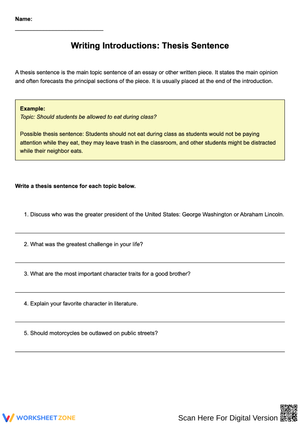
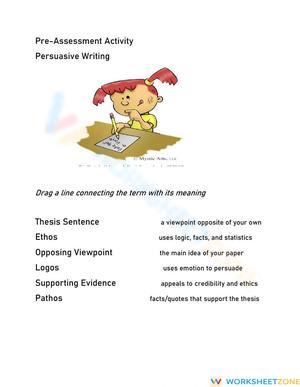
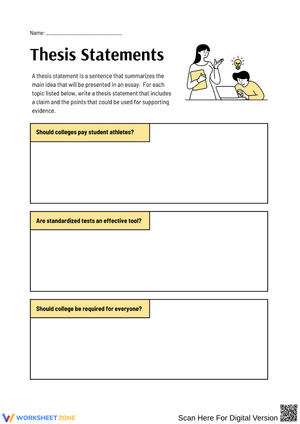
These 11th grade persuasive writing printable worksheets give teachers discrete, focused tools for one of the harder transitions in secondary ELA: moving students from opinion-based writing into genuine, evidence-driven argumentation. Each worksheet targets a specific sub-skill — rhetorical appeals, counterclaim construction, logical fallacy identification, or evidence integration — so teachers can sequence them alongside an existing essay unit rather than replacing instruction wholesale.
The Specific Skills Each Worksheet Builds
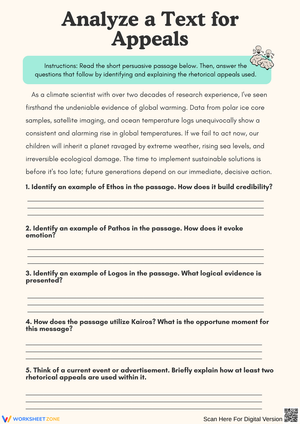
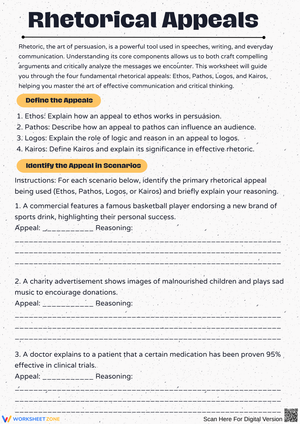
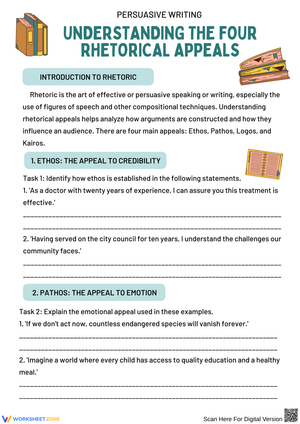
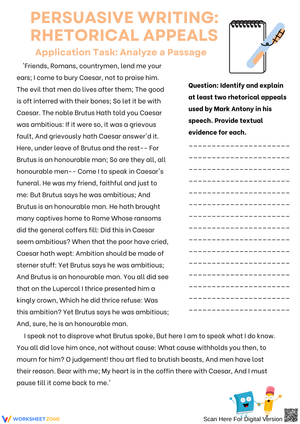
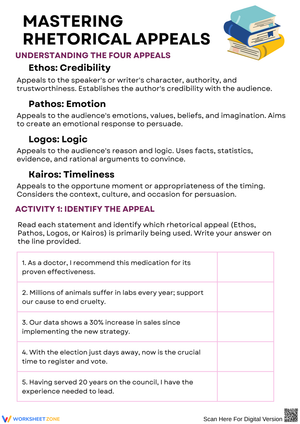
The set covers the full arc of persuasive argument construction. Some worksheets ask students to analyze how a given text handles ethos, pathos, and logos separately before they attempt to use those appeals in their own drafts. Others focus on the rebuttal — specifically, how to address an opposing argument without simply dismissing it. A handful of worksheets work through logical fallacies: students read short flawed arguments, name the fallacy, and rewrite the passage using sound reasoning. The final group addresses evidence integration, covering how to embed a quotation, paraphrase without distorting meaning, and make the connection between evidence and claim explicit in the prose.
Each of these is a genuinely discrete skill, and treating them that way matters. Students who can identify pathos in a print advertisement do not automatically know how to use it in a body paragraph. The worksheets are structured to keep those skills separate until students demonstrate control over each one individually.
Common Misconceptions to Watch For and Correct
The most persistent error in Grade 11 persuasive writing is the hollow counterclaim paragraph. Students learn that an argument needs to address the opposition, so they write something like "Some people believe that [X], but I disagree because [restatement of original claim]." That is acknowledgment, not refutation. The counterclaim worksheets push students past this by requiring them to steelman the opposing position first — to write the strongest version of the argument they plan to dismantle — before constructing a rebuttal. The process is uncomfortable for students who want to dismiss opposition quickly, but it produces significantly stronger final essays.
Two other error patterns appear regularly. First, students who understand ethos as a concept will still write "experts say" without identifying the expert or establishing their credentials — they have learned the label without understanding the mechanism. Second, evidence integration collapses into what many teachers call the quote dump: a block quotation followed immediately by a new claim, with no sentence in between that explains what the quoted passage means or why it supports the argument. Both errors require direct instruction, and these worksheets give teachers a concrete surface on which to catch and address them.
Building These Worksheets Into Your Instructional Sequence
The most effective sequencing starts with analysis before construction. When introducing rhetorical appeals, begin with low-stakes source material — infomercials and exaggerated print advertisements work better than historical speeches at the entry point. An 11th grader can immediately see how a celebrity endorsement manufactures ethos without real authority, or how a before-and-after image manufactures pathos. Once students can name and explain those moves in a familiar, somewhat absurd context, they bring a sharper analytical lens to Lincoln's Second Inaugural or a contemporary op-ed. The analysis worksheet provides a recording structure that works equally well across both source types.
For full essay units, the prewriting worksheets belong in the planning phase. A rhetorical situation graphic organizer — one that asks students to identify audience, purpose, context, and constraints before writing a single sentence of their draft — reduces the number of audience-unaware arguments that show up in first drafts. The evidence integration worksheets, by contrast, work better during revision, not drafting. Students who try to perfect their citation mechanics while generating ideas tend to lose momentum and produce shorter drafts overall. Saving that work for after the first draft is down keeps the cognitive demands of each stage manageable.
The logical fallacy worksheets run well as bell-ringers spread across two or three weeks rather than used all at once. Five minutes of fallacy identification at the start of class, distributed over time, builds better retention than a single workshop day — and it creates shared classroom vocabulary that makes peer revision conversations noticeably more precise.
Standard Alignment
These worksheets align directly with CCSS ELA-Literacy.W.11-12.1, which requires students to write arguments supporting claims in an analysis of substantive topics or texts, using valid reasoning and sufficient, relevant evidence. The standard's sub-components map onto the worksheet categories in practical terms: W.11-12.1a (introducing a claim and organizing reasons logically) connects to the prewriting and outline worksheets; W.11-12.1b (developing claims with evidence while acknowledging and distinguishing counterclaims) maps to the counterclaim and evidence integration worksheets; W.11-12.1c (using transitions and syntax to clarify relationships among claims) ties to the sentence-level revision exercises. Teachers working in states using the CCSS framework will find these resources usable without modification.
Adjusting the Set for Different Student Levels
For students who are still developing basic argument structure, the logical fallacy identification worksheets function as a gentler entry point than the full argument-construction tasks. Recognizing flawed reasoning in someone else's writing is cognitively less demanding than producing a well-reasoned argument from scratch, and it builds the analytical vocabulary students need before they attempt to construct a rebuttal of their own. These worksheets give those students a concrete, achievable task that still connects directly to grade-level standards work.
Advanced writers sometimes resist the graphic organizer format because they already have a working organizational instinct and find structured template boxes constraining. For those students, using the checklist versions of the worksheets — applying the criteria to a draft they have already written rather than filling in a template before drafting — tends to produce more useful results. The 11th grade persuasive writing printable worksheets that include open-ended analytical prompts rather than fill-in templates also tend to serve stronger writers better. It is worth having both formats accessible and making the choice based on where an individual student is in their drafting process, not on their general ability level.
Frequently Asked Questions
What is the difference between persuasive and argumentative writing at this grade level?
The distinction matters most for how students weight their evidence. Persuasive writing historically leaned on emotional appeals and the writer's credibility as primary tools. Argumentative writing — the mode emphasized in the CCSS 11th and 12th grade band — requires that logic and evidence carry the argument, with emotional appeals playing a supporting rather than a lead role. In practice, the strongest student essays use all three rhetorical appeals, but they anchor every emotional or credibility-based move with data or specific textual evidence. These worksheets address both modes and ask students to identify which tools they are using and why — not just whether they have included a compelling opening.
How do I help students balance pathos and logos without flattening their voice?
The color-coding technique is practical and fast: students highlight every emotionally charged word or phrase in one color and every piece of factual evidence or logical deduction in another. Students who overuse pathos see the imbalance immediately, and so do students who have overcorrected into bloodless, evidence-only writing. The goal is not equal distribution of each color but intentional distribution. What these 11th grade persuasive writing printable worksheets add is a follow-up annotation step: students must note beside each highlighted section what job that passage is doing and whether it is grounded in the other type of appeal. That annotation step is where the real metacognitive work happens.
Are graphic organizers appropriate for students who are already strong writers?
Not always in their fill-in format. Strong writers at this level often find that completing a template before drafting disrupts rather than supports their process. The more useful approach for those students is to use the graphic organizer retrospectively — after a first draft exists — as a diagnostic. If a student cannot map their completed draft onto the organizer's structure, that is a reliable signal that the argument is missing an explicitly stated claim, has no actual counterclaim, or contains evidence that is never connected back to the central argument. Used that way, the organizer functions as a revision lens rather than a pre-writing constraint.
How do these worksheets connect to timed writing on standardized assessments?
Most standardized writing tasks at this grade band — including the SAT Essay, AP Language and Composition free-response questions, and many state ELA assessments — ask students to read a source text and respond to its argument under a time limit. The skills built through these 11th grade persuasive writing printable worksheets map directly onto that task: reading for rhetorical strategy, identifying how evidence supports a claim, and constructing a clear organized response. Students who have repeatedly practiced rhetorical analysis and evidence integration through structured worksheets approach those timed prompts with a set of named, practiced moves rather than trying to generate a strategy on the spot.












 Interactive Worksheet Maker
 Quiz Maker
 Word Search Maker
 Crossword Puzzle Maker
 Word Scramble Generator
 Sentence Scramble Generator
 Handwriting Worksheet Generator
 Name Tracing Generator
 Fill In The Blank Generator