


























Views
Downloads
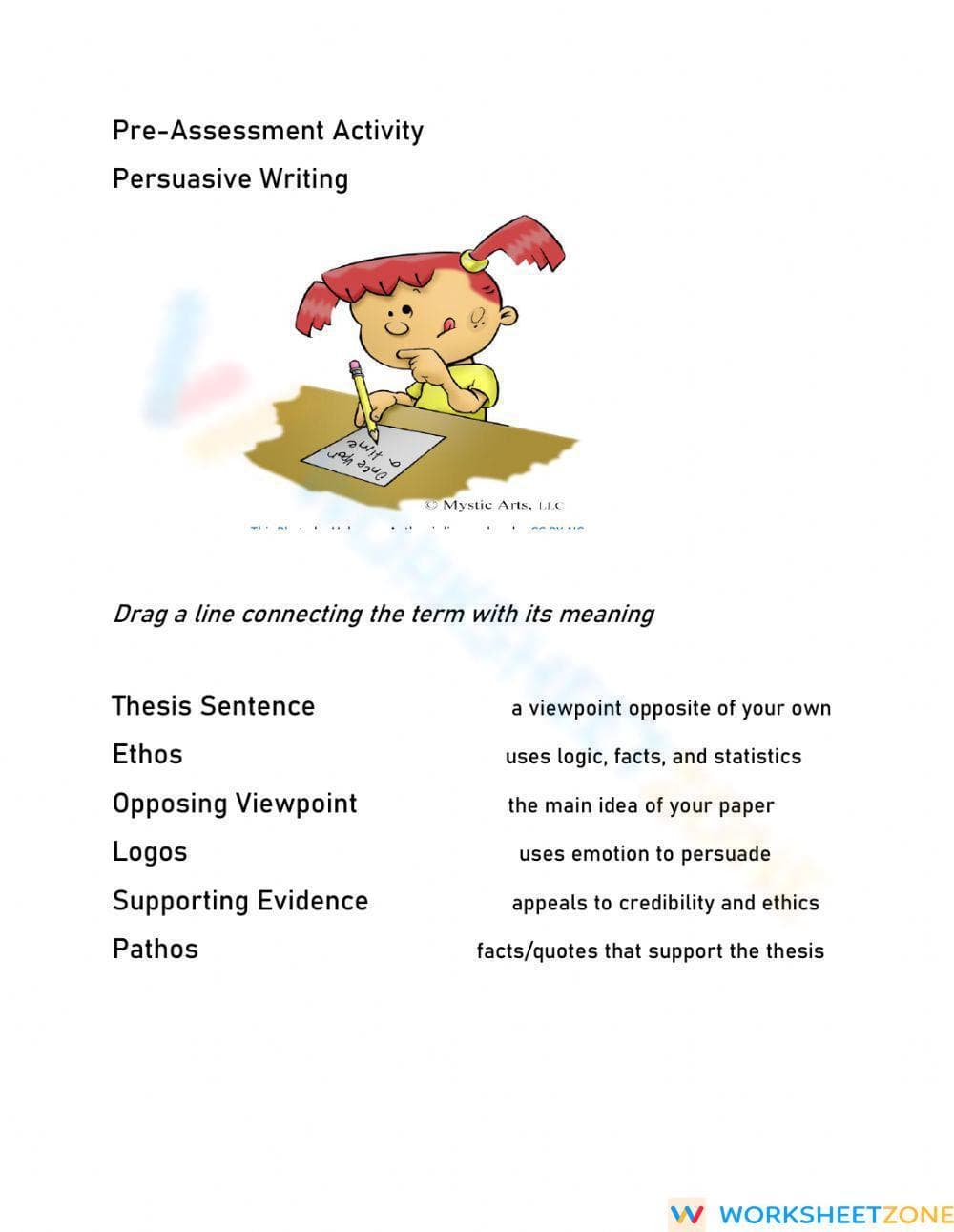

W.11-12.1 Worksheet: Persuasive Writing — Complete Guide
Paste this activity's link or code into your existing LMS (Google Classroom, Canvas, Teams, Schoology, Moodle, etc.).
Students can open and work on the activity right away, with no student login required.
You'll still be able to track student progress and results from your teacher account.
This Grade 10-12 persuasive writing pre-assessment allows educators to evaluate student proficiency in argumentative writing before beginning a new unit. Students demonstrate their ability to form clear claims and support them with logical reasoning. This diagnostic tool ensures instruction targets specific student needs from day one.
At a Glance
- Grade: 10-12 · Subject: ELA
- Standard:
CCSS.ELA-LITERACY.W.11-12.1— Write arguments to support claims using valid reasoning and relevant evidence- Skill Focus: Persuasive Writing / Argumentation
- Format: 1 page · 3 problems · Answer key included · PDF
- Best For: Diagnostic assessment and unit planning
- Time: 20–30 minutes
What's Inside
This assessment includes one comprehensive worksheet featuring a structured prompt and space for drafting a thesis statement and supporting points. It comes with a clear rubric for teacher evaluation and an answer key with model responses to guide grading and provide immediate feedback.
Mastery Evidence
The included rubric features three tiers—Approaching, Meeting, and Exceeding—allowing teachers to map student performance directly to the sub-skills of the CCSS writing standard. Each task, from claim development to evidence selection, provides measurable data on student readiness. Scores can be entered directly into gradebooks or used to inform IEP progress notes for differentiated instruction.
Standards Alignment
This resource is aligned with CCSS.ELA-LITERACY.W.11-12.1: "Write arguments to support claims in an analysis of substantive topics or texts, using valid reasoning and relevant and sufficient evidence." It supports secondary standards related to organization and clarity. Both standard codes can be copied directly into lesson plans, IEP goals, or district curriculum mapping tools.
How to Use It
Administer this pre-assessment at the start of a persuasive writing unit to establish a baseline of student skills. Use the results for formative assessment, observing how students structure their arguments to identify those needing additional scaffolding. Most students will complete the tasks in 20 to 30 minutes.
Who It's For
Designed for high school students in Grades 10 through 12, this tool is ideal for standard classrooms, Honors courses, and College Prep environments. It pairs naturally with an argumentative writing anchor chart or a mentor text analysis lesson.
Research from Fisher & Frey (2014) emphasizes the importance of diagnostic assessment in the gradual release of responsibility model. By identifying a student's zone of proximal development in persuasive writing early, teachers can more effectively scaffold instruction to meet the rigorous demands of CCSS.ELA-LITERACY.W.11-12.1. This pre-assessment provides the necessary data to bridge the gap between initial student understanding and the complex argumentation required for college and career readiness. Effective use of such diagnostic tools is linked to significant gains in student writing proficiency, as noted in recent NAEP reports. This self-contained summary underscores the pedagogical value of standard-aligned assessments in the secondary ELA classroom, providing a clear evidence base for its implementation in diverse educational settings.


