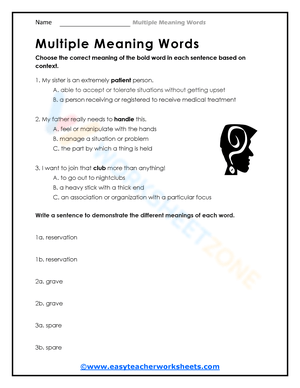
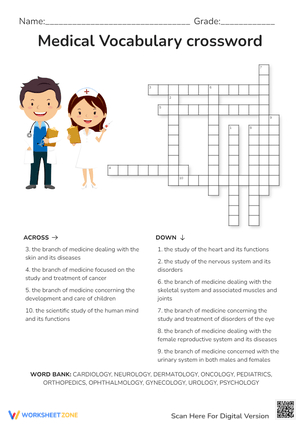
These language and vocabulary worksheets for 11th grade address the moment in high school ELA when precision matters as much as correctness — students are expected not just to understand words, but to analyze how a writer's specific choices construct tone, argument, and rhetorical stance. The set spans Tier 2 academic vocabulary, morphological analysis, connotation work, and context-based inference, giving teachers flexible entry points that fit naturally alongside a novel unit or a writing cycle.
What the Worksheets Target
The skills across this set cover a wider range than a typical vocabulary list assignment. Students work with:
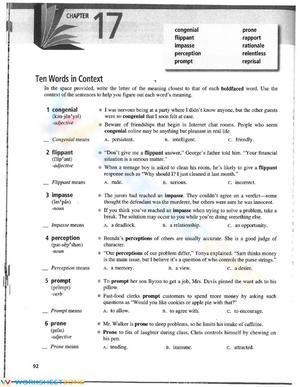
- Context clues in extended literary and informational passages — not short sentences with a blank, but full paragraphs where students must test an inference against the surrounding argument
- Greek and Latin roots, prefixes, and suffixes applied to unfamiliar academic and technical terms
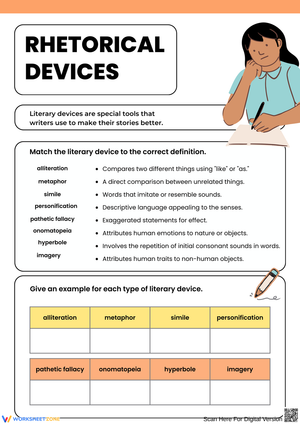
- Distinguishing denotation from connotation, with particular attention to words that carry evaluative weight — assertive versus aggressive, frugal versus stingy
- Ranking synonyms on a connotative spectrum from most to least positive, or most to least formal
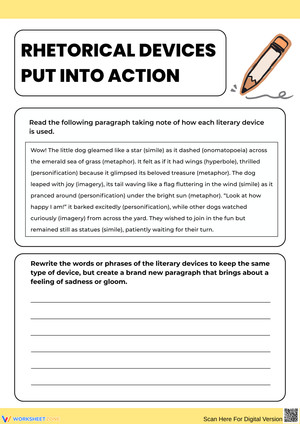
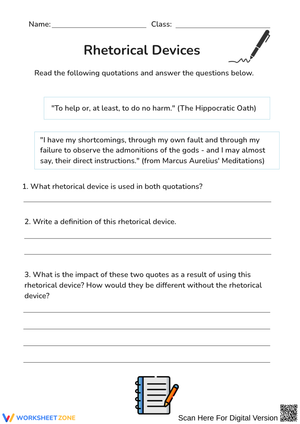
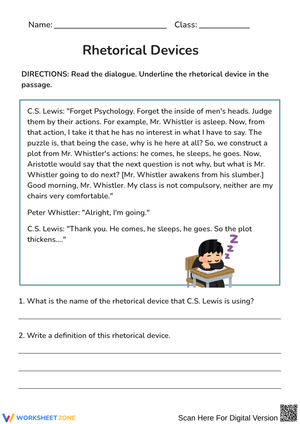
- Analyzing how a writer's word choice signals attitude or rhetorical position in argumentative and analytical passages
- Applying Tier 2 academic terms — words like ambiguous, corroborate, pragmatic, juxtapose — in original sentences and short written responses
The morphology work functions differently from the other exercises. When students recognize that phil (love) and anthro (human) both appear in philanthropy, philosophy, and anthropology, they stop treating vocabulary as a memorization problem and start treating it as a pattern-recognition task. That reframe extends well beyond ELA — students who internalize root analysis decode technical terms in biology and social studies using the same tools.
Word Choice and the Weight of Connotation
At the 11th-grade level, connotation exercises do something more than sort words by feeling tone. One worksheet presents two student-written sentences about the same historical figure — one using assertive, one using aggressive — and asks students to identify which word a sympathetic biographer would choose and why. That question forces students to hold denotation and connotation simultaneously, which is exactly what rhetorical analysis prompts demand. It also makes any follow-up writing task more grounded: students who have thought hard about word choice write analysis with noticeably more precision.
Connotation ranking activities reveal something diagnostic about student reading. Strong readers sort a set like economical, frugal, stingy, and miserly quickly, with clear reasoning. Students with weaker semantic awareness treat near-synonyms as interchangeable and struggle to articulate why frugal carries a more neutral charge than stingy. That's more useful information about a student's linguistic development than a multiple-choice vocabulary quiz score.
Standard Alignment
These language and vocabulary worksheets for 11th grade address standards L.11-12.4, L.11-12.5, and L.11-12.6 from the Common Core State Standards for ELA. L.11-12.4 covers strategies for determining word meaning — context clues, root analysis, and reference materials — which maps directly to the inference and morphology exercises in the set. L.11-12.5 focuses on figurative language, nuance, and connotation, the core skill targeted by the spectrum-ranking and word-choice analysis activities. L.11-12.6 requires students to acquire and use general academic and domain-specific vocabulary with accuracy, which the Tier 2 practice exercises and applied usage prompts address directly.
In classroom terms, these three standards sit at the intersection of reading and writing. Students who work through L.11-12.4 and L.11-12.5 in systematic, repeated practice are better prepared to write the rhetorical analysis essays that appear on AP Language assessments and district-level 11th-grade finals alike.
Fitting These Worksheets Into Your Weekly Schedule
The most effective placement is alongside an active reading unit rather than as a freestanding vocabulary week. If the class is working through a Morrison or Fitzgerald novel, use vocabulary pulled from that text to frame the exercises. Students retain words significantly longer when they first encounter them in a passage already discussed in class — the context anchors the meaning, so the worksheet reinforces rather than cold-introduces.
Bell-ringers work particularly well with connotation ranking activities. A single task sorting four words takes about six minutes and reliably generates enough student disagreement to justify a brief whole-class debrief. The morphology exercises hold up as independent work — students who finish a writing task early can analyze three or four roots without needing additional teacher direction. For dedicated test-prep blocks, the vocabulary-in-context passages translate directly to the SAT Reading and Writing section format, so they pull double duty as skill-building and test-readiness practice without requiring a separate set of materials.
Student Errors Worth Catching Early
The most common error in context-clue work at this level is using surrounding mood as a definition rather than surrounding argument. A student who encounters ephemeral in a passage about cherry blossoms will often write "something beautiful" because the imagery is positive — they're reading atmosphere, not syntax. The passages in these exercises include deliberately ambiguous emotional contexts that force students to trace a word's meaning through sentence structure, not the general feeling of the paragraph.
Morphology exercises expose a separate problem: students who correctly memorize a root meaning apply it too broadly. A student who knows bene means good will define beneficial as "something good" — technically accurate, but too vague for academic writing. Each worksheet includes a step where students write their own sentence using the target word in context, which surfaces shallow understanding quickly. Students who genuinely grasp a word write specific, purposeful sentences; students who are guessing produce something grammatically fine but semantically empty.
On connotation tasks, watch for students who confuse personal association with shared cultural connotation. A student might rank thrifty as more negative than stingy because they've heard the word used dismissively at home. A short whole-class debrief — not calling anyone out — tends to correct this while building the kind of metalinguistic conversation that makes the activity worth the class time.
Adapting These Worksheets for a Range of Learners
For students who need more structured entry points into context-clue work, annotating the surrounding clauses before independent practice makes a real difference — mark the sentence containing the target word and the two sentences on either side, so students know where to focus their attention. Advanced students doing the same exercise benefit from passages where the surrounding mood contradicts the word's actual meaning, which happens in irony and satire and demands more analytical rigor than straightforward literary prose.
Language and vocabulary worksheets for 11th grade that include morphology components are particularly adaptable. Students newer to root analysis work with two-part constructions — prefix plus root — before encountering three-part words. Advanced students can reverse the task: given a definition, build the word from its parts, then identify one related word not listed anywhere on the worksheet. That version requires genuine generative thinking rather than pattern matching, and it pushes students toward the kind of independent word-solving that payoffs appear in college coursework.
The connotation ranking activities pair naturally with a tiered writing follow-up. Students who struggle with written expression work from sentence frames: "The word ___ has a more [positive/negative] connotation because ___." Students who write fluently skip the frame entirely and write two sentences about the same subject using words from opposite ends of the spectrum they've built, then explain what the shift in word choice reveals about the speaker's attitude. That upper-level prompt lands well in preparation for AP Language rhetorical analysis tasks.
SAT and ACT Preparation
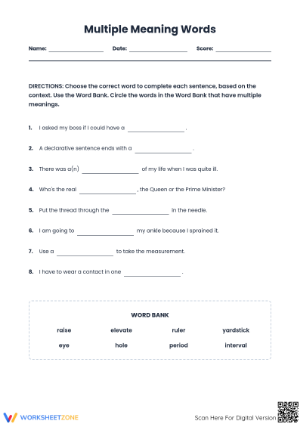
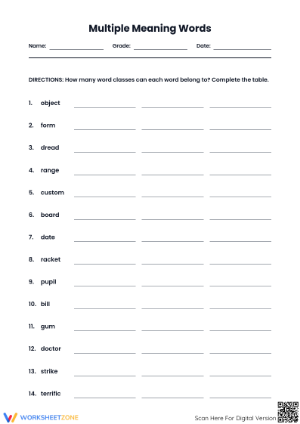
The SAT Reading and Writing section no longer tests obscure, low-frequency words in isolation. The College Board moved toward testing words with multiple meanings that shift depending on context — terms like qualify, distinguish, challenge, and address, where the correct answer depends entirely on the surrounding sentence. This makes language and vocabulary worksheets for 11th grade built around vocabulary-in-context formats directly applicable to test prep, since students are practicing the exact reasoning process the exam rewards.
The ACT English section focuses less on vocabulary definition and more on choosing the most precise or rhetorically effective word in a sentence. The word-choice and connotation activities in this set transfer directly to that format: students are already in the habit of evaluating near-synonyms for tone, precision, and rhetorical effect rather than simply matching terms to dictionary definitions.
Frequently Asked Questions
Do these worksheets require students to have read specific texts beforehand?
No. Each worksheet is self-contained — the passages and sentences include everything a student needs to complete the exercises without prior reading. The morphology and context-clue worksheets also integrate smoothly into existing units; teachers regularly substitute sentences or short passages from their current class text without changing the underlying skill being practiced.
How do the exercises distinguish between Tier 2 and Tier 3 vocabulary?
The primary focus across the set is Tier 2 — high-utility academic terms that appear across disciplines and on standardized tests: words like ambiguous, corroborate, ephemeral, and pragmatic. These show up in college applications, AP essay prompts, science articles, and history analyses, not just literature class. Tier 3 terms appear when they arise naturally in a passage used for context-clue or connotation work, but the set does not build Tier 3 lists as a primary instructional goal.
Can these serve as formative assessment, or are they better suited to independent practice?
Most exercises generate visible, gradeable thinking — rankings with written justifications, context-clue inferences with explanations, morphology work that asks students to produce original examples. A teacher walking the room during a connotation ranking activity can identify within a few minutes which students are reasoning and which are guessing. The vocabulary-in-context passages work as a graded reading check when a summative measure is needed, since correct answers require explanation rather than a circled letter.
How long does each worksheet take to complete?
Context-clue passages with multiple inference questions run about 15 to 20 minutes for most 11th graders. Connotation ranking activities with a short written reflection take 10 to 12 minutes. Root identification exercises run 8 to 10 minutes; prompts that ask students to generate their own examples from a given root push closer to 15. These estimates reflect typical class pacing — not the fastest students in the room, who may finish several minutes early and benefit from the extension prompts included on each worksheet.