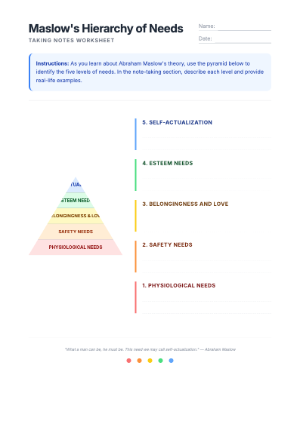
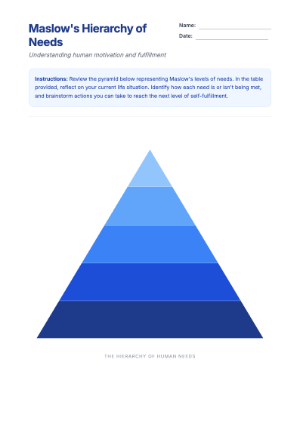
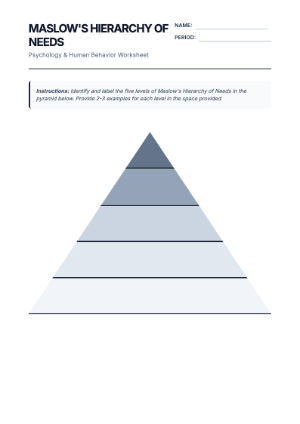
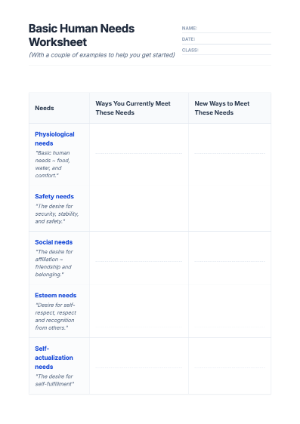
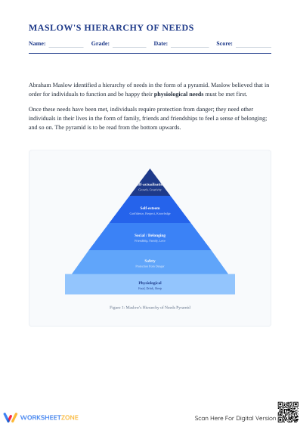
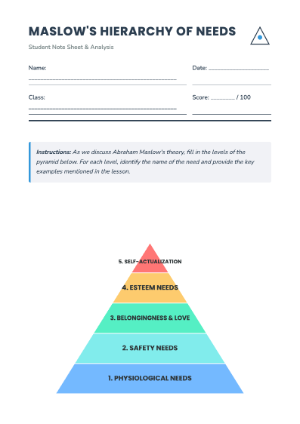
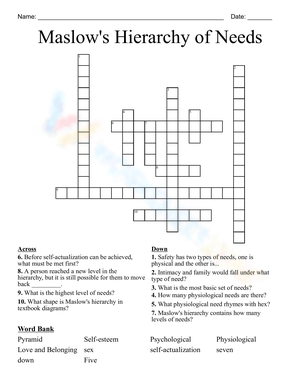
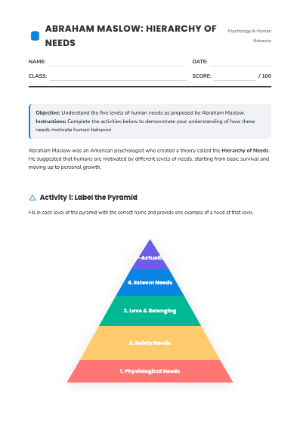
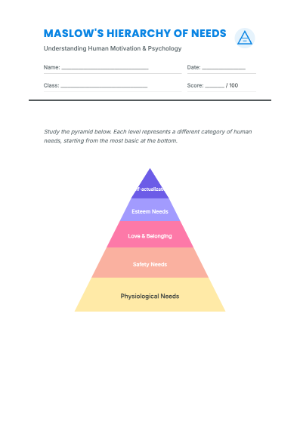
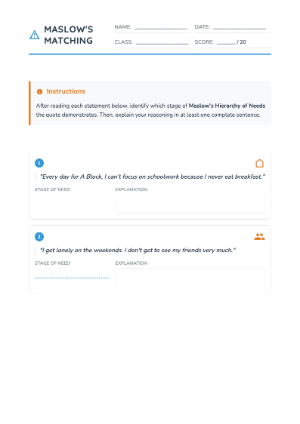
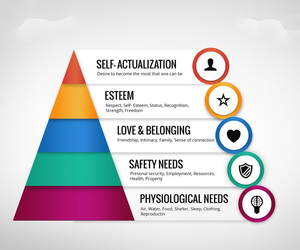
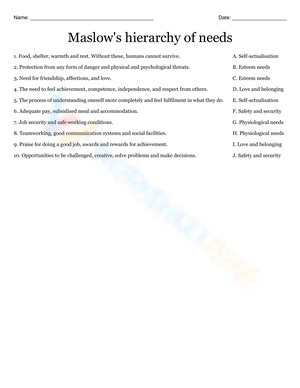
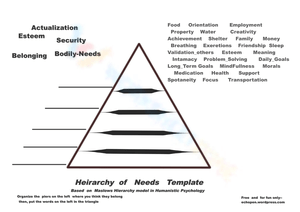
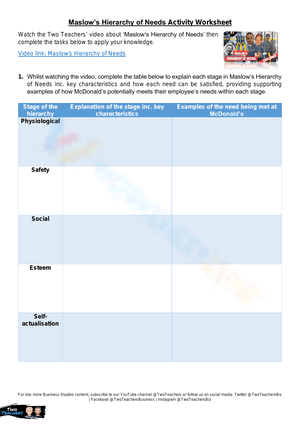
These maslows hierarchy of needs printable worksheets for 11th grade give psychology teachers — and English or social studies teachers who draw on motivational theory for character and historical analysis — a set of resources focused on application, not just recall. Each worksheet targets a specific analytical task: labeling and distinguishing the five tiers, separating deficiency needs from growth needs, applying the framework to case studies or characters, or engaging seriously with the theory's documented limitations.
Skills Covered Across the Set
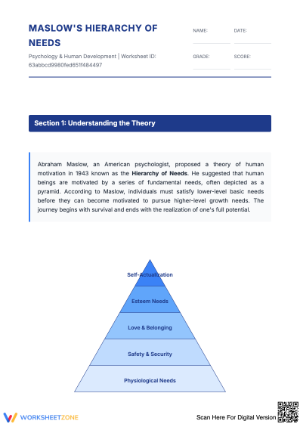
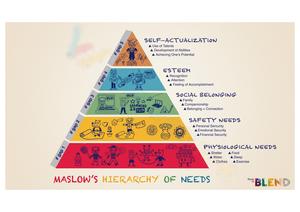
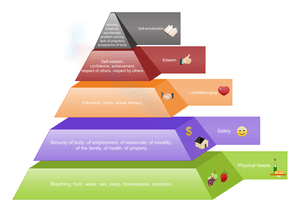
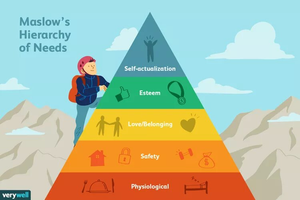
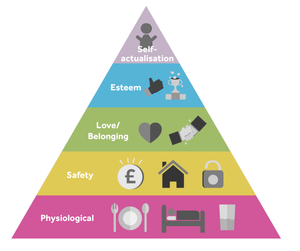
The core labeling worksheet asks students to name and describe each of the five tiers — physiological, safety, love and belonging, esteem, and self-actualization — using original examples rather than textbook ones. That requirement immediately reveals which students understand the tier well enough to generate their own cases and which students are paraphrasing a definition. From there, each worksheet moves into progressively more demanding application.
- Scenario worksheets present brief cases and ask students to identify the most active tier, justify the placement, and name the unmet need driving the behavior
- A character-motivation worksheet asks students to trace a figure's position in the hierarchy at three distinct points — useful alongside a novel, play, or biographical unit
- A comparative argument worksheet has students examine two individuals with unequal access to lower-tier needs and evaluate whether the model accurately predicts their self-actualization timelines
- A critiques worksheet addresses sampling bias in Maslow's original research population and cross-cultural challenges to the universal pyramid model
The esteem tier gets its own focused task because students collapse it more than any other. Maslow identified two distinct forms — internal self-regard built on competence and independence, and external regard based on status and recognition — and confusing them produces shallow analysis. The worksheet separates the two sub-types explicitly before asking students to apply either to a person or character.
How to Work These Worksheets Into Your Unit Plan
In most 11th grade psychology courses, motivation theory arrives in the first few weeks of the semester. The labeling worksheet fits as an opener — it establishes vocabulary and the pyramid structure before anything analytical is asked. The scenario worksheet belongs the following class session, moving students from recall into judgment. Physiological and safety tiers settle quickly for most students; the harder conceptual work — separating esteem sub-types and understanding self-actualization as something distinct from happiness or success — takes a week of repeated practice before it holds.
The cross-disciplinary angle deserves deliberate planning. maslows hierarchy of needs printable worksheets for 11th grade require no prior psychology coursework, which means an English teacher can assign the character-motivation worksheet during a novel unit without a pre-teaching block. The worksheet provides enough framing that students use the hierarchy as a reading tool even if they've never encountered Maslow. In schools where psychology is an elective taken by only some 11th graders while English is universal, that portability matters.
Common Mistakes Students Make and What They Reveal
The most persistent error is absolutism. Students write that a character "cannot" achieve self-actualization while a lower need goes unmet, which misreads the model. Maslow described a tendency in motivation, not a locked gate. In literary analysis writing, this produces especially thin conclusions — if safety is unmet, the analysis stops there, even when the character's behavior clearly shows multiple tiers operating at once. The scenario worksheets interrupt that habit by presenting cases where individuals pursue higher-tier needs despite deficits at lower levels.
A second predictable problem is the collapse of self-actualization into happiness or career achievement. In student work, it reads as: "At the top of the pyramid, Maslow says everyone just wants to feel fulfilled." The growth-needs worksheet addresses this by asking students to name a specific domain of potential — creative, intellectual, moral, relational — and describe what its full development would look like independent of any external reward. That structured prompt consistently produces stronger writing than open-ended questions about personal goals.
Students applying the theory to literary characters also miss the internal-versus-external esteem distinction. Willy Loman's entire drive in Death of a Salesman is external — status, admiration, his sons' approval — which is a meaningfully different psychological state from a character pursuing mastery or self-respect. Students who articulate that difference write sharper character analysis. Students who don't tend to write the same esteem paragraph for every ambitious character they encounter.
Standard Alignment
These worksheets align with the College Board AP Psychology curriculum, Unit 7 (Motivation, Emotion, and Personality), which requires students to explain theories of motivation, compare their explanatory power, and evaluate the research evidence behind them. The critiques worksheet targets the evaluation requirement directly — the AP exam consistently tests awareness of Maslow's methodological limits, particularly the non-representative sample drawn from his original research subjects.
For non-AP courses, these worksheets align with the APA's National Standards for High School Psychology Curricula, Standard Area VII (Motivation and Emotion), specifically the expectation that students compare motivation theories and identify weaknesses in each. The labeling and scenario worksheets address the comprehension strand; the comparative argument and critiques worksheets address the evaluation strand.
Differentiating the Set Across Student Levels
Students who need more support with academic vocabulary benefit from pairing the labeling worksheet with a brief reference card — terms like physiological, esteem, and actualization restated in plain language with one everyday example each. That reduces the vocabulary barrier without simplifying the analytical task. For students building academic English alongside content knowledge, completing the scenario worksheets in pairs lets them talk through the placement reasoning before writing independently.
For students ready for more demanding work, the critiques worksheet extends further when paired with an outside source on cross-cultural motivation research — specifically, work questioning whether the Western individualist assumption embedded in self-actualization translates into collectivist cultural frameworks. The worksheet leaves space for that argument. In AP Psychology courses, maslows hierarchy of needs printable worksheets for 11th grade serve double duty as exam preparation, since evaluating Maslow's methodology is a reliable free-response target.
Frequently Asked Questions
Do students need a psychology background to begin these worksheets?
No. The definition and labeling worksheet introduces the five tiers with enough structure that students can complete it with no prior exposure to Maslow. Teachers in English and social studies assign it as the first introduction to the theory, not as a review of prior learning. The set moves from recall to analysis across worksheets, so the sequencing handles most of the orientation work without requiring a separate introductory lesson.
How do the critiques tasks hold up for AP exam preparation?
Directly and specifically. The AP Psychology exam tests students on identifying Maslow's hierarchy, applying it to scenarios, and evaluating the limitations of the model. The critiques worksheet addresses all three. For multiple-choice preparation, the scenario worksheets are strong — students practice exactly the "which tier best explains this behavior" reasoning that item-format questions require. The evaluation tasks also prepare students for free-response questions that ask them to compare motivation theories rather than simply describe one.
What's the best way to handle students who think Maslow's model is simply wrong?
Use that skepticism as the entry point into the critiques worksheet rather than resolving it before assigning it. Students who push back on the theory's universality — often citing counterexamples from their own family or community experience — write the strongest critique essays when given a structured task. The critiques worksheet gives that skepticism a rigorous channel: sampling bias, the linear-stage assumption, cross-cultural validity. Teachers who want to extend that conversation further use these maslows hierarchy of needs printable worksheets for 11th grade alongside a paired-source argument task, where students cite a specific challenge to the model and evaluate whether it undermines or merely complicates the theory.












 Interactive Worksheet Maker
 Quiz Maker
 Word Search Maker
 Crossword Puzzle Maker
 Word Scramble Generator
 Sentence Scramble Generator
 Handwriting Worksheet Generator
 Name Tracing Generator
 Fill In The Blank Generator




 BACK TOSCHOOL