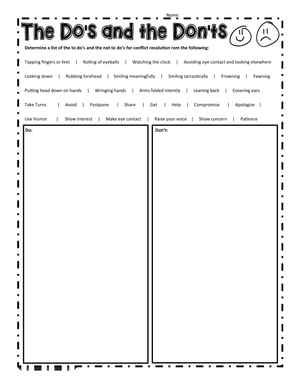
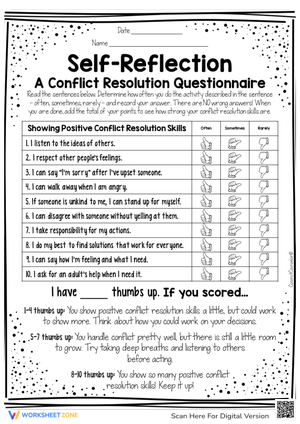
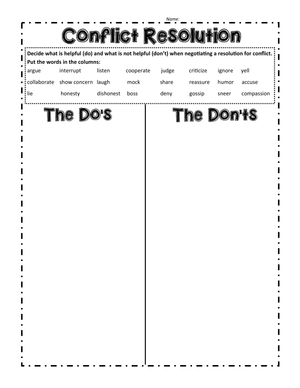
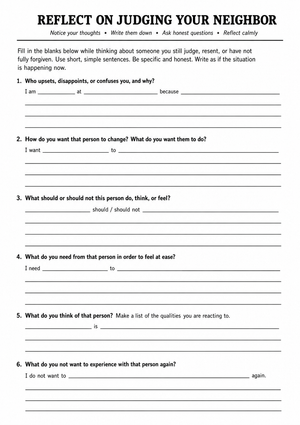
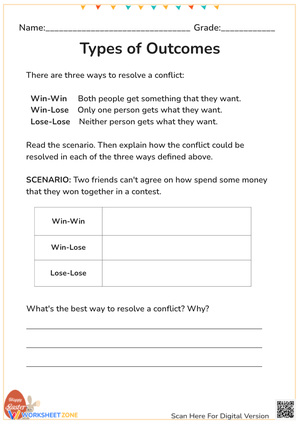
These 11th grade conflict resolution worksheets set teachers up with print-ready, targeted activities for one of the most practically important social-emotional skill areas at the high school level — interpersonal disputes with real professional and social stakes. The scenarios inside reflect the actual texture of junior-year life: friction with a part-time supervisor who keeps reassigning shifts without notice, a senior group project where one member goes silent in the final week, or a misread text exchange that fractures a friendship held since eighth grade.
The Skills These Worksheets Build
Four distinct skill areas, each addressed by its own worksheet type. Scenario analysis worksheets present realistic conflict situations and walk students through identifying the root cause, naming the emotions on each side, and writing a resolution plan that accounts for what both parties actually need — not just what the winning party wants. I-statement worksheets move students from accusatory phrasing to needs-based language through structured conversion exercises: a prompt gives them a blame-heavy sentence and asks them to rewrite it. The shift from "You always ignore my suggestions" to "I feel overlooked when my input gets skipped without discussion" takes genuine repetition to internalize, and the worksheets build that repetition deliberately across multiple exercises with escalating emotional stakes.
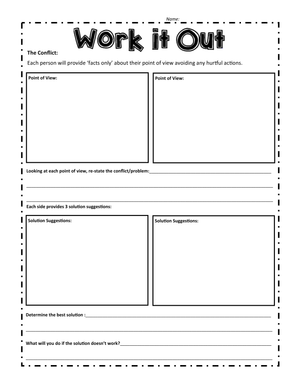
Perspective-taking worksheets require students to write out a single conflict from at least two distinct viewpoints before proposing any resolution — a structural requirement that forces them to slow down and genuinely consider the other party's position. De-escalation worksheets address what happens before the conversation even starts: students map their own physiological anger signals, identify personal triggers, and commit to a calming strategy they will use before entering a high-stakes discussion. That sequencing matters. Students who skip internal regulation and jump straight to communication techniques tend to deploy those techniques at the wrong emotional moment, which makes them less effective than silence.
Mistakes Students Make That These Worksheets Help You Catch
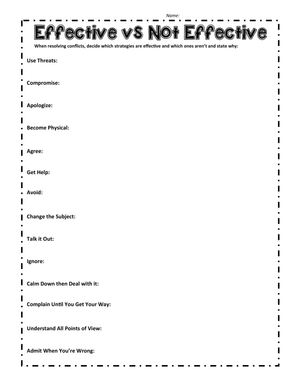
The most persistent error at this level isn't ignorance of conflict resolution vocabulary — most 11th graders can define "active listening" and "empathy" without difficulty. The problem is zero-sum default thinking. Students who write fluent, textbook-accurate analyses of a fictional conflict still tend to propose solutions that favor one party entirely when they are emotionally invested in the scenario. You see it clearly when a student correctly diagnoses a conflict as a "communication breakdown" and then writes a resolution that amounts to: the other person should apologize and change their behavior. The scenario analysis worksheets push back on this by requiring students to articulate what each party needs before proposing any solution — a step that is easy to bypass without a structured prompt requiring it.
A second consistent pattern: students who write technically correct I-statements on paper but abandon the format the moment they roleplay the same scenario aloud. The worksheet performance and the live behavior stay disconnected until there are enough repetitions for the new phrasing to cross over into conversational habit. One worksheet rarely gets you there. That is the reasoning behind including multiple I-statement practice worksheets in the set, each built around a different type of conflict — the stakes and the social relationships shift from worksheet to worksheet so students are applying the same skill in genuinely different contexts.
Building These Worksheets Into Your Lesson Planning
Advisory and homeroom blocks are the most natural home for 11th grade conflict resolution worksheets — a 15-minute period accommodates one worksheet comfortably: five minutes of framing, ten minutes of independent work, a short partner check at the end. Running one worksheet per week across a month gives students spaced practice across all four skill areas without pulling time from core academic classes or requiring a dedicated SEL course.
School counselors running small groups find the de-escalation and perspective-taking worksheets particularly useful as structured starting points for sessions where a real interpersonal issue is already present. The worksheet gives students something concrete to write toward, which reduces the pressure of a blank conversation and keeps the session focused on skills rather than grievances. English teachers working through The Crucible or A Raisin in the Sun regularly use the perspective-taking worksheets as literary analysis tools — students apply the same conflict analysis framework to characters that they are building for their own lives, and the transfer is more visible than most teachers anticipate.
One approach that generates strong student investment: asking juniors to submit anonymized conflict scenarios drawn from their own experience at the start of the unit, then anchoring at least one worksheet discussion around those submitted situations. When students recognize the texture of their own social world in a scenario prompt, the work carries a different weight than when every example involves someone else's problem.
Differentiating the Set Across Readiness Levels
For students who need more support, the scenario analysis worksheets work best when the teacher pre-identifies one of the emotions involved and notes it in the margin before distributing — this reduces the cognitive load of the emotion-naming step so the student's energy goes toward the resolution process itself. For students who find the standard scenarios too straightforward, the extension move is to complicate the scenario: add a power differential (one party has authority over the other), add a time constraint, or require the student to propose a resolution that remains workable even if the other party refuses to engage. That last constraint is genuinely difficult and produces the most substantive written work in the set.
Students who struggle with written expression can complete the perspective-taking and I-statement activities orally, with a partner recording key phrases. The thinking and the skill practice stay intact; only the documentation method shifts. For multilingual learners, the sentence-frame activities provide the most reliable entry point because the linguistic structure is explicitly laid out, and students are practicing a new communication pattern rather than generating one without support.
Standard Alignment
These worksheets align directly with CASEL's relationship skills and responsible decision-making competency areas — the two CASEL domains most school counselors and SEL coordinators prioritize at the 11th grade level. The active listening and I-statement worksheets also address CCSS.ELA-LITERACY.SL.11-12.1, which requires students to initiate and sustain collaborative discussions, respond thoughtfully to diverse perspectives, and resolve contradictions through reasoning. That standard often gets treated narrowly as a participation requirement in Socratic seminars, but it carries a real interpersonal skills dimension — one that classroom discussion alone rarely develops as explicitly as these worksheets do.
Frequently Asked Questions
What order should I introduce these worksheets in?
Start with de-escalation and self-awareness before moving into communication skills. Students who have not mapped their own anger responses bring unexamined reactivity into I-statement practice and perspective-taking exercises, which undermines both. A reliable sequence: de-escalation first, I-statements second, perspective-taking third, scenario analysis and full resolution planning last. That order moves from internal regulation to interpersonal communication to full conflict resolution — which mirrors the actual sequence these skills need to be used in real situations.
What do I do if a student's written response reveals a serious real-world conflict or safety concern?
Before distributing any worksheet in this set, be explicit with students that if their written responses indicate a safety concern — for themselves or someone else — you will follow your school's mandatory reporting protocol. Most students who are processing something serious through a writing prompt actually want a trusted adult to notice. Having a clear protocol established before the first worksheet matters far more than any specific activity design choice.
Can a school counselor run these activities in small groups rather than a full class?
Small-group use often produces stronger outcomes than whole-class delivery. Each worksheet in the set works as a standalone activity, so counselors can select specific skills to address based on what a group needs rather than running the full sequence. The 11th grade conflict resolution worksheets format makes it easy to print only the relevant activity for a given session without distributing the entire set. Groups of four to six students typically give everyone enough airtime to share their written responses aloud — which is where the real consolidation of skill tends to happen, not in the independent writing itself.
How do I handle it when a class discussion after a worksheet becomes heated?
That moment is the most instructive one in the lesson. When a discussion about a conflict scenario starts to feel like a real conflict, you have live data about which students are applying the skills and which ones are defaulting to their baseline patterns. Naming what is happening — "Notice we just hit the exact moment these worksheets are preparing you for" — redirects the energy productively and models the metacognitive awareness that conflict resolution education is ultimately trying to build. The 11th grade conflict resolution worksheets set is most effective when teachers treat heated moments as the application layer of the lesson rather than a disruption to contain.












 Interactive Worksheet Maker
 Quiz Maker
 Word Search Maker
 Crossword Puzzle Maker
 Word Scramble Generator
 Sentence Scramble Generator
 Handwriting Worksheet Generator
 Name Tracing Generator
 Fill In The Blank Generator




 BACK TOSCHOOL