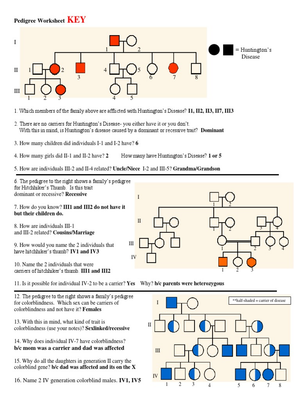
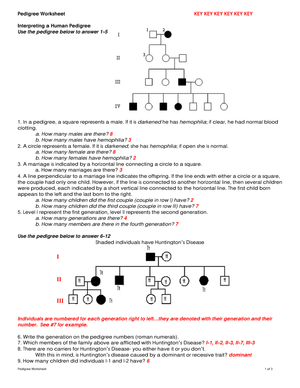
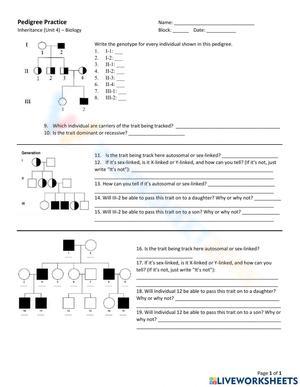
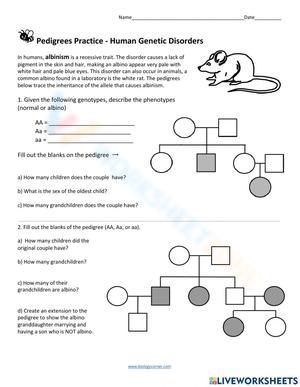
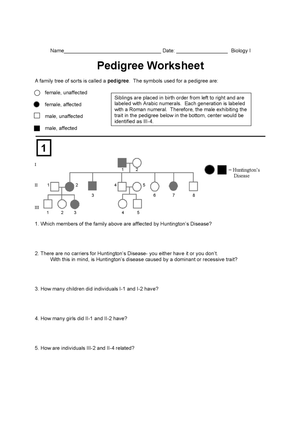
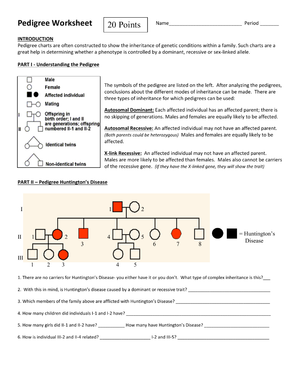
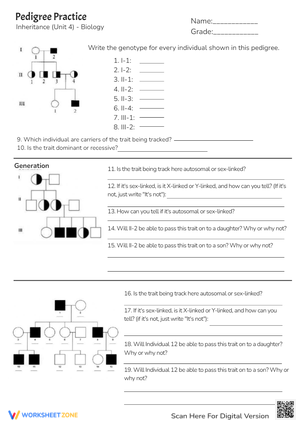
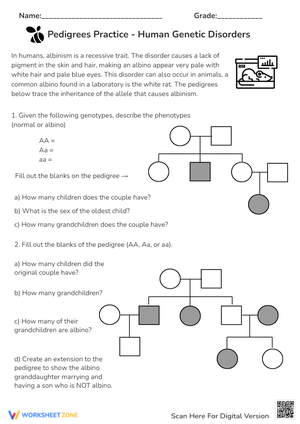
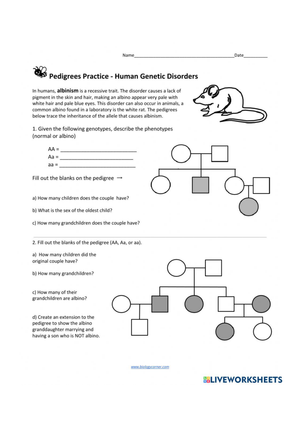
These 10th grade pedigree pdf worksheets give genetics teachers a ready set of family-tree problems that move students from basic symbol reading into evidence-based inheritance analysis. Each worksheet uses standard pedigree conventions — circles and squares, shading for affected individuals, horizontal bars for matings — and asks students to do something with that information: assign genotypes, identify carriers, and determine which inheritance pattern the family data actually supports.
The Specific Skills These Worksheets Target
Pedigree analysis asks students to hold several things in mind at once: visual decoding, trait vocabulary, genotype logic, and pattern recognition across generations. That cognitive demand is real, and it explains why many students who handle Punnett squares confidently still stall when the same genetics content is embedded in a multi-generation family tree. These worksheets address each component directly rather than treating the pedigree as a single undivided skill.
- Reading standard pedigree symbols — identifying sex, trait expression, and family structure before attempting any genetics questions
- Assigning genotypes — writing definite genotypes for individuals whose status is certain, and possible genotypes where the pedigree leaves ambiguity
- Distinguishing carriers from affected individuals — a distinction students frequently collapse, especially with recessive traits
- Identifying inheritance patterns — determining whether a trait is autosomal dominant, autosomal recessive, or X-linked based on distribution across generations and sexes
- Written justification — explaining which specific pedigree observations support the pattern, not just circling a label
The written justification component matters more than it might initially seem. When a student writes "the trait must be recessive because two unaffected parents produced an affected child in Generation II," a teacher can assess actual reasoning rather than a lucky guess. That's the kind of student work that shapes what comes next in the lesson.
Student Errors Worth Anticipating Before You Hand Out the Pedigree
The most persistent error in 10th-grade pedigree work is conflating "carrying an allele" with "expressing the trait." Students see a heterozygous individual described as a carrier and immediately want to shade that circle or square. They have internalized "having the allele = affected," which is exactly backward for recessive traits. Worksheets that include explicit carrier questions — and require students to explain why a carrier remains unaffected — surface this misunderstanding in a way a multiple-choice test simply will not.
A second pattern involves inheritance-type shortcuts. Students frequently decide dominant vs. recessive after examining only one generation. They spot an affected child with two unaffected parents, correctly call it recessive, and then try to apply that same reasoning to an autosomal dominant pedigree where the affected parent is heterozygous — and they stall because "some children don't have it." Teaching students to survey the entire family tree before drawing a conclusion takes deliberate repetition. A well-built worksheet enforces that habit by placing the inheritance-pattern question at the end, after genotype and relationship questions have already required students to read every generation carefully.
X-linked patterns introduce a third category of errors. Students who correctly understand that sex linkage means the gene sits on the X chromosome will still predict that all daughters of an affected father must be affected, forgetting the mother's allele contribution entirely. A pedigree showing a carrier mother paired with an unaffected father — producing a mix of affected and unaffected sons — breaks that assumption more efficiently than any explanation alone.
Fitting These Worksheets Into Your Genetics Unit
Most 10th-grade genetics units introduce vocabulary and Mendelian ratios before reaching pedigrees, which means students arrive at pedigree work with some background but very little practice reading family data. That gap makes the first pedigree worksheet most effective as a guided whole-class activity rather than an independent assignment. Modeling the annotation process aloud — circle the affected individuals, label the generations, identify all known relationships — before releasing students to work independently reduces careless errors significantly. Students who build that annotation habit on the first worksheet carry it forward automatically. Research from the University of Utah Genetic Science Learning Center reinforces what teachers see in practice: students who actively mark up a pedigree before answering questions identify patterns more accurately than those who attempt to read and reason simultaneously.
For daily pacing, a short two- or three-question pedigree works well as a bell ringer in the five to eight minutes before attendance and announcements. Longer worksheets with mixed question types fit station rotations — one station for pedigree analysis, another for Punnett square crosses, a third for trait vocabulary review. When a unit assessment is approaching, pulling one pedigree from the set and pairing it with a few open-response questions gives students realistic test practice without requiring a new document entirely. The PDF format also makes these dependable sub-plan materials: a substitute can distribute the worksheet and follow a short direction sheet without needing to explain inheritance patterns from scratch.
Adjusting the Worksheets Across Ability Levels
The same pedigree can serve students at different readiness levels with focused adjustments to the questions and support materials rather than to the family tree itself. Students still learning the symbols benefit from a reference card showing standard shapes and shading conventions paired with a shorter family tree spanning two generations rather than three or four. The task for those students centers on reading the visual accurately — naming relationships, identifying who is affected — before any genetics reasoning is introduced.
Students who are comfortable with the basics move to genotype assignment, where the work involves reasoning backward from an affected individual to determine what each parent must carry. That inference process is where the genuine genetics thinking happens, and it does not require a more complicated pedigree — just questions that demand more precision in the answer.
For students ready for the most demanding work, the strongest questions ask them to compare two possible inheritance patterns and rule one out using specific evidence. For example: "Could this trait be X-linked dominant? Cite two observations from the chart that support or eliminate that possibility." Those open-response prompts produce writing that reveals whether a student understands inheritance logic or is pattern-matching from a formula. Having 10th grade pedigree pdf worksheets at multiple complexity levels inside one downloadable set keeps the class on the same genetics topic simultaneously — which matters for pacing and for whole-class debriefs.
Standard Alignment
These worksheets align most directly with NGSS HS-LS3-3: "Apply concepts of statistics and probability to explain the variation and distribution of expressed traits in a population." In classroom terms, that standard asks students to move beyond memorizing ratios and actually reason about why traits appear at different frequencies across a family. Pedigree analysis is the clearest instructional vehicle for that standard at the 10th-grade level because it requires students to use real family data — not hypothetical Punnett square calculations — to support a claim about inheritance.
NGSS HS-LS3-1 is also relevant. Students examining a pedigree are working through exactly the questions that standard targets: how chromosomal inheritance explains which traits pass from parents to offspring and why some individuals are affected while others carry the same allele without expressing it.
Frequently Asked Questions
Do students need Punnett square experience before working on pedigrees?
Prior exposure to dominant and recessive traits and basic genotype notation helps considerably. Students who have not yet worked with heterozygous vs. homozygous notation will struggle when a worksheet asks them to assign possible genotypes. That said, 10th grade pedigree pdf worksheets that open with symbol identification and relationship questions can function as an introduction to family-tree format before genotype reasoning is introduced — as long as those foundational questions come first in the sequence and genotype prompts come later.
What is the most effective way to check student work on pedigree questions?
For genotype questions, a brief whole-class debrief works better than individual grading. Project the pedigree and walk through the logic step-by-step — which individuals are definitely homozygous recessive, which must carry at least one recessive allele, which are genuinely ambiguous. Students catch their own errors during that discussion more reliably than when they receive a marked paper the following day. For written justification questions, spot-checking four or five responses per class gives enough information to decide whether the concept needs another round of instruction.
How does pedigree work connect to broader genetics assessment at the 10th-grade level?
Pedigree items appear regularly on end-of-course biology exams and state assessments that follow NGSS-aligned frameworks. The format requires students to apply genetics reasoning to unfamiliar data rather than recall a memorized definition, which is precisely the type of question those assessments emphasize. Using pedigree worksheets throughout the unit — rather than saving them for the week before the test — builds the pattern-recognition fluency students need to work through a new family tree accurately under timed conditions.
Can these worksheets be assigned digitally rather than printed?
PDF worksheets function on any device that supports annotation — tablets with a stylus, Chromebooks with a PDF reader, or a Google Classroom assignment with annotatable copies enabled. The fixed layout keeps pedigree symbols and spacing intact regardless of device, so students marking up the family tree digitally replicate the same annotation practice that improves accuracy on paper.












 Interactive Worksheet Maker
 Quiz Maker
 Word Search Maker
 Crossword Puzzle Maker
 Word Scramble Generator
 Sentence Scramble Generator
 Handwriting Worksheet Generator
 Name Tracing Generator
 Fill In The Blank Generator