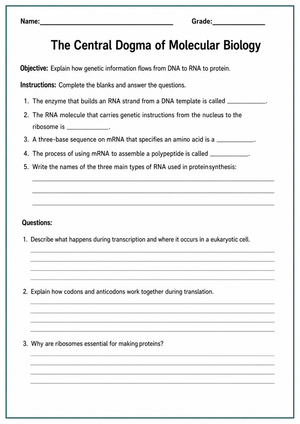
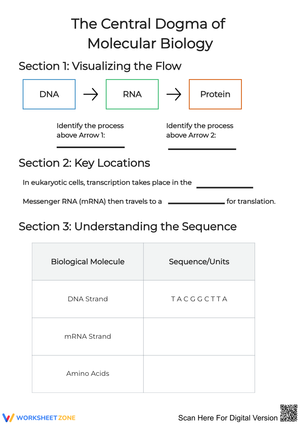
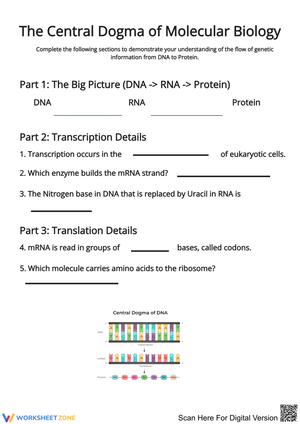
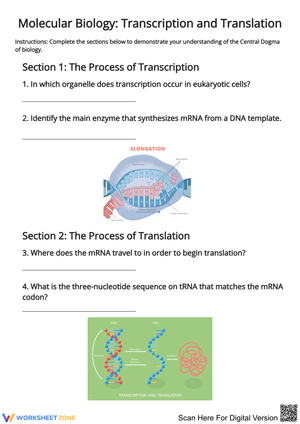
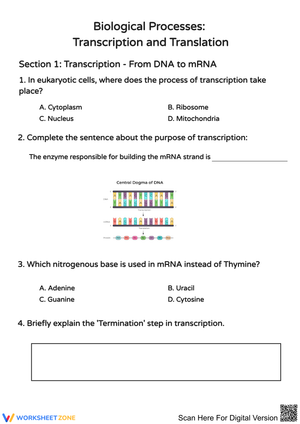
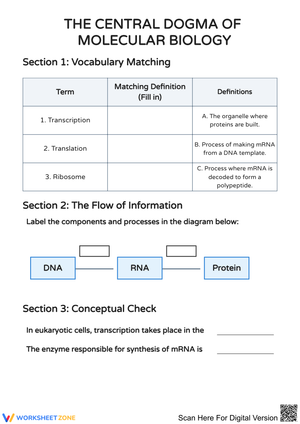
These central dogma worksheets for 10th grade give biology teachers a structured, ready-to-use set of activities covering DNA replication, transcription, and translation — the three molecular processes students must master before the curriculum moves into gene regulation, heredity, or biotechnology. Each worksheet targets a distinct stage of the pathway so teachers can assign them in sequence or pull individual ones to match exactly where the class is on a given week.
The Specific Skills Targeted Across the Set
The worksheets distribute practice across the full central dogma pathway without asking students to hold all three processes in working memory at once. Replication worksheets focus on the mechanics of helicase unwinding, complementary base pairing, and the directionality of DNA polymerase. Transcription worksheets move students through identifying the template strand, writing the mRNA sequence, and locating the process inside a cell diagram. Translation worksheets center on codon-table reading: given an mRNA sequence, students work codon by codon to build the amino acid chain, marking start and stop signals as they go.
Two worksheet types in the set go beyond single-process practice. Mutation analysis activities give students a normal DNA sequence and a mutated version side by side; they transcribe and translate both, then explain how the substitution, insertion, or deletion changes — or fails to change — the resulting protein. Sequencing activities present the steps of all three processes scrambled and ask students to restore the correct order, which is a fast but surprisingly revealing check on whether students understand the overall information flow or have only memorized isolated vocabulary.
Where These Worksheets Fit in the Instructional Sequence
The diagram-labeling and vocabulary worksheets work well as the first two days of the unit — use them before any codon-table work, not alongside it. Cognitive load research is clear that students who are still sorting out where transcription ends and translation begins will make systematic errors on translation problems that have nothing to do with their ability to read a codon table. Separating the stages by at least one class period gives students time to consolidate the location and direction of each process before adding the decoding layer.
The codon-table worksheets are strong candidates for the 8–10 minutes before the end of a period, once direct instruction is finished — short enough that students can complete a 4–6 codon sequence and check it before the bell, long enough that the practice is meaningful. Mutation analysis worksheets, by contrast, need a full period; the comparison step is where the real reasoning happens, and rushing it produces superficial answers.
One classroom move worth building in: after students complete a diagram worksheet, ask them to annotate one or two steps with a written reason — not just the label, but why. A student who writes "RNA polymerase reads 3' to 5' so the new mRNA strand grows 5' to 3'" has revealed something a correctly filled blank never could. That annotation also gives the teacher a fast formative read at the start of the next class.
Frequent Student Errors Worth Watching For
The most consistent error in student work is conflating the template strand with the coding strand during transcription. Students who correctly write the complementary mRNA sequence will sometimes compare it to the wrong DNA strand when checking their work and conclude they made a mistake — then introduce an actual error by changing a correct answer. A brief note on the worksheet directing students to compare their mRNA only to the template strand (marked explicitly) prevents most of this confusion without giving the answer away.
On codon-table problems, students frequently forget that the codon table uses mRNA codons, not DNA codons. A student who skips the transcription step and reads directly from the DNA template will produce a sequence full of thymine — which has no entry on the codon chart — and stall out. The fix is structural: worksheets that require students to write out the full mRNA sequence on a dedicated line before touching the codon table reduce this error substantially because there is no shortcut available.
Frameshift mutations trip up even students who handle substitution mutations accurately. They understand that one wrong amino acid may result from a point substitution, but they underestimate the downstream disruption of an insertion or deletion. Showing a concrete worked example — inserting a single nucleotide early in a 15-codon sequence and asking students to translate both versions — makes the cascade effect visible in a way that a definition alone does not.
Standard Alignment
These worksheets align to NGSS HS-LS1-1, which asks students to construct an explanation for how the structure of DNA determines the structure of proteins that carry out the essential functions of life. At the 10th grade level, this standard is typically addressed as a foundational unit before HS-LS3 (heredity) and HS-LS4 (natural selection), making it one of the first places in high school biology where students connect molecular-level events to organism-level outcomes. The mutation analysis worksheets in particular support the explanatory reasoning this standard requires — students are not just describing what happens but tracing cause and effect from a nucleotide change to a protein change to a possible phenotypic result.
Frequently Asked Questions
How many worksheets are in the set, and can I use them independently?
Each worksheet in the set is a standalone activity. Teachers regularly use individual worksheets as warm-ups, formative checks, or sub plans without working through the full set in order. The replication, transcription, and translation worksheets are sequenced to build on each other, but the mutation analysis and sequencing activities can be dropped in wherever they fit the unit timeline.
Do students need to have the codon table memorized before using these worksheets?
No — and they should not be expected to. The codon-table worksheets are designed to be used with a standard mRNA codon chart in hand. The skill being practiced is reading the table accurately and applying it in sequence, not recall. Students who use the chart consistently during practice develop fluency with it over several class periods without explicit memorization drills.
Are these worksheets appropriate for an honors or AP-preparatory 10th grade course?
The core worksheets align to standard 10th grade expectations. Honors and pre-AP students will move through the base activities faster and benefit most from the mutation analysis worksheets and the open-ended extension prompts, particularly the retrovirus reverse-transcription question, which introduces the exception to the standard DNA → RNA → Protein directionality and gives students something genuinely interesting to wrestle with.
What is the most common misconception these worksheets are built to address?
The location problem — students regularly place transcription and translation in the wrong cellular compartment, or collapse them into a single process. Several worksheets include a cell cross-section diagram where students mark the site of each process, which forces explicit attention to the nucleus-versus-cytoplasm distinction. This single structural choice addresses the error more reliably than re-explaining it in lecture.












 Interactive Worksheet Maker
 Quiz Maker
 Word Search Maker
 Crossword Puzzle Maker
 Word Scramble Generator
 Sentence Scramble Generator
 Handwriting Worksheet Generator
 Name Tracing Generator
 Fill In The Blank Generator