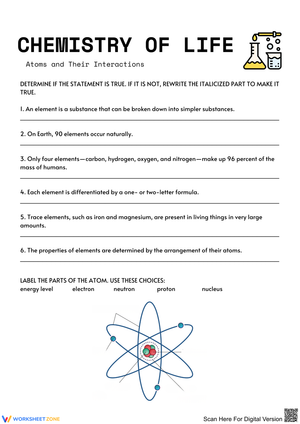
These 10th grade chemistry of life printable worksheets hand students the visual practice they need to make sense of molecules they will never see with the naked eye — labeling water's partial charges, sorting the four macromolecule classes, and tracing what happens to an enzyme when the pH drops. The set covers polarity, carbon bonding, monomers and polymers, and enzyme function, with diagrams students annotate rather than blocks of text they passively read.
What Each Worksheet Asks Students to Do
Biochemistry is where tenth-grade biology stops being descriptive and starts being mechanistic. Students who were comfortable naming cell parts suddenly have to explain why a phospholipid lines up the way it does, and that shift trips up a lot of them. These worksheets break the unit into the pieces that carry the heaviest conceptual load.
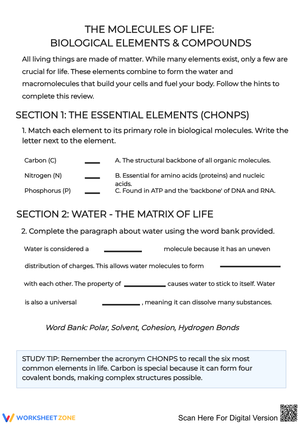
- Properties of water — labeling partial charges on a molecule, marking hydrogen bonds between neighboring molecules, and connecting cohesion and adhesion to capillary action in plants.
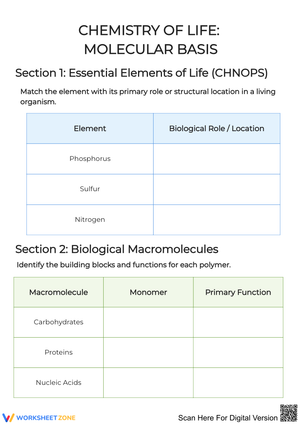
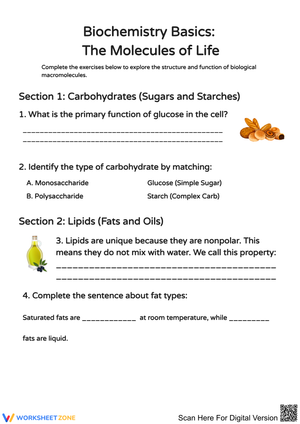
- Carbon and macromolecules — distinguishing carbohydrates, lipids, proteins, and nucleic acids by their monomers, then matching a glucose ring or a fatty acid tail to its job in the cell.
- Dehydration synthesis and hydrolysis — diagramming where the water molecule leaves or enters when monomers bond, which is the step students most often skip.
- Enzymes — labeling lock-and-key and induced-fit models, identifying the active site, and predicting what denaturation does to function.
- Data reading — interpreting a graph of enzyme activity across temperature or pH and explaining the curve, not just reading a single point off it.
Frequent Student Errors Worth Watching For
The mistakes here are predictable, and watching for them changes how you grade. Students routinely confuse the polarity of water with charge, writing that one end of the molecule is "positive" as if it carried a full proton instead of a partial charge. The greek prefixes get tangled too — they read "polysaccharide" and "monosaccharide" but can't tell you that the difference is the number of sugar units.
The biggest one shows up around dehydration synthesis. A student will correctly draw two monomers, then bond them without removing water, or remove water during hydrolysis instead of adding it. They have memorized the vocabulary and missed the chemistry. Enzymes bring their own trouble: students treat "denatured" as a synonym for "used up," so they'll write that an enzyme is destroyed permanently after one reaction, missing that enzymes are reusable and that denaturation is about shape loss from heat or acidity. When a worksheet asks them to explain a flat line at high temperature on an enzyme graph, the weak answers say "it stopped working" with no mention of the protein unfolding. Catching that gap early is worth more than any unit test result a week later.
Working These Into Your Week
The 10th grade chemistry of life printable worksheets do their best work as short formative checks at the close of a lesson rather than as overnight homework you grade in bulk. Hand out a half-length macromolecule sheet in the last ten minutes, collect them, and you walk in the next morning knowing exactly who still can't separate a fatty acid from an amino acid. That immediate read keeps a fast unit from leaving a third of the class behind.
Pairing the worksheet with a physical model is where the abstract concepts settle. Have students finish a sheet on macromolecule structure, then build a dipeptide or a nucleotide from paper cutouts or a modeling kit using the labels they just practiced. The act of physically pulling out a "water" piece during bonding makes dehydration synthesis stick in a way a diagram alone rarely does. Colored pencils help more than they should — asking students to shade carbon one color and oxygen another forces them to actually look at the structure instead of glancing past it. The Biology Corner's cell biology and chemistry materials pair well as extra diagram practice when a student needs another pass.
Adjusting the Set for a Range of Learners
For students who need more support, the partially labeled diagrams and a word bank let them focus on the relationships rather than stalling on recall. A sheet that already names the active site lets a struggling student spend their effort explaining what the active site does. Stronger students get extension prompts that push past identification: predict how a single amino acid substitution would change a protein's folded shape, or explain why raising temperature speeds an enzyme reaction up to a point and then collapses it. These tenth-grade resources hold up for review too — students heading into AP Biology or anatomy use the clean diagrams to rebuild a foundation they half-remember.
Standard Alignment
These worksheets align with NGSS HS-LS1-6, which asks students to construct and revise an evidence-based explanation for how carbon, hydrogen, and oxygen from sugar molecules combine with other elements to form amino acids and other large carbon-based molecules. The macromolecule and dehydration synthesis sheets give students the structural practice that standard expects — they are not just naming molecules, they are tracing how smaller subunits assemble into larger ones and where the energy goes. The 10th grade chemistry of life printable worksheets also build the science practices of developing and using models and obtaining information from diagrams, since nearly every sheet requires reading a structure and explaining it in words.
Frequently Asked Questions
What topics do these worksheets cover?
The set covers the properties of water — polarity, hydrogen bonding, cohesion, adhesion, and high specific heat — along with the structure and function of carbohydrates, lipids, proteins, and nucleic acids. Carbon's role in forming four covalent bonds and the mechanics of enzymes and activation energy round out the unit.
Are these better as homework or in-class work?
They work best in class as quick formative checks. Because biochemistry builds fast and each concept depends on the last, you want to see student work the same day so a misconception about monomers doesn't quietly carry into the genetics unit. Using the 10th grade chemistry of life printable worksheets as exit tickets gives you that read before the gap widens.
How do I teach macromolecules so they stick?
Put the structures side by side and have students compare rather than memorize in isolation. A graphic organizer that sorts monomer, polymer, function, and example for all four classes does more than four separate definition lists. Follow the comparison with a hands-on build so students physically assemble a polymer from monomers.
Can these be used to review before a later course?
Yes. The diagrams and explanations make the resources useful for students who need a refresher before AP Biology or anatomy, even though they're written for the standard tenth-grade biology sequence.












 Interactive Worksheet Maker
 Quiz Maker
 Word Search Maker
 Crossword Puzzle Maker
 Word Scramble Generator
 Sentence Scramble Generator
 Handwriting Worksheet Generator
 Name Tracing Generator
 Fill In The Blank Generator