




























Views
Downloads

Essential DNA Transcription Worksheet | Grade 9-12 Biology

Paste this activity's link or code into your existing LMS (Google Classroom, Canvas, Teams, Schoology, Moodle, etc.).
Students can open and work on the activity right away, with no student login required.
You'll still be able to track student progress and results from your teacher account.
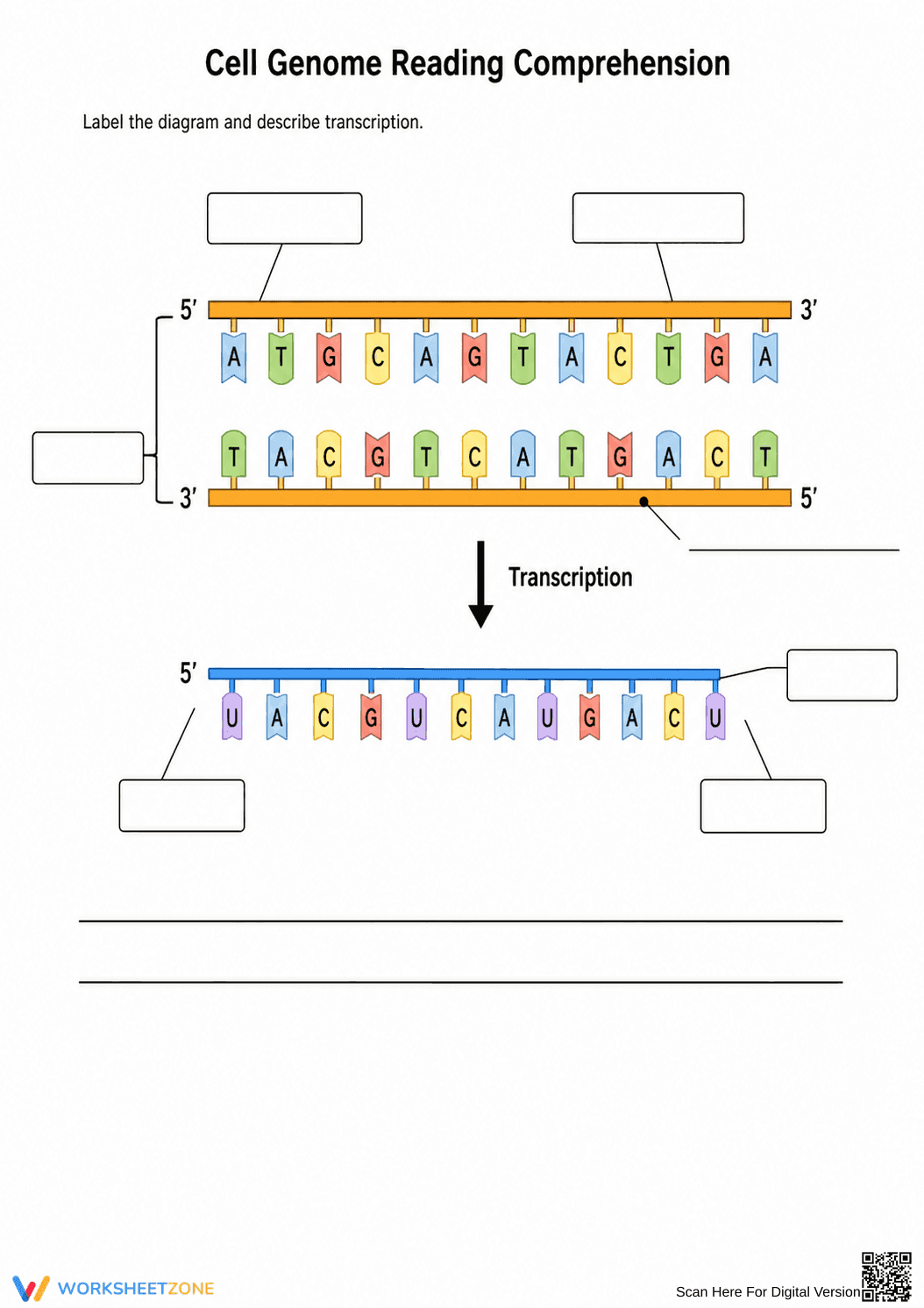
This high school biology worksheet provides a focused visual exercise on the transcription phase of protein synthesis. Students demonstrate their understanding of the central dogma by identifying DNA and RNA components and explaining how genetic information flows from the genome. It ensures students grasp the critical relationship between nucleotide sequences and mRNA formation.
At a Glance
- Grade: 9-12 · Subject: Biology
- Standard:
HS-LS1-1— Explain how DNA structure determines protein structure and essential cell functions- Skill Focus: DNA Transcription & Labeling
- Format: 1 page · 8 tasks · Answer key included · PDF
- Best For: Formative assessment or visual review
- Time: 15–20 minutes
The worksheet features a high-resolution diagram of a DNA double helix undergoing transcription into a single-stranded RNA molecule. It includes 7 specific labeling boxes targeting the 5' and 3' ends, template strands, and the resulting transcript. A dedicated writing space at the bottom allows students to synthesize their knowledge into a coherent technical description of the process.
This resource is designed for a zero-prep classroom workflow. Teachers can print the single-page PDF in less than 1 minute. Distribution takes seconds during a transition period. Because the diagram is self-explanatory, students can begin working immediately, allowing the instructor to review the completed labels and descriptions in under 5 minutes. It serves as an ideal printable activity for sub plans or quick checks for understanding.
Aligned to `HS-LS1-1`, this activity requires students to construct an explanation based on evidence for how the structure of DNA determines the structure of proteins. By labeling the specific base pairings (A-U, G-C) and the directionality of the strands, students provide the structural evidence needed to explain gene expression. This standard code can be copied directly into lesson plans, IEP goals, or district curriculum mapping tools.
Use this worksheet as a mid-lesson check after introducing the role of RNA polymerase. It functions well as a visual aid to a lecture, where students fill in the labels as the teacher explains the diagram on the board. For formative assessment, observe if students correctly identify the uracil (U) bases in the RNA strand versus thymine (T) in DNA. Expect completion in 15 to 20 minutes.
This resource is tailored for Grade 9-12 biology students, including those in Honors or AP Biology tracks who need a refresher on molecular directionality. It provides visual scaffolding for English Language Learners through the use of color-coded base pairs. Pair this worksheet with a DNA-to-Protein anchor chart or a short video clip of molecular machinery in action.
According to research by Fisher & Frey (2014) on the gradual release of responsibility, visual scaffolds like this transcription diagram are essential for moving students from guided instruction to independent mastery of complex biological systems. The worksheet addresses the HS-LS1-1 standard by requiring students to translate visual data into a written explanation of gene expression. By focusing on the specific mechanics of how cells read the genome, the activity reinforces the 8 tasks necessary to identify the template strand and the resulting mRNA sequence. This structured approach ensures that students do not just memorize terms but understand the spatial and chemical logic of molecular biology. Such targeted practice is a hallmark of high-quality science instruction, providing the evidence-based practice required for long-term retention of the central dogma of biology.


