10th Grade Translation Worksheets for Biology Practice
Translation is the process of using an mRNA sequence to build a polypeptide at the ribosome. Sources such as the National Human Genome Research Institute, Khan Academy, OpenStax Biology 2e, and YourGenome all present translation as part of the larger DNA-to-protein pathway. For Grade 10 biology, that means worksheets should help students connect transcription and translation without blending the two into one confusing task.
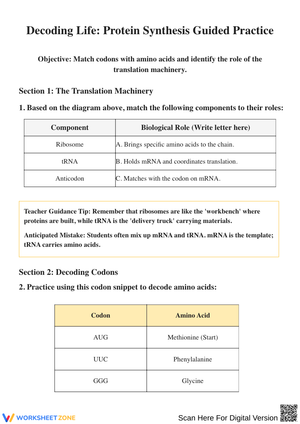
The strongest classroom materials usually combine three elements: labeled diagrams, sequence decoding, and short reasoning prompts. Instead of giving students a page of definitions only, teachers can use a worksheet sequence that asks them to identify codons and anticodons, match mRNA to amino acids, and explain how a protein chain is assembled. This approach supports both review and assessment.
What Effective Translation Worksheets Should Include
When teachers choose or create 10th grade translation worksheets, it helps to look for tasks that match the main concepts students need to master. Translation practice is most useful when it goes beyond one isolated skill and shows how the system works together.
- Core vocabulary practice: codon, anticodon, tRNA, ribosome, amino acid, start codon, and stop codon.
- Diagram labeling: students identify where mRNA, tRNA, and the ribosome appear in the process.
- Codon chart use: students read mRNA codons and select the correct amino acids.
- Sequence work: students translate a short mRNA strand into an amino acid chain.
- Error analysis: students find where a translation step went wrong and correct it.
- Transcription contrast: students explain how making mRNA differs from building a protein.
This mix matters because students often do fine with vocabulary matching but struggle when they must apply those terms in a sequence. A worksheet that includes only definitions may look complete, but it does not always show whether students can perform the decoding process on their own.
High-Value Worksheet Formats for Biology Class
Several worksheet formats work especially well for translation lessons in Grade 10. Teachers can use one format for direct instruction or combine them into a short practice set.
Codon-Chart Decoding Sheets
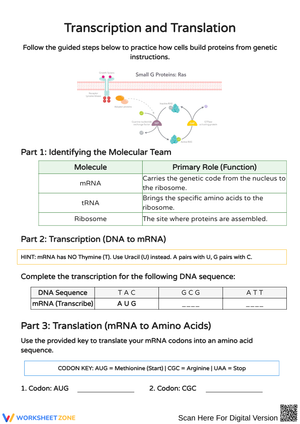
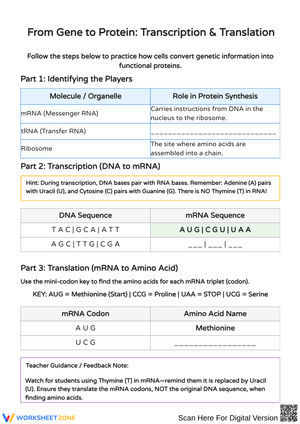
These are often the most direct way to check whether students understand translation. Students receive an mRNA sequence, use a codon table, and write the amino acid sequence. This format is simple, but it reveals a lot. If a student reads DNA instead of mRNA, skips the start codon, or treats a stop codon like an amino acid, the misunderstanding becomes easy to spot.
Label-and-Explain Diagrams
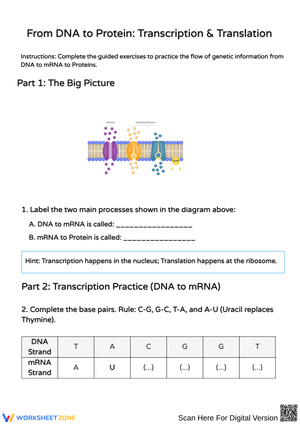
Visual worksheets ask students to label parts such as the ribosome, mRNA, tRNA, codon, and anticodon. A short written explanation under the diagram can then ask what is happening at that moment in translation. This is useful for students who need a concrete image of the process before they can decode a sequence accurately.
Paired Transcription and Translation Practice
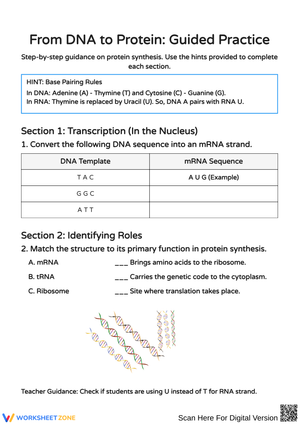
A standard classroom progression is DNA to mRNA by transcription, then mRNA to protein by translation. A paired worksheet can begin with a DNA sequence, ask students to transcribe it into mRNA, and then translate the mRNA into amino acids. This structure helps students keep the two processes separate while still seeing how they connect.
Mutation and Error Analysis Tasks
Challenge items can ask what happens if one mRNA codon changes or if the start codon is missing. These questions push students to think beyond answer-finding and toward explanation. They also work well for small-group discussion or quick written checks.
Classroom Implementation
Teachers can use translation worksheets across a full lesson cycle instead of saving them only for review day. A short bell-ringer might ask students to identify a codon and anticodon pair. During guided practice, students can complete one translation sequence together while the teacher models how to read the codon chart carefully. Independent work can then include two or three new sequences, a labeled diagram, and one comparison question about transcription versus translation.
For lab-style or station-based classes, one station can focus on vocabulary, another on codon-chart practice, and another on error analysis. This keeps the work active without requiring extra materials. In a digital classroom, the same structure can be used with fillable worksheets or slides, especially if students need immediate feedback on sequence decoding.
One practical move that helps many Grade 10 students is to require them to mark every sequence in groups of three before they look at the codon chart. This small routine reduces random errors, keeps students from sliding across the mRNA strand one base at a time, and makes it easier for teachers to see whether the problem is grouping, chart use, or concept confusion.
Exit tickets can be even shorter. Ask students to translate one mRNA sequence, identify the role of tRNA, or explain why translation happens at the ribosome. These quick checks help teachers decide whether students are ready for more complex protein synthesis tasks.
How Worksheets Support Common Student Challenges
Translation can feel mechanical to students at first, but their mistakes often show deeper confusion. A targeted worksheet helps teachers diagnose those issues quickly.
- Confusing transcription with translation: include a side-by-side question that asks what product each process makes.
- Reading the wrong molecule: provide both DNA and mRNA and ask students to identify which one is used during translation.
- Ignoring start and stop codons: build in prompts that ask where translation begins and ends.
- Mixing up codon and anticodon: use paired examples where students label each clearly.
- Skipping vocabulary meaning: combine decoding tasks with short sentence explanations.
According to the source materials from Khan Academy and OpenStax Biology 2e, translation depends on interactions among mRNA, tRNA, amino acids, and the ribosome. When worksheets show those relationships instead of treating each term alone, students are more likely to understand why the steps happen in a certain order.
Frequently Asked Questions
1. What should a 10th grade translation worksheet include?
A strong worksheet should include key vocabulary, a diagram of translation, codon-chart practice, and at least one task where students convert mRNA codons into an amino acid chain. It should also help students separate translation from transcription.
2. How do students use a codon chart to translate mRNA?
Students read the mRNA sequence in groups of three bases called codons. Each codon matches one amino acid on the chart, unless it is a stop codon. The amino acids are then written in order to show the growing polypeptide chain.
3. What is the difference between transcription and translation on worksheets?
Transcription is the step where DNA is used to make mRNA. Translation is the step where the mRNA sequence is used at the ribosome to build a protein. On worksheets, transcription usually ends with an mRNA strand, while translation ends with an amino acid sequence.
4. How can teachers make translation practice easier for struggling biology students?
Use shorter mRNA sequences, pre-highlight codon groupings, provide a clear codon chart, and add diagram supports. It also helps to model one full example aloud before students work independently. Guided practice first usually leads to better accuracy than assigning a long decoding page at the start.
For Grade 10 biology, the best 10th grade translation worksheets are the ones that turn protein synthesis into a clear set of steps students can see, label, and practice. When worksheets combine vocabulary, visual structure, codon decoding, and quick error checks, they become useful tools for daily instruction, review, and formative assessment.
Clear All