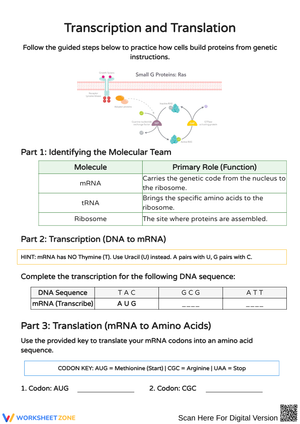
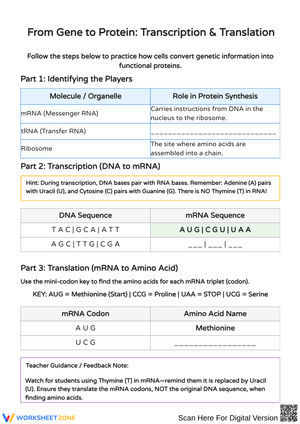
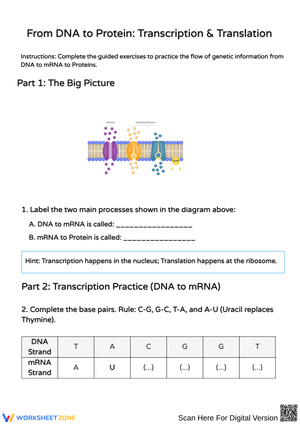
Transcription is a fundamental process in molecular biology that every 10th-grade student needs to grasp to understand how life functions at a cellular level. It represents the first stage of the Central Dogma, where the genetic information stored within DNA is rewritten into a portable format known as messenger RNA (mRNA). By utilizing 10th grade transcription worksheets, educators can provide students with the necessary practice to visualize this microscopic event. These resources help students transition from viewing DNA as a static molecule to understanding it as a dynamic set of instructions that the cell actively reads and interprets. In the high school science curriculum, mastering this concept is essential for moving on to more complex topics like translation and gene regulation.
The Mechanics of RNA Synthesis
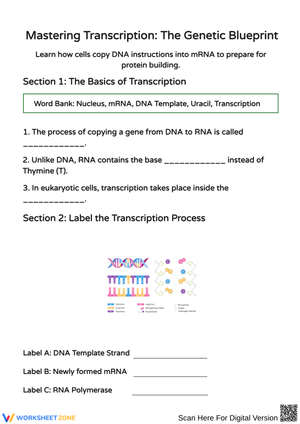
The actual synthesis of RNA involves a series of coordinated steps that students must be able to identify and describe. These stages include initiation, elongation, and termination. During initiation, a specific enzyme called RNA polymerase recognizes and binds to a region of the DNA known as the promoter. This binding site acts as a start signal for the enzyme to begin unzipping the DNA double helix. In many 10th grade transcription worksheets, students are asked to label diagrams showing the RNA polymerase attached to the promoter, which reinforces their understanding of how the cell knows where a specific gene begins.
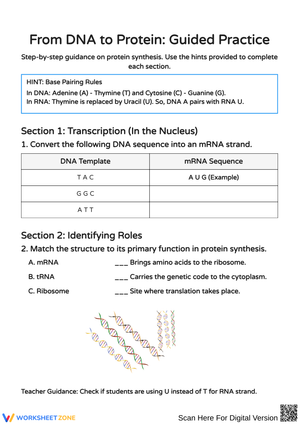
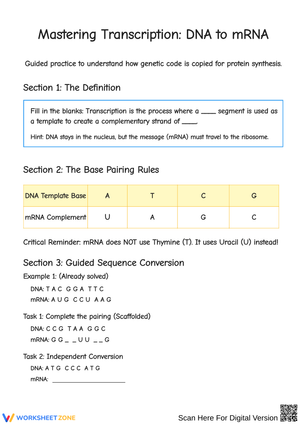
Once the enzyme is properly positioned, the elongation phase begins. The RNA polymerase moves along the DNA template strand, adding RNA nucleotides that are complementary to the DNA sequence. As noted in the Khan Academy: Stages of Transcription, this process ensures that the genetic message is accurately preserved in the new RNA molecule. Students often find this stage challenging because they must remember to substitute Uracil for Thymine. Practice exercises that require students to build an mRNA strand from a provided DNA sequence are highly effective at solidifying these base-pairing rules and reducing common errors during assessments.
Base Pairing and the RNA Transcript
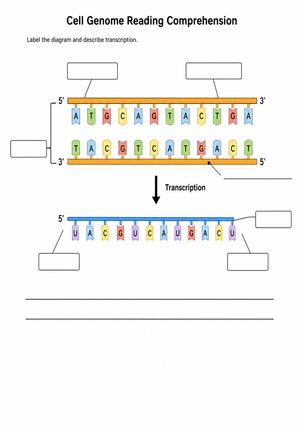
A significant portion of any 10th grade transcription worksheet focuses on the specific logic of base pairing. While DNA replication involves pairing Adenine with Thymine, transcription requires pairing Adenine with Uracil. This chemical difference is a key point of emphasis in high school biology. Students must also learn to distinguish between the template strand, which the enzyme reads, and the coding strand, which has a sequence nearly identical to the resulting mRNA. By working through multiple examples, students develop the cognitive fluency needed to quickly convert genetic sequences without confusion.
Understanding the directionality of transcription is another important learning objective. RNA polymerase always builds the new RNA strand in a 5' to 3' direction. While this may seem like a minor detail, it is essential for understanding how the cell maintains the correct reading frame for later translation. Worksheets often include arrows and labeled ends to help students visualize this one-way flow of information. When students can successfully identify the template strand and produce a correctly oriented mRNA sequence, they demonstrate a high level of mastery over the molecular mechanics of the gene.
Classroom Implementation
Integrating these worksheets into a standard biology unit can be done through a variety of methods. Many teachers find success using them as guided practice immediately following a visual presentation. As the teacher explains each step, students can fill in the corresponding parts of a diagram or answer short-response questions. This immediate application helps clear up misconceptions in real-time. For example, if a student is still trying to pair Adenine with Thymine in an RNA strand, the teacher can catch the error during the worksheet phase rather than waiting for a unit test.
These resources also function well as part of a collaborative lab activity. Students can be given different "mutated" DNA sequences and asked to transcribe them to see how the resulting mRNA changes. This connects the abstract concept of transcription to the tangible reality of genetic variation and disease. When students see how a single change in the DNA template results in a different mRNA sequence, they begin to understand the high stakes of molecular accuracy. This level of engagement aligns with the NGSS Standards: HS-LS1-1 Structure and Function, which requires students to explain how the structure of DNA determines the structure of proteins.
Frequently Asked Questions
1. What is the role of RNA polymerase in transcription?
RNA polymerase is the primary enzyme that carries out transcription. It is responsible for recognizing the promoter region of a gene, unwinding the DNA double helix, and assembling the mRNA strand by adding complementary RNA nucleotides. Without this enzyme, the cell would be unable to read its genetic instructions or produce the messengers needed for protein synthesis.
2. How do DNA and RNA base pairing rules differ?
In DNA, Adenine (A) always pairs with Thymine (T). However, in RNA, Thymine is replaced by Uracil (U). Therefore, during transcription, an Adenine on the DNA template strand will pair with a Uracil on the growing mRNA strand. The pairing between Cytosine (C) and Guanine (G) remains the same in both DNA and RNA molecules.
3. Where does transcription occur in a eukaryotic cell?
In eukaryotic cells, transcription occurs exclusively within the nucleus. This is because the cell's genomic DNA is housed inside the nuclear envelope for protection. Once the mRNA transcript is fully formed and processed, it travels through nuclear pores into the cytoplasm, where it can be used by ribosomes to build proteins during the process of translation.
4. What is the difference between the template strand and the coding strand?
The template strand is the side of the DNA molecule that RNA polymerase actually reads to build the mRNA. The coding strand is the opposite side of the DNA. Interestingly, the mRNA sequence is almost identical to the coding strand sequence, with the only major difference being that the mRNA has Uracil (U) instead of the Thymine (T) found in the DNA coding strand.
5. Why is transcription considered the first step of gene expression?
Transcription is the first step because it creates the necessary intermediate molecule required to turn genetic code into a physical product. Since the instructions in DNA cannot leave the nucleus, the cell must first make a portable copy (mRNA) that can reach the protein-building machinery in the cytoplasm. It is the essential starting point for the entire process of building a living organism.
Conclusion
Mastering transcription is a major milestone for 10th-grade biology students. It provides the foundation for understanding how life is built and maintained at the molecular level. By using structured 10th grade transcription worksheets, teachers can ensure that their students develop a strong grasp of base-pairing rules, enzymatic functions, and the overall flow of genetic information. These tools not only help students succeed on standardized exams but also prepare them for more advanced studies in genetics and biotechnology. With clear instruction and consistent practice, the complex world of the cell becomes accessible and engaging for every learner.












 Interactive Worksheet Maker
 Quiz Maker
 Word Search Maker
 Crossword Puzzle Maker
 Word Scramble Generator
 Sentence Scramble Generator
 Handwriting Worksheet Generator
 Name Tracing Generator
 Fill In The Blank Generator