


























Views
Downloads

Essential Transcription and Translation Diagram | Grade 10
Paste this activity's link or code into your existing LMS (Google Classroom, Canvas, Teams, Schoology, Moodle, etc.).
Students can open and work on the activity right away, with no student login required.
You'll still be able to track student progress and results from your teacher account.
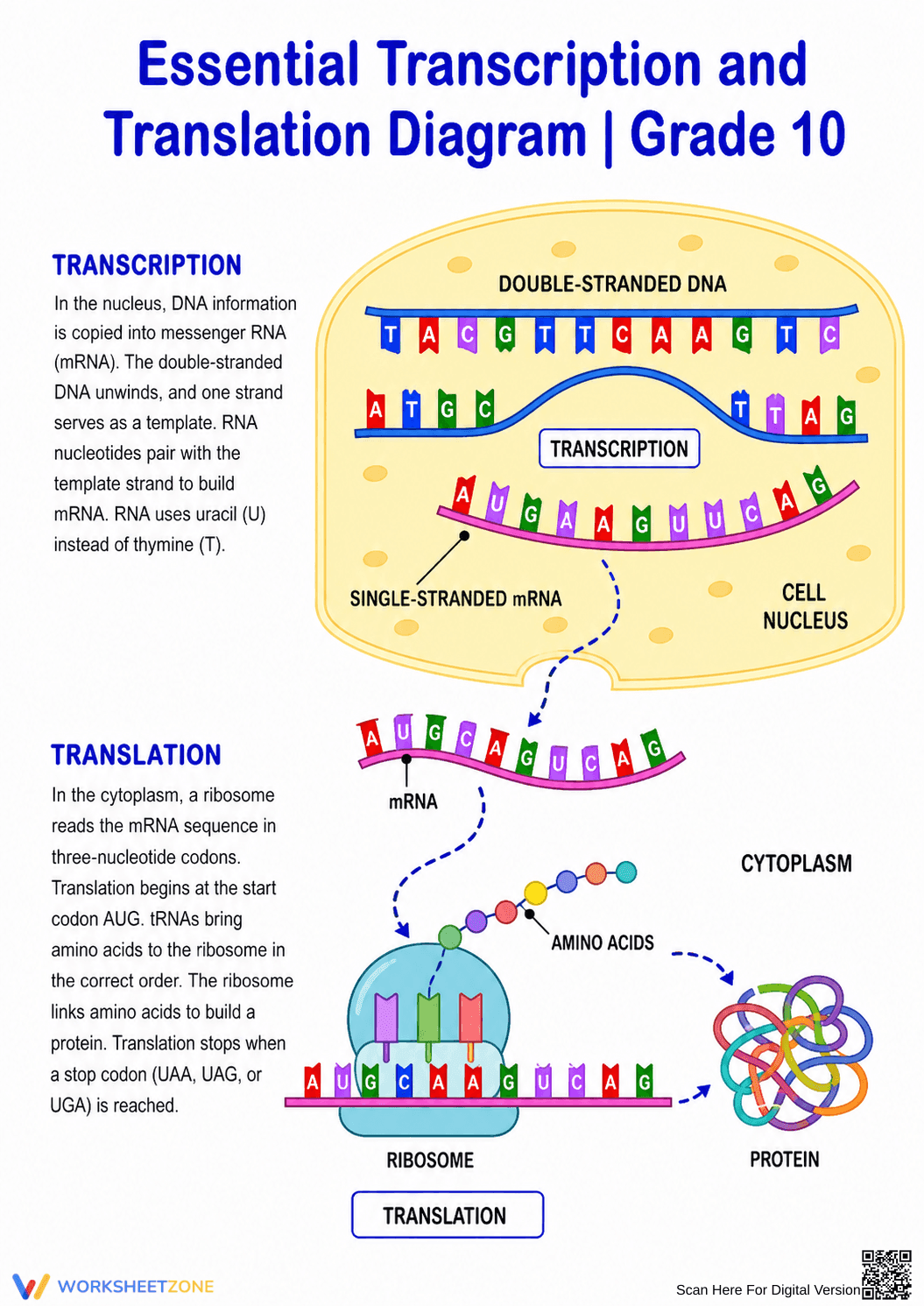
This Grade 10 Biology reference diagram provides a clear visual breakdown of how cells convert genetic information from DNA into functional proteins. By illustrating the distinct stages of transcription within the nucleus and translation at the ribosome, students can visualize the central dogma of molecular biology before applying the concepts to practice problems.
At a Glance
- Grade: 10 · Subject: Biology
- Standard:
HS-LS1-1— Explain how DNA structure determines protein structure and essential cell functions- Skill Focus: Protein Synthesis Visualization
- Format: 1 page · Reference Diagram · No-Prep · PDF
- Best For: Interactive Notebooks or Anchor Charts
- Time: 10–15 minutes
This single-page PDF features a high-resolution, color-coded diagram of the protein synthesis process. It includes detailed text descriptions of transcription, highlighting the role of mRNA and the substitution of uracil for thymine. The translation section explains the function of ribosomes, codons, and amino acid sequencing, including specific start and stop signals for protein completion.
Zero-Prep Workflow:
- Print: Select the color or grayscale version and print enough copies for your class in under 1 minute.
- Distribute: Hand out the diagrams as a supplement to your lecture or as a reference for a lab activity (30 seconds).
- Review: Use the visual cues to lead a quick 5-minute check-for-understanding on the movement of mRNA from the nucleus to the cytoplasm.
Total teacher prep time is under 2 minutes, making this an ideal resource for emergency sub plans or last-minute lesson enhancements.
The primary standard addressed is `HS-LS1-1`. This resource helps students construct an explanation for how the sequence of nucleotides in DNA is transcribed into mRNA and then translated into a specific sequence of amino acids. Both standard codes can be copied directly into lesson plans, IEP goals, or district curriculum mapping tools.
Use this diagram during the instructional phase of a lesson cycle to clarify the abstract steps of the central dogma. It also serves as an excellent formative assessment tool; ask students to cover the text and explain the process using only the visual arrows. Expected completion for a labeling activity using this as a key is 10-15 minutes.
Designed for Grade 9 and 10 Biology students, this resource is particularly helpful for visual learners and English Language Learners (ELLs) who benefit from the direct mapping of text to imagery. It pairs naturally with a DNA modeling kit or a codon wheel practice sheet for a complete lesson on gene expression.
According to the RAND AIRS 2024 report on science literacy, high-quality visual representations are critical for student mastery of microscopic biological processes like protein synthesis. This diagram aligns with HS-LS1-1 by providing a concrete model of transcription and translation, allowing students to trace the flow of genetic information. Research from Fisher & Frey (2014) emphasizes that anchor charts and reference diagrams reduce cognitive load during complex multi-step tasks. By clearly labeling the nucleus, cytoplasm, ribosome, and mRNA strand, this resource supports the NGSS requirement for students to explain the relationship between DNA and protein structure. The inclusion of specific nucleotide bases and codon functions ensures that the material meets the rigor expected in secondary life science curricula, facilitating a deeper understanding of the molecular machinery that drives cellular function and trait expression across all living organisms.


