Assessing Credibility of Sources printable worksheets for Grade 10
These assessing credibility of sources printable worksheets for 10th grade give teachers a set of focused evaluation tasks that move source analysis from an abstract concept into visible, gradable thinking — students stop labeling a source "reliable" or "unreliable" and start examining authorship, evidence quality, publication purpose, and timeliness in writing. Each worksheet in the set targets a distinct layer of that evaluation process, and the written justification requirements built into every task make student reasoning legible enough to diagnose in real time. They fit a research day, a media literacy block, or an argument writing unit without requiring a full curriculum redesign.
What Students Examine on Each Worksheet
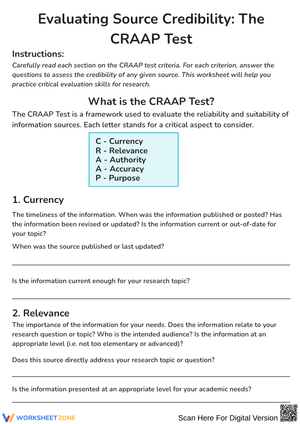
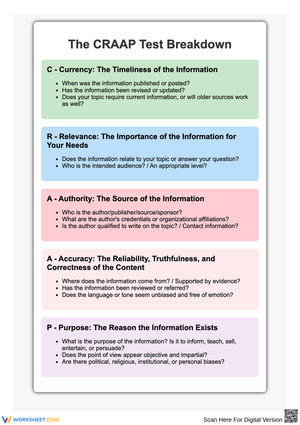
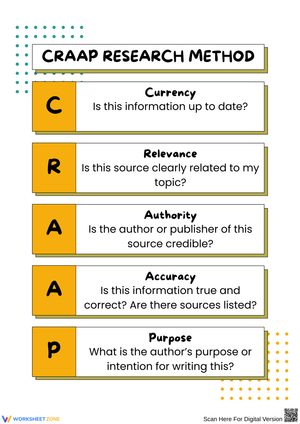
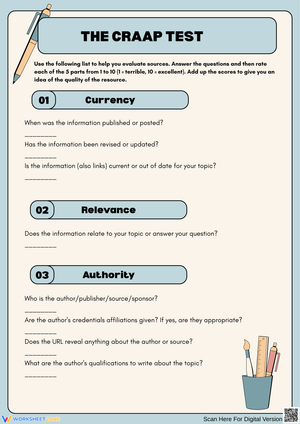
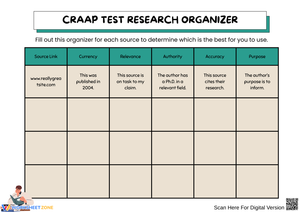
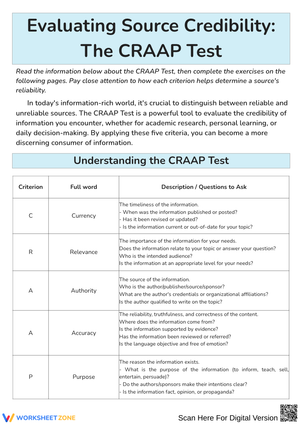
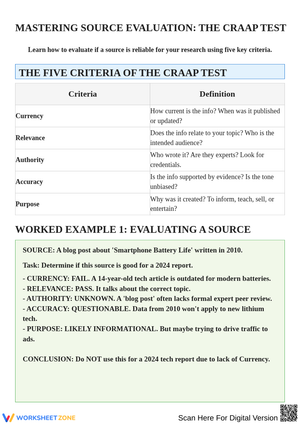
The five evaluation categories that form the backbone of these worksheets — authority, accuracy, bias and purpose, currency, and relevance — are not new to research pedagogy, but 10th graders consistently struggle to apply all five simultaneously. The worksheets break that process into discrete, sequential checks so students build toward a final source judgment rather than collapsing every consideration into a single gut reaction.
- Authority — Who wrote or published this source, what credentials do they hold, and are those credentials independently verifiable?
- Accuracy — Does the source name its evidence, cite external references, or provide data that can be traced back to an original study or record?
- Bias and purpose — Is this source designed to inform, persuade, sell, or provoke a reaction, and how does that purpose shape what it includes or omits?
- Currency — When was this published or last updated, and does the date matter for this specific topic?
- Relevance — Does this source actually answer the research question, or does it only brush against the topic?
Each worksheet requires students to write a short justification for each category rather than check a box. That requirement is deliberate. A checkmark tells a teacher nothing about where the student's reasoning collapsed, but a sentence like "no author listed, published by an organization with a stated financial interest in the topic" tells exactly what the student noticed and whether they're connecting the right details to the right category.
Where Students Consistently Go Wrong With Source Evaluation
The most predictable 10th-grade error is equating website polish with trustworthiness. Students will confidently rate a professionally formatted page with no listed author as credible while dismissing a dense government report packed with citations because it "looks boring." The worksheets address this directly by requiring students to locate and record the author's name and credentials before they assign any rating at all. If that field stays blank, that's the finding — and it's a more honest evaluation than a high score based on visual design.
A second consistent pattern: students treat bias and unreliability as synonyms. A news outlet with a visible editorial perspective gets crossed off the list entirely, while a cleanly designed anonymous blog passes because it "doesn't seem political." The side-by-side comparison worksheets surface this confusion by asking students to rate publication purpose separately from overall credibility. A source can hold a clear point of view and still present verifiable data; another source can appear neutral while making claims it cannot support. Students need to sit with that distinction long enough for it to stick.
The third pattern is all-or-nothing thinking about credibility itself. Students want to declare a source either fully reliable or completely useless and resist the middle. Requiring them to write one strength and one limitation for every source — including the sources they ultimately choose to use — breaks that binary. A peer-reviewed article may be authoritative but too narrowly focused for a broad claim; a news article may be timely but light on cited statistics. Both observations are useful; neither disqualifies the source automatically, and students who internalize that nuance write better argument essays.
Fitting These Worksheets Into the Research Unit
The most reliable single-period structure starts with a five-minute teacher think-aloud. Pull one source onto the projector — a Wikipedia entry, a news article, and a .gov report all work — and verbalize each evaluation step aloud as you move through the worksheet categories. Students particularly need to hear the teacher say something like "I don't see an author anywhere on this page, so I'm noting that as a concern before I look at anything else," because that narrated hesitation models the deliberate slowness the worksheets are designed to produce.
After the model, move students into pairs with one of the comparison worksheets. Each pair scores two sources on the same topic, writes a one-sentence justification for each rating, and decides which source they would cite first in a timed argument essay. Close with a brief whole-class share-out — pairs frequently disagree on marginal sources, and that disagreement is the most instructionally productive moment of the period. Assessing credibility of sources printable worksheets for 10th grade work especially well in this pair format because the justification requirement turns what could be a quiet individual task into material for a real whole-class conversation rather than silent compliance.
For sub plans or independent work days, the scenario-based worksheets are self-contained enough to run without live instruction. Students read a brief research scenario, evaluate three provided sources, discard one with a written explanation, and write a short recommendation paragraph. The structure holds the period without a teacher present.
Standard Alignment
The primary standard connection is CCSS.ELA-LITERACY.W.9-10.8, which requires students to gather relevant information from multiple authoritative print and digital sources, assess the usefulness of each source in answering the research question, and integrate information selectively. In most classrooms, W.9-10.8 gets evaluated after students have already drafted with whatever sources they grabbed first. These worksheets move that standard to the front of the research process — before note-taking begins — which is where source quality decisions actually shape the writing that follows.
CCSS.ELA-LITERACY.RI.9-10.6 is the second relevant anchor: determining an author's point of view or purpose and analyzing how an author uses rhetoric to advance that purpose. The bias and purpose section of each worksheet asks students to name the rhetorical signals that reveal intent — loaded language, selective evidence, emotional framing — and explain how those signals affect the source's appropriateness for academic writing. That applies RI.9-10.6 to the research materials students actually encounter, not only to the literary nonfiction excerpts that typically appear in anthology-style instruction.
Using These Worksheets Across the Full Ability Range
For students who are still building academic reading fluency, the most practical adjustment is pre-selecting the sources. Rather than asking those students to locate materials independently, provide two or three short excerpts and let them work through the evaluation categories without also managing a search process. The thinking the worksheet requires — identifying authority, checking for cited evidence, naming purpose — stays unchanged; only the source-finding step is removed so cognitive attention goes to the evaluation itself.
Assessing credibility of sources printable worksheets for 10th grade can be extended meaningfully for students who move through the standard version quickly. Add a third source to comparison tasks, or ask those students to write a full paragraph defending their source ranking rather than two or three sentences. A particularly effective challenge is introducing a deliberately misleading source — a convincingly formatted piece with a fabricated expert name and plausible-sounding citations — and asking students to explain how they detected the problem and what verification step they would take before citing it in a real essay. That variation reveals more about evaluation habits than any multiple-choice question could.
For English language learners, pairing each worksheet with a brief reference list of evaluation vocabulary — authorship, editorial purpose, peer review, primary vs. secondary source — reduces processing load without lowering the analytical demand. Students direct their attention to the evaluation itself rather than decoding unfamiliar terms mid-task.
Frequently Asked Questions
Do students need prior source evaluation instruction before using these worksheets?
A five-minute think-aloud introducing the five evaluation categories is sufficient for most 10th graders. The worksheets guide students through each step sequentially, so students encountering formal source evaluation for the first time can complete them after a brief teacher model. Students with some prior exposure will move faster and can be given the extended comparison tasks or the misleading-source challenge described above.
Can students evaluate sources they found themselves rather than provided excerpts?
That is often the more productive use. When students bring in sources they actually located through their own searches, the evaluation worksheet functions as a gate between "I found this" and "I am citing this" — which is precisely the research habit 10th grade writing standards require. The worksheet becomes purposeful rather than procedural, and students are more invested in the outcome because the source is theirs.
How do these worksheets connect to argument writing?
Students who complete assessing credibility of sources printable worksheets for 10th grade before drafting arrive at note-taking with a cleaner, more defensible source list. The written justifications produced on the worksheet also double as planning notes: students have already articulated in writing why a source supports their claim, which makes evidence integration faster and more precise during the drafting step. The evaluation work done before writing shows up directly in the quality of the cited evidence inside the essay.
What's a practical way to grade these worksheets?
A four-point rubric tied to the five evaluation categories works cleanly: credit for accurate identification of authority, evidence quality, purpose, and currency, plus a point for a written justification that references a specific, observable detail from the source. The justification point separates students who completed the worksheet from students who engaged with it. A rating of "somewhat credible" with no explanation is nearly ungradable; "somewhat credible because the author holds relevant credentials but the article cites no external sources for its central statistics" tells exactly what the student noticed and confirms that the evaluation was genuine.
Clear All