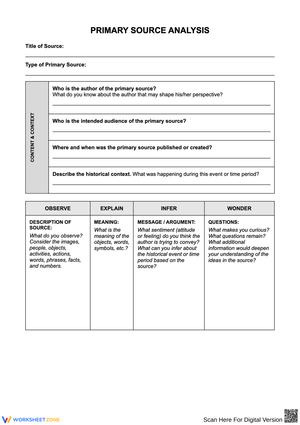
These 10th grade research strategies printable worksheets give teachers something a lecture alone cannot: isolated, repeatable practice at each distinct phase of inquiry — from forming a researchable question through integrating source evidence into analytical prose. Each worksheet targets one skill, so students aren't expected to learn citation format, source evaluation, and synthesis simultaneously while also managing a full research paper.
What Students Practice Across the Set
The worksheets address the full arc of academic research at the grade 10 level, broken into the specific sub-skills that tend to get compressed or skipped when teachers treat research as a single, undifferentiated assignment.
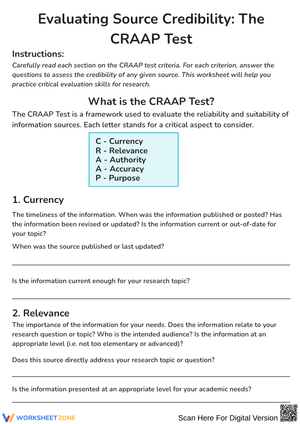
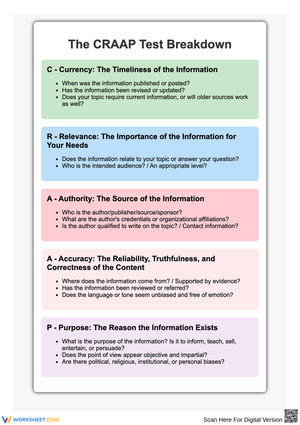
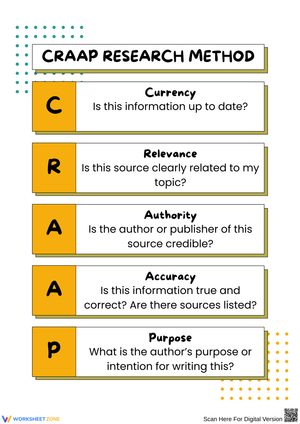
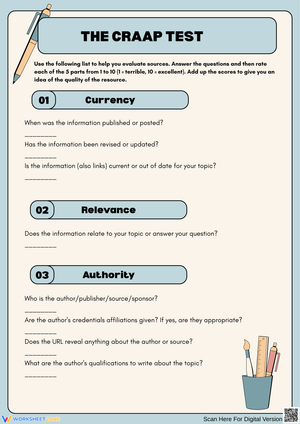
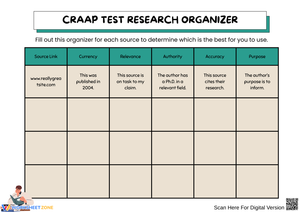
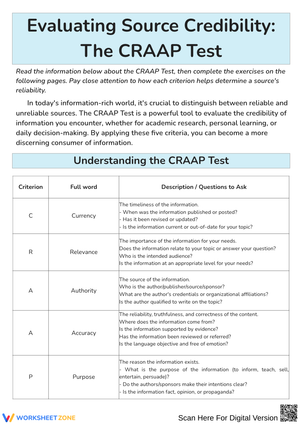
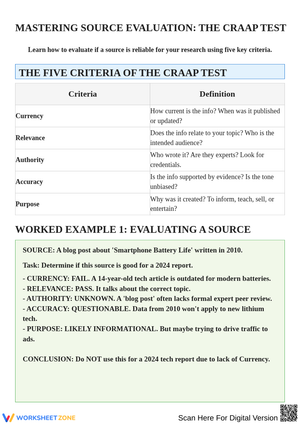
- CRAAP framework source evaluation — students apply Currency, Relevance, Authority, Accuracy, and Purpose criteria to real websites and articles, recording scores and written justifications for each category
- Lateral reading practice — prompts that direct students to leave a site and search for information about its sponsoring organization before accepting any claim as credible
- Thesis narrowing sequences — brainstorming maps and question-generation chains that move a student from "I want to write about social media" to a specific, arguable claim worth researching
- Boolean search operator drills — exercises where students predict how AND, OR, and NOT will expand or restrict a database query, then verify their predictions against live results
- Synthesis matrix organizers — grid-style worksheets where sources appear on one axis and subtopics on the other, requiring comparative notes at each intersection rather than sequential summaries
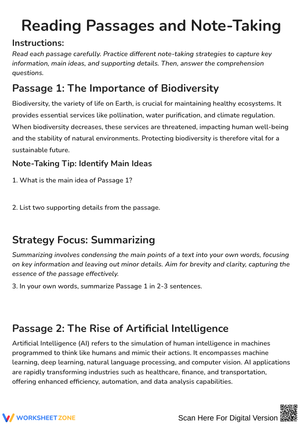
- Paraphrasing and summary practice — read-cover-write sequences that surface patchwriting before it reaches a draft
- MLA citation formatting drills — isolated exercises on works cited entries and in-text parenthetical format, separated from the composing task so students can focus on mechanics alone
Student Errors That Surface Before the Final Draft
The most persistent mistake at grade 10 isn't a missing citation — it's patchwriting. A student reads a source passage, substitutes three or four synonyms, and genuinely believes the result is a paraphrase. The sentence structure mirrors the original exactly; only the vocabulary has shifted. The paraphrasing worksheets address this by requiring the read-cover-write sequence: students read, cover the text, write the idea from memory, then compare their version to the source. When both versions sit on the same page side by side, the structural similarity becomes visible in a way that a syllabus warning never achieves. Students who see the problem in their own writing correct it far more reliably than students who receive it as an abstract rule.
Source evaluation surfaces a different error pattern. Students consistently treat visual polish as a credibility signal — a well-designed homepage reads as authority. The lateral reading worksheets counteract this directly: before completing any evaluation form, students must open a separate search and find information about the organization behind the site. In a typical class, several students discover that a convincingly formatted page is run by a single-issue advocacy group with no peer review process, which changes their rating and, more importantly, their instincts for future searches.
The synthesis mistake is additive thinking. Students write what Source A says, then what Source B says, treating each as a sealed container. The synthesis matrix forces comparison because both sources occupy the same subtopic column — students can see agreement, contradiction, or a gap where no source addresses a particular angle. That visual pressure is what moves a paper from a sequence of summaries into an actual argument.
Building These Worksheets Into Your Research Unit
Releasing 10th grade research strategies printable worksheets one at a time — pegged to specific stages of the research process — prevents the cognitive overload that results when students face a full stack of unfamiliar materials at once. On library orientation day, hand out only the source evaluation worksheet. Students have a concrete, focused task from the moment they sit down at a database terminal, rather than spending the period in aimless browsing. The synthesis matrix belongs in students' hands only after they've gathered sources; introduced earlier, it's an empty grid that teaches nothing. Timing the distribution matters as much as the content of each worksheet.
Citation drills work best as a focused ten-minute warm-up in the class period immediately before the first full draft is due. At that moment students are already thinking about their papers. The formatting practice connects to something they're actually about to produce, rather than floating as a decontextualized exercise from two weeks ago. Running the drill the same day as the draft — not well in advance — is what makes the mechanics transfer.
The Boolean search worksheets pair well with a projected demonstration. Have students complete the prediction section of each worksheet first — write down what they expect AND versus OR to do — then execute the searches live and compare. Prediction before observation activates prior knowledge and sharpens attention to the result in a way that demonstration-first sequences do not.
Standard Alignment
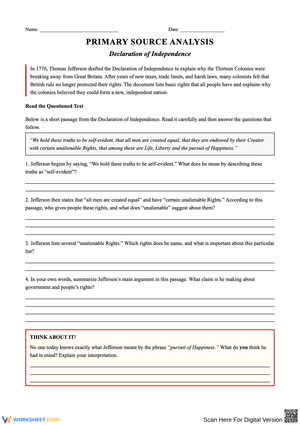
The 10th grade research strategies printable worksheets address CCSS.ELA-LITERACY.W.9-10.7 (conducting short and sustained research projects), W.9-10.8 (gathering relevant information from multiple authoritative print and digital sources, assessing usefulness, and integrating information while avoiding plagiarism), and W.9-10.9 (drawing evidence from informational texts to support analysis). In practical classroom terms, W.9-10.8 is the standard that governs most of what a research unit actually asks students to do — it covers the entire evaluative chain from an initial search query through accurate in-text attribution. Each worksheet in this set maps to at least one of these codes, and teachers can use that alignment to account for instructional time during department reviews or curriculum audits.
Reaching Students Across a Range of Ability Levels
Students who find the CRAAP evaluation framework abstract benefit from completing their first source evaluation in a structured pair discussion before applying the criteria independently. Talking through "who wrote this and how do we know they're qualified" builds the evaluative vocabulary students need before they can work through the form on their own. The worksheet doesn't change; the instructional structure around it does.
For students operating above grade level, the synthesis matrix becomes a vehicle for rhetorical analysis rather than content tracking. Instead of noting what each source says about a subtopic, they note the rhetorical move each source makes — providing context, countering a claim, presenting data, acknowledging complexity. The worksheet structure is identical to what the rest of the class uses; the intellectual demand shifts through the task framing alone, without requiring a separate set of materials.
Frequently Asked Questions
Do students need a research topic before starting any of these worksheets?
Not for all of them. The source evaluation and lateral reading worksheets include sample sites and articles students can evaluate independently of their own topic. The Boolean search drills also function as standalone exercises that require no prior topic selection. The synthesis matrix and thesis narrowing sequences require a topic or a set of sources already in hand. Most teachers introduce the evaluation and search worksheets first, then move to thesis work once students have a subject area in focus.
What citation style do the formatting drills cover?
The citation worksheets use MLA 9th edition format, which most high school English departments currently require. Works cited entries and in-text parenthetical citations appear in separate exercises so teachers can assign whichever component the current unit demands. The underlying approach — identify the source type, locate the required fields, arrange them in the correct sequence — transfers to APA with straightforward adaptation of the answer key.
How long does each worksheet take to complete?
Most run 15 to 25 minutes for an on-task student. The synthesis matrix takes longer depending on source load; it fits comfortably in a block period but may need to carry across two sessions in a 45-minute class. The paraphrasing drills clock in at 10 to 15 minutes, which makes them reliable warm-up material the week before a draft is due.
Can individual worksheets be used outside a dedicated research paper unit?
Yes. Each worksheet functions independently — a source evaluation drill fits into a media literacy unit, and the paraphrasing practice works inside any writing unit that draws on secondary sources. Teachers who assign 10th grade research strategies printable worksheets outside a formal research unit often return to them later in the year because the skills — especially lateral reading and synthesis — transfer across argument types and assignment formats.












 Interactive Worksheet Maker
 Quiz Maker
 Word Search Maker
 Crossword Puzzle Maker
 Word Scramble Generator
 Sentence Scramble Generator
 Handwriting Worksheet Generator
 Name Tracing Generator
 Fill In The Blank Generator