These essay printable worksheets for 10th grade address the most consequential shift in secondary writing: the move from summarizing sources to constructing arguments with them. The set gives teachers printable resources targeting thesis construction, evidence integration, counterclaim structure, and revision — the specific stages where 10th-grade writers most reliably stall.
What Each Worksheet Targets
Each worksheet isolates one component of the writing process rather than asking students to manage all of it simultaneously — which is what produces the disorganized drafts that land on our desks in the first place. The skills addressed across the set are:
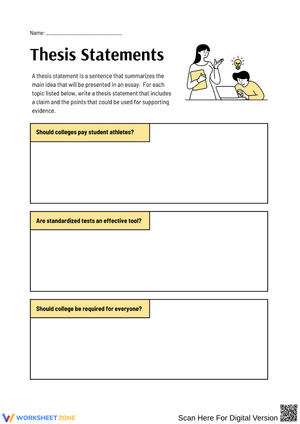
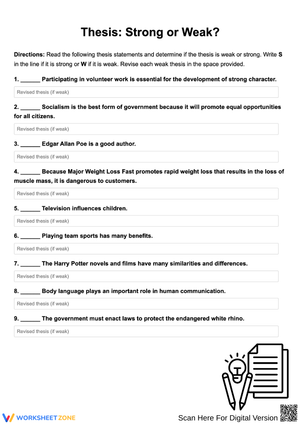
- Thesis development: Students practice converting a topic and opinion into a three-part claim — specific subject, debatable stance, and forecasted support — then test whether their thesis is arguable rather than factual.
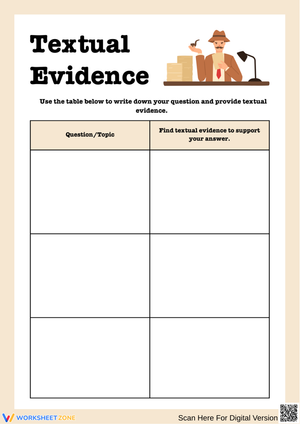
- Evidence integration: Worksheets walk through the introduce-quote-explain sequence using sentence frames students complete, then rewrite in their own voice.
- Counterclaim and rebuttal: A dedicated worksheet addresses concession language and the internal logic of rebuttal — a skill most 10th graders have heard of but rarely practiced in isolation.
- Transitions and cohesion: Students sort transitional phrases by function — contrast, addition, causation — and apply chosen transitions inside actual paragraph stubs.
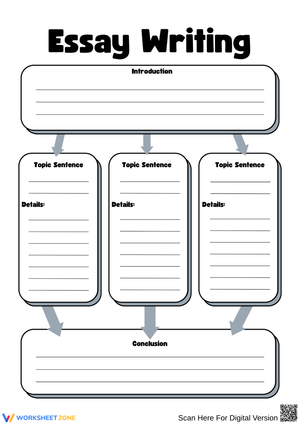
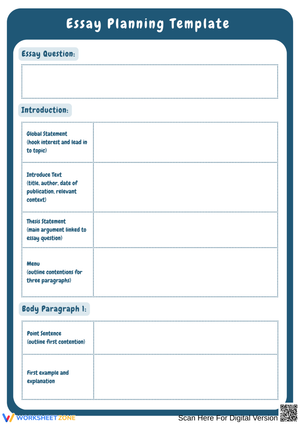
- Essay outline: A planning worksheet maps the introduction, body paragraph claim/evidence/analysis slots, and conclusion, completed before any drafting begins.
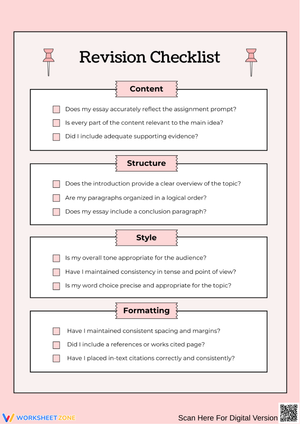
- Revision checklist: A criterion-referenced tool that matches the scoring language teachers use on rubrics, so students know precisely what to look for when reading their own drafts.
Standard Alignment
The worksheets align directly to CCSS ELA-Literacy W.9-10.1, which requires students to write arguments that introduce precise claims, distinguish those claims from counterclaims, and establish logical organization among claims, reasons, and evidence. W.9-10.5 is also addressed: the revision and editing worksheets support the expectation that students develop and strengthen writing through planning, drafting, revising, and editing with guidance. In classroom terms, W.9-10.1 is where most writing instruction concentrates by mid-year in 10th grade — it drives the on-demand writing tasks teachers assign alongside major fiction and nonfiction units, and it is the standard most directly tested in state writing assessments.
Student Errors Worth Anticipating Before the First Draft
The most common thesis error in 10th grade is not vagueness — it is false specificity. A student writes "The author uses imagery to convey a dark mood in the story," and when asked to argue something, looks at you blankly, because that sentence feels to them like a claim. The thesis development worksheet addresses this directly by requiring students to complete the sentence "Someone might disagree with my thesis because..." If they cannot complete it, the thesis is a statement of fact, not an argument.
Evidence integration produces its own predictable failure. Students drop a block quote at the end of a sentence and stop, leaving it to the reader to determine relevance. The evidence integration worksheet reverses the usual order: students write the analysis sentence first — before selecting the quote — which forces them to identify what they are actually trying to prove. That sequence catches the dropped-quote habit at the planning stage rather than inside a completed draft.
Counterclaim paragraphs are where the most serious structural collapses happen. Students who have been told to "acknowledge the other side" will write a full, persuasive concession and then close with a single weak sentence: "But my side is still right." The counterclaim worksheet has students evaluate and rank a set of sample rebuttals by how specifically each one addresses its concession — a task that makes the abstract idea of refutation concrete and discussable before students attempt it themselves.
Building These Worksheets Into Your Writing Unit
Release each worksheet at the moment students need it, not at the start of the unit. Handing out the entire set on day one suggests the essay must be written all at once. Instead, open the thesis development worksheet during the prewriting lesson and give students 10–15 minutes to complete it in class. Collect them at the end of the period, skim for structural patterns, and address the most frequent problems aloud at the start of the next session before moving to the outline worksheet. That early-intervention loop — distribute, collect, address publicly, move forward — prevents students from drafting full essays around a flawed premise.
The revision checklist works best as a peer task two days before final submission, not as a last-minute teacher check. Pair students and give each pair two different-colored highlighters. Assign one color to claims and another to evidence, and have them mark each other's drafts against the checklist criteria. That step transforms the checklist from a summary rubric into an active reading instrument. The essay printable worksheets for 10th grade in this set are built for that kind of teacher-directed sequence — not for take-home completion in isolation.
Adjusting the Set for Mixed-Readiness Writers
For students still building sentence-level fluency, the thesis worksheet works better when preceded by a brief oral practice step: present a sample topic, have students state their claim aloud before writing anything. Once they can articulate it in conversation, transferring it to the worksheet takes far less time. This cuts the "I don't know what to write" paralysis that costs 5–8 minutes of on-task time per student in mixed-readiness classes.
Advanced writers who have already internalized basic argument structure benefit most from the counterclaim and evidence analysis worksheets, where the tasks require evaluation and synthesis rather than formula application. A productive extension for these students is asking them to complete a second round of the evidence integration worksheet using a source they locate themselves — shifting the cognitive demand from application to transfer. The essay printable worksheets for 10th grade in this set are formatted with enough white space that teachers can add their own sentence frames or remove them depending on what a given group needs, without reprinting or reformatting anything.
Standard Alignment
Frequently Asked Questions
Do these worksheets support argumentative writing, literary analysis, or both?
Each worksheet targets a transferable skill — thesis precision, evidence analysis, counterclaim logic — that applies across both essay types. The thesis development worksheet uses both argumentative and literary analysis prompts as examples so students can see that the same structural expectations apply whether they are arguing a policy position or analyzing a character's motivation in a novel.
How many class periods does it take to work through the full set?
A standard 10th-grade writing unit runs two to three weeks. Distribute the worksheets across that timeline: thesis and outline worksheets in week one, evidence integration and body paragraph practice in week two, and the revision checklist in the final days before submission. Each worksheet takes roughly 15–25 minutes to complete during class time, which makes them workable within a standard 50-minute period alongside direct instruction.
What if students have never had explicit instruction in quote integration before?
Many 10th graders have encountered rules about quoting but have not had deliberate practice writing the analytical sentence that follows. Before distributing the evidence integration worksheet, display a completed model on the projector and annotate it together — label the introduction, the quote, and the explanation sentence. The first time students complete the worksheet, allow partners to compare their explanation sentences and revise. The second time, the process moves considerably faster because the expectation is already concrete. The essay printable worksheets for 10th grade in this set are designed for exactly that kind of two-pass practice, with enough variation in the sample texts to keep the second attempt from feeling repetitive.












 Interactive Worksheet Maker
 Quiz Maker
 Word Search Maker
 Crossword Puzzle Maker
 Word Scramble Generator
 Sentence Scramble Generator
 Handwriting Worksheet Generator
 Name Tracing Generator
 Fill In The Blank Generator