These social studies pdf worksheets for 1st grade are organized around the four domains that define early elementary instruction — community helpers and citizenship, foundational map and geography skills, needs versus wants, and comparing past and present life. Each worksheet targets one focused concept, so teachers can pull exactly what a given lesson requires without working through content that hasn't been introduced yet.
What These Worksheets Address
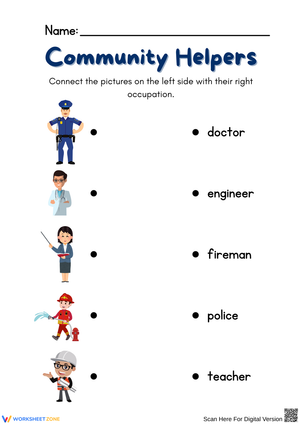
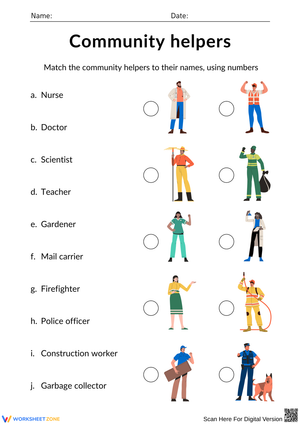
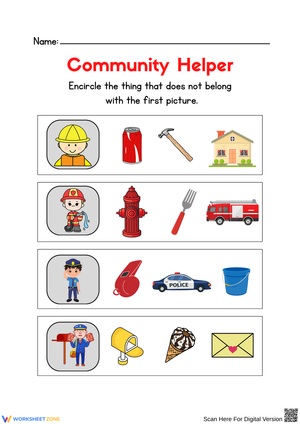
Community helpers worksheets ask students to match each worker to a tool or vehicle, sort helpers by where they work, and identify what each person contributes to the neighborhood. Citizenship printables present classroom and playground scenarios — a student helping someone pick up dropped books, a student cutting in line — and ask students to identify which behavior demonstrates responsible membership in a community. That format also gives teachers a formative read on whether students have the vocabulary to discuss it.
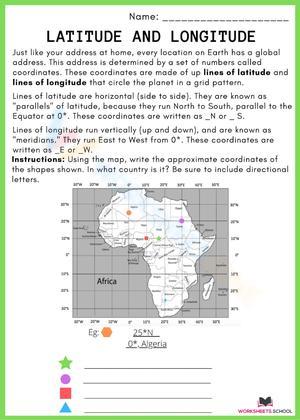
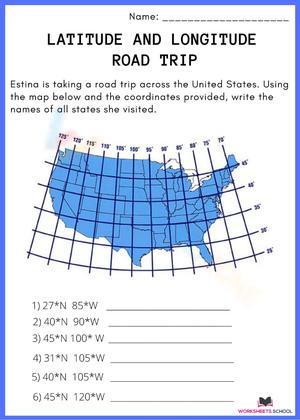
Map skills worksheets introduce cardinal directions, simple map keys, and basic grid coordinates. One worksheet type gives students a bird's-eye-view drawing of a small neighborhood and asks them to locate three places using a labeled map key. Geography worksheets address landform and body of water vocabulary — mountains, hills, rivers, lakes, oceans — through labeled diagrams, sorting tasks, and fill-in identification exercises.
The economics content centers on the needs-versus-wants distinction, which is the foundational economic concept in most first-grade frameworks. Students sort pictures into two columns, then work through harder cases designed to surface reasoning errors. Separate worksheets introduce goods and services, asking students to look at images of a haircut, a loaf of bread, and a bicycle repair and sort them by category.
History and timeline worksheets ask students to sequence events from shortest to longest time span, arrange personal history images in order, and compare historical and modern transportation or housing using paired photographs. The visual comparison format is the most accessible entry point for historical thinking at this age because it sets aside reading demand and places the full cognitive weight on interpretation and comparison.
Errors That Surface Early and Stay Late If You Miss Them
The needs-versus-wants unit produces a predictable mistake: students mark a smartphone as a need because every adult they know carries one. A worksheet that places a phone alongside a winter coat, food, and a toy brings this out in the first five minutes. The conversation that follows — why a coat is a need when a phone is not, even though both are ubiquitous — is where the actual understanding forms. Worksheets that rely only on obvious contrasts like "bread versus video game" allow this misclassification to go undetected.
Map skills produce a different confusion. Students who can state "north is up" still draw north arrows pointing toward the top of the page even on a rotated map, because they haven't yet separated north as a real-world direction from north as the top edge of a piece of paper. Worksheets that place the compass rose in varying positions and require students to read it rather than assume it address this directly before it hardens into a fixed wrong habit.
In the community helpers unit, many first graders define a job by location rather than function. They describe the school nurse as someone "who stays at school," not as someone who provides medical care. Worksheets that show the same helper in two or three different settings and ask what remains consistent push students toward functional definitions — which is the actual conceptual target the standard requires.
Where These Worksheets Fit in a Teacher's Week
Map skills worksheets pair naturally with a short clipboard walk around the school before students complete the printable. Students carry a rough sketch of the building's floor plan, mark the library, cafeteria, and gym as they find them, then return to their seats for a grid location task. Retention on end-of-unit checks is noticeably stronger when the physical experience precedes the abstract map work.
Using social studies pdf worksheets for 1st grade as Monday warm-ups or post-recess transitions keeps the content present throughout the week without requiring a dedicated instructional block every day. A community helpers sort takes about eight minutes — enough time to settle the room after lunch while revisiting content that will reappear on the unit assessment. Economics comparison worksheets work well in pairs: two students arguing over whether a cell phone qualifies as a need accomplish more in three minutes than ten minutes of teacher-led definition review.
Learning centers offer another reliable context for these materials. Timeline and history worksheets work at a station where a small image set — four or five pictures of transportation from different eras — is available for students to physically sort before they complete the written task. The images carry the conceptual weight; the worksheet records the thinking in a form teachers can collect and review.
Standard Alignment
The content maps to NCSS Thematic Standards 1 (Culture), 3 (People, Places, and Environments), and 7 (Production, Distribution, and Consumption). Standard 3 governs the map skills and geography worksheets — students are practicing the spatial reasoning skills the framework places explicitly at grade 1, not previewing concepts from a later grade. Standard 7 drives the needs-versus-wants content; first grade is the entry point where most frameworks introduce economic vocabulary at the definitional level before building toward supply-and-demand reasoning in later years. The community helpers and citizenship worksheets address Civic and Government strand benchmarks around roles and responsibilities, including the expectation that students can describe what community members do to support shared life. Teachers working in states with C3-aligned curricula will find the inquiry framing — observing, comparing, and describing — already present in the worksheet tasks themselves.
Adjusting These Worksheets for a Range of Learners
For students still developing print awareness, the community helpers and timeline worksheets work without text modification — the visual prompts carry enough information to complete the sorting or sequencing task independently. Cut-and-paste formats reduce writing demand while preserving the conceptual work, which is categorizing and ordering, not handwriting.
Students reading above grade level often finish quickly and disengage during the final minutes of center time. Adding a sentence frame at the bottom of economics worksheets — "I sorted ___ as a need/want because ___" — extends the task at the same conceptual level without altering the grade-level content, and it surfaces reasoning that makes the teacher's feedback more specific than a checkmark on a sorted column.
When social studies pdf worksheets for 1st grade are used across a mixed-readiness classroom, the single most effective adjustment is reading the instructions aloud before students work independently. The concepts are grade-appropriate for nearly every first grader; what varies is reading fluency, not conceptual readiness. Partner tasks that pair a fluent reader with a still-developing one keep both students engaged with the social studies content rather than stalling on the directions.
Frequently Asked Questions
How many worksheets should a first-grade social studies unit include?
Most units run four to six class sessions. One worksheet per session is a practical load — using one for guided instruction and a second for independent or partner practice can work on the same day, but only if the two address genuinely different tasks rather than repeating the same activity in a slightly different format.
Do these worksheets work for students who aren't reading independently yet?
Most do. The visual format — labeled pictures, cut-and-paste sorts, image timelines — lets students demonstrate social studies understanding even before they are reading full sentences. Reading the task directions aloud before work time removes the literacy barrier for worksheets that do include text.
Can a completed worksheet function as a formative assessment?
A completed sort or matching task shows whether a student can apply a distinction, not just recall a definition. The needs-versus-wants sort and the community helpers matching are particularly informative because the errors students make reveal specific misconceptions rather than just an unmarked wrong answer — which gives teachers something to act on before the unit closes.
How do these worksheets fit into a lesson that begins with a read-aloud?
Teachers who are building a full unit around social studies pdf worksheets for 1st grade typically introduce the concept through a read-aloud or class discussion first, then use the worksheet as structured application of what was just introduced. The worksheets function best as the practice component of a lesson, not the first exposure to a concept.