Why leveled reading multiple choice worksheets matter in 1st grade
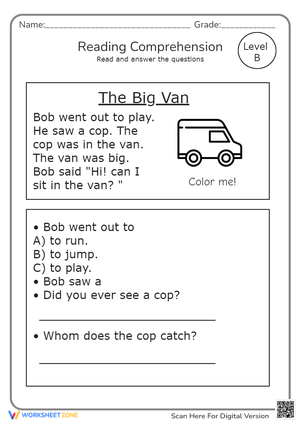
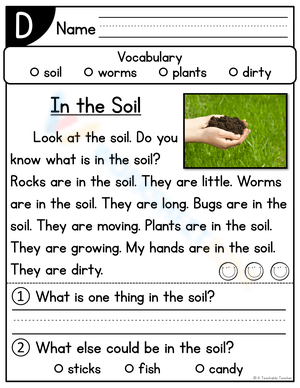
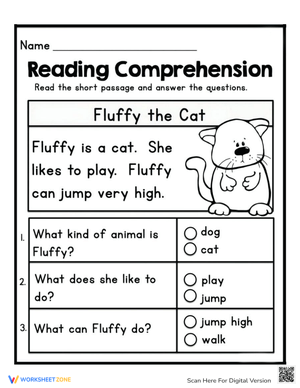
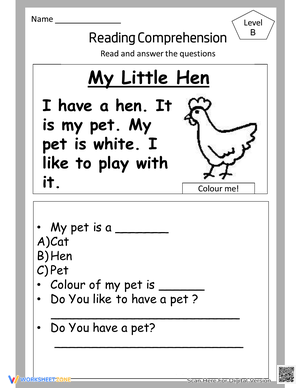
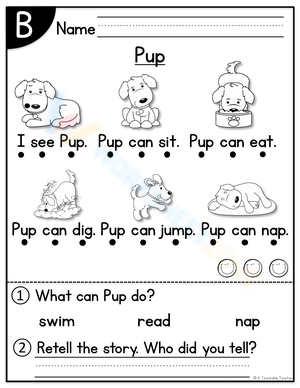
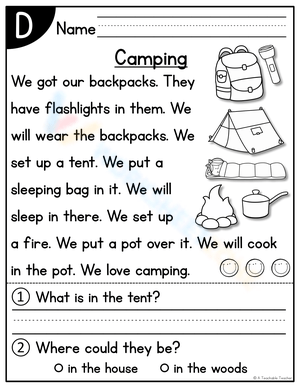
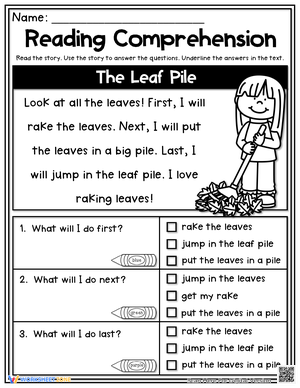
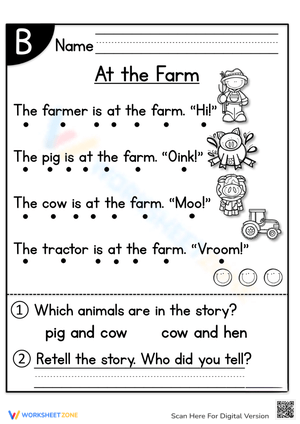
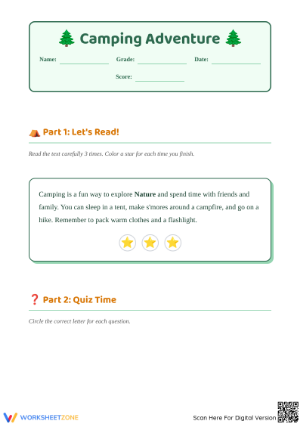
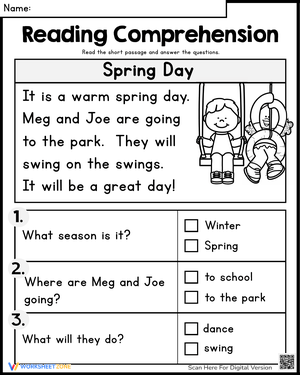
Leveled reading multiple choice worksheets printable for 1st grade give teachers a fast way to match comprehension work to real reading readiness. In many first-grade classrooms, students are not all reading the same kind of text at the same time. Some are still building confidence with simple patterned sentences, while others are ready for longer passages with more varied vocabulary and clearer opportunities for retelling, detail recall, and early inference. A printable format helps teachers move quickly between whole-group instruction and targeted follow-up without redesigning every practice page from scratch.
For classroom teams, the value is not just convenience. A leveled worksheet can make a small-group lesson easier to manage because the text difficulty is already closer to the learner's needs. Adding multiple-choice questions turns that same printable into a quick comprehension checkpoint that can be reviewed in minutes. That is especially useful when teachers need evidence from guided reading, center rotation, intervention blocks, sub plans, or take-home review.
What teachers should look for in a strong printable set
The best 1st grade reading printables are simple in the right ways. Passages should be short enough for young readers to finish with focus, but still substantial enough to check understanding. The answer choices should be clear, readable, and distinct from one another. In first grade, a multiple-choice task works best when it checks one thinking move at a time instead of overloading students with tricky wording.
Teachers usually get the strongest results when worksheets include questions on main idea, key details, vocabulary in context, and a very light level of inference. The text should also sound like early elementary reading, not an upper-grade passage cut down to size. When the reading level fits, the worksheet measures comprehension more accurately because students are not spending all of their energy decoding unfamiliar structures.
- Short, level-fit passages that support independent or lightly supported reading
- Clean answer choices with only one clearly correct response
- Grade-appropriate question types focused on recall, meaning, and simple reasoning
- Printable layout that works well for centers, folders, and send-home packets
How leveled reading supports differentiation for early readers
In first grade, differentiation is often less about making one lesson harder or easier and more about matching students to text they can actually work with productively. Leveled reading materials are commonly organized by text difficulty so teachers can place students in a more appropriate range for practice. The prefetched research for this task notes that many grade 1 readers are often found in early levels such as D-J, depending on the leveling system used. That range is useful because it reminds teachers that first-grade readers can vary widely even within the same class.
A practical way to use this insight is to treat the worksheet as a confirmation tool, not just an assignment. If a student can decode the passage but misses nearly every detail question, the text may still be too demanding at the meaning level. If the student reads fluently and answers accurately with little effort, the teacher may need a slightly richer passage next time. That kind of quick adjustment is one reason leveled multiple-choice printables can sharpen small-group planning from week to week.
Using leveled sets also reduces the common problem of false data. When every child receives the same passage, wrong answers can reflect text difficulty rather than comprehension skill. When the level is closer to the student, the teacher gets cleaner information about whether the child can identify the topic, recall an event, or choose a word meaning from context.
Where these worksheets fit in daily instruction
Printable comprehension checks work well because they are flexible. In guided reading, a teacher can use one passage after discussion to see which students can transfer the strategy independently. In literacy centers, students can complete a short reading and mark answers while the teacher runs another group. During intervention, the same format helps track whether students are improving with repeated practice on manageable text.
These worksheets are also useful for review lessons, homework, and emergency planning. A first-grade teacher often needs material that can be picked up quickly by a substitute or paraprofessional. A short passage with two to four carefully written multiple-choice questions keeps the task focused and realistic. It also gives teachers something easy to collect and scan for patterns. If several students miss the same item, that can point to a reteaching need more clearly than a broad participation check.
Because the format is selected response, it should not replace oral retelling, partner talk, or teacher questioning. It works best as one part of a balanced reading routine. Used that way, the worksheet saves time while still giving a useful record of performance.
What the cited leveling sources suggest
Teachers often rely on familiar leveling references when estimating fit for independent or guided practice. The source hints for this task point to the Learning A-Z Level Correlation Chart and the Scholastic Guided Reading Leveling Chart, both of which are commonly used to compare text-level systems across classrooms and programs. They are helpful because they show that level labels are tools for approximate matching, not rigid labels that define everything a first grader can do.
The Reading A-Z Leveled Reading Samples source is also useful because sample passages let teachers preview how text complexity changes across levels. Looking at samples before assigning a printable helps teachers judge sentence length, vocabulary load, repetition, and topic support.
Citation capsule: The prefetched source set indicates that many first-grade readers are commonly placed in early ranges such as levels D-J, depending on the system used. Teachers can see this pattern reflected across correlation tools from Learning A-Z and Scholastic, then use sample leveled texts from Reading A-Z to preview whether a printable passage is likely to fit a specific small group.
Classroom Implementation
To make these worksheets instructional instead of routine paperwork, teachers should decide the purpose before assigning them. If the goal is grouping, give the same skill question across different passage levels and compare how students perform with level-fit text. If the goal is progress monitoring, keep the structure consistent over several weeks so the teacher can notice whether accuracy improves as students build independence. If the goal is center work, choose pages that students can complete with minimal directions.
- Use one worksheet after a guided reading lesson to check transfer of the taught strategy.
- Place two or three printable options in centers so students can work at an assigned level.
- Send a short passage home when families need simple, low-prep reading review.
- Keep a few pages ready for substitute plans or intervention folders.
It also helps to review the answer choices with young learners. First graders may understand the passage but still need support reading directions, circling answers neatly, or checking all options before choosing. A brief model at the start of the year can make the printable more reliable for the rest of the term.
How to judge whether the worksheet is doing its job
A good worksheet should tell the teacher something specific. After students finish, the teacher should be able to answer questions such as: Did the passage level appear manageable? Were errors mostly about text understanding or about test format? Did the class miss one question type more than others? Those answers matter more than the raw score alone.
If students consistently struggle, the next step is not always more of the same page type. The teacher may need a shorter passage, more oral rehearsal before independent reading, or direct work on vocabulary and sentence structure. On the other hand, if students complete the worksheet quickly and accurately, that result can support a move to a more demanding passage or questions that require comparing details and drawing a simple conclusion.
That is why leveled reading multiple choice worksheets printable for 1st grade are most effective when they are used as a decision-making tool. They help teachers sort out whether a student needs easier text, clearer comprehension modeling, or just more chances to practice independently.
Frequently Asked Questions
1. What does leveled reading mean for 1st grade worksheets?
It means the passage is organized by text difficulty so teachers can match reading practice to what a first grader can handle with reasonable success. In first grade, that often supports small-group instruction more effectively than giving every student the same passage.
2. How do I choose the right reading level for a first grader?
Start with the student's current classroom reading performance, then preview the passage length, sentence patterns, and vocabulary. The prefetched research for this task notes that many first-grade readers are commonly found in early levels such as D-J, depending on the system being used.
3. What skills should multiple-choice reading worksheets cover in grade 1?
They usually work best for main idea, key details, vocabulary in context, sequencing, and light inference. The questions should stay readable and focused so students are showing comprehension rather than getting lost in the format.
4. Can printable leveled reading worksheets be used for intervention or homework?
Yes. They fit intervention, homework, centers, and review because they are easy to assign, collect, and scan. They are especially helpful when teachers need quick evidence from a short passage without turning every reading check into a full written response.