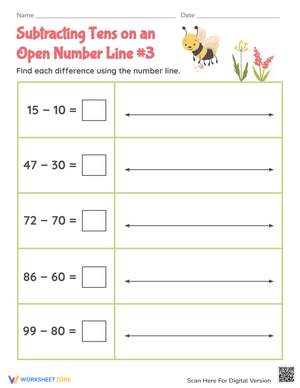
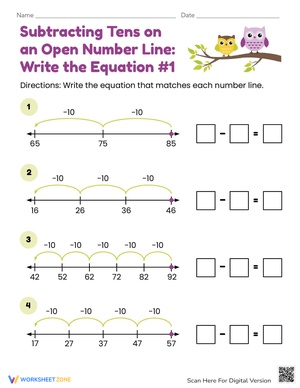
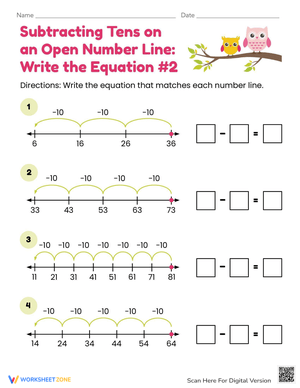
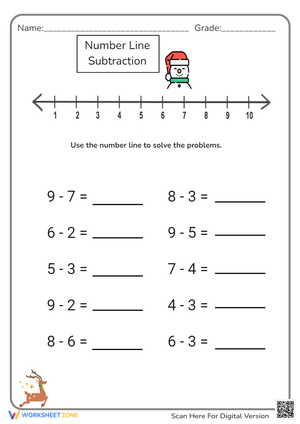
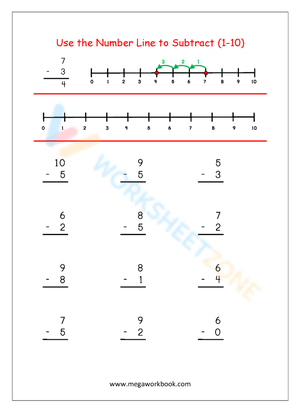
These subtraction on a number line printable worksheets for 1st grade address the specific moment when students need to stop counting on their fingers and start reasoning about the distance between numbers on a line — a shift that sounds simple and consistently trips students up without focused, structured practice. Each worksheet targets a particular number range or problem structure, so teachers can match the resource to where the class actually is rather than working through a general set that covers too much at once. The collection spans subtraction within 10 and within 20, with clean tick marks and room for students to draw their own backward jumps.
What Each Worksheet Has Students Do
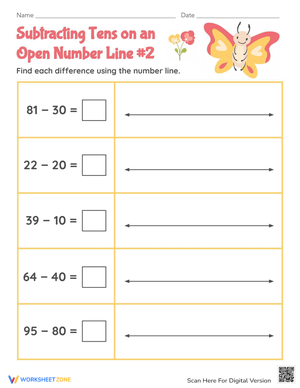
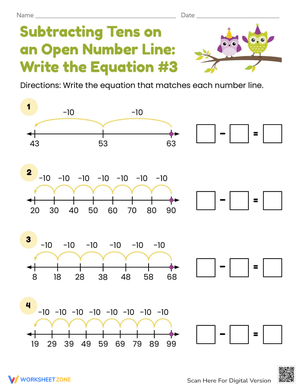
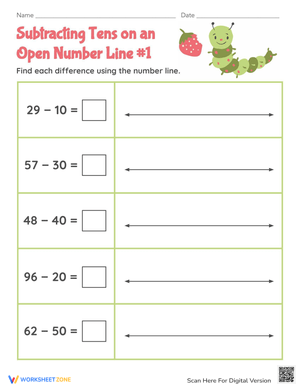
The core task across the set is counting back on a printed number line: students locate the minuend, draw distinct arcs to the left — one arc per unit subtracted — and land on the difference. That procedure requires students to hold three things in mind simultaneously: where they start, how many jumps to make, and which direction to move. Worksheets that isolate each demand before combining all three let students build the routine before the full cognitive load arrives.
Beyond the basic count-back format, the set includes worksheets where students receive both endpoints and must count the jumps between them — finding the missing subtrahend rather than the result. Others present equations with the unknown in different positions, so students cannot solve by pattern-matching the layout. A subset pairs each number line with a short word problem, requiring students to parse a simple sentence, identify the starting quantity and the amount removed, and construct the model themselves before solving.
Errors That Show Up in Student Work — and How to Catch Them
The off-by-one error is the single most predictable problem we see when students work with subtraction on a number line printable worksheets for 1st grade. A student solving 9 − 4 places a finger on 9, counts "one" as they rest there, and ends up on 6 instead of 5. They are counting the starting tick mark rather than the space — the jump — between numbers. The correction is consistent: have students say "start" when they place their pencil on the minuend, then count only as they move. Modeling this distinction explicitly, before students pick up their pencils, prevents the error from becoming habitual.
A second error appears less often but matters: students draw jumps to the right. When subtraction work immediately follows an addition unit, some students default to the familiar left-to-right direction. A brief class conversation about "taking away means moving backward" — reinforced by a large number line posted with a leftward arrow clearly labeled — typically resolves this within two or three practice sessions.
Fitting These Worksheets Into Your Instruction
The most effective entry point is a five-minute whole-group launch with a projected or drawn number line. The teacher models two problems aloud, narrating each decision — "I'm starting at 8, I need to take away 3, so I draw three jumps to the left" — while students watch without writing. That brief observation window is worth protecting. The moment hands are busy with a pencil, attention shifts to the paper and away from the strategy being modeled.
From there, these worksheets fit naturally into a center rotation — a stack sorted by number range, pre-assigned by ability group or left for student choice. The Monday warm-up after a weekend and the Friday review block before a unit test are both high-value moments for this format, since the number line gives students a reliable entry point even when the concept feels distant. For small-group pullout sessions, the missing-subtrahend worksheets work especially well: every student in the group approaches the same problem structure, but the cognitive demand varies depending on whether they're counting back or counting the spaces between two marked points.
Standard Alignment
These worksheets address three Grade 1 standards from the Common Core State Standards for Mathematics. 1.OA.C.5 asks students to relate counting to addition and subtraction — the exact cognitive move a number line demands when students count jumps rather than objects. 1.OA.C.6 covers adding and subtracting within 20, and the repeated procedural practice these worksheets provide builds toward the fluency this standard requires by year's end. 1.OA.B.4 frames subtraction as an unknown-addend problem; worksheets where students count the spaces between two marked points, rather than counting back from the minuend, build precisely this interpretation. All three standards position the number line not as a crutch to be discarded once facts are memorized, but as a conceptual model that extends into second-grade strategies like using known facts and open number lines for two-digit subtraction.
Adjusting the Worksheets for a Range of Learners
The subtraction on a number line printable worksheets for 1st grade in this set include distinct tiers of challenge, and teachers can assign based on current assessment data rather than general grade-level assumptions.
- Within 10, pre-labeled tick marks: For students still shaky on the number sequence, worksheets with numbers already printed above each tick reduce working memory demands so students can focus on the jump-counting procedure itself.
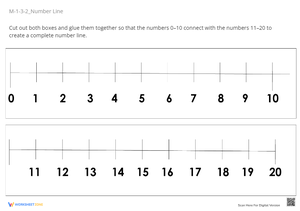
- Within 20, blank tick marks: Students who are solid within 10 label the number line themselves before solving — a step that surfaces gaps in the number sequence and prepares them for problems where the relevant section of the line does not begin at zero.
- Missing subtrahend and missing minuend problems: Once the basic count-back routine is secure, problems with the unknown in a non-standard position require genuine algebraic reasoning rather than procedure-following.
- Word problems paired with a number line: The highest-demand worksheets require students to parse a brief story, decide which number is the starting point and which represents what was removed, and then build the model independently. These suit students who solve computation problems efficiently but have not yet applied the strategy to unfamiliar contexts.
Frequently Asked Questions
How many problems does each worksheet include?
Most worksheets contain 8 to 12 problems, which fits a typical first-grade independent work window of 10 to 15 minutes without students rushing or sitting idle. Teachers who use these during a five-minute warm-up block often assign half a worksheet and save the rest for a quick exit-ticket check before the next lesson.
Can these double as formative assessment?
The number line format is particularly useful for formative purposes because students' drawn arcs leave a visible record of their thinking. A student who drew four jumps starting at 7 to solve 7 − 4 but landed on 4 instead of 3 has made the off-by-one error in a way you can see and address the following day — something a circled answer alone would not reveal. Summative use is less typical for this format, but the missing-subtrahend worksheets serve as a reasonable mastery check at the end of a number line unit.
Do these still have value for students who have memorized their subtraction facts?
Students who have committed basic facts within 10 to memory still benefit from number line work, but the purpose shifts. Rather than building procedural fluency, they're using the visual model to extend into problems within 20 where facts aren't yet automatic, and to develop a check on their own answers. Directing these students toward the missing-subtrahend format keeps the cognitive demand high enough to merit the time. The number line also pays forward — in second grade, students use open number lines without tick marks to subtract two-digit numbers, so fluency with the underlying model remains relevant well after fact memorization arrives.
Are the worksheets formatted for standard paper?
Every worksheet prints cleanly on standard 8.5 × 11 paper. The number lines are sized so students can draw arcs without marks overlapping — a detail that matters more than it sounds, because cramped tick marks on subtraction on a number line printable worksheets for 1st grade produce drawings students themselves cannot read back, and the self-checking benefit of the visual model disappears entirely.













 Interactive Worksheet Maker
 Quiz Maker
 Word Search Maker
 Crossword Puzzle Maker
 Word Scramble Generator
 Sentence Scramble Generator
 Handwriting Worksheet Generator
 Name Tracing Generator
 Fill In The Blank Generator