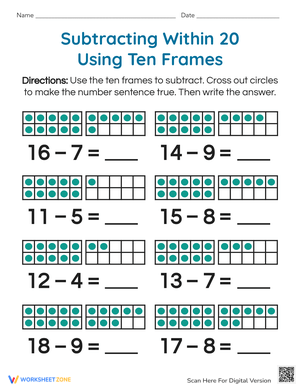
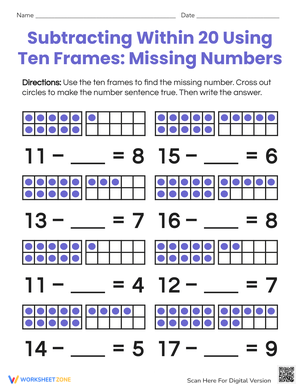
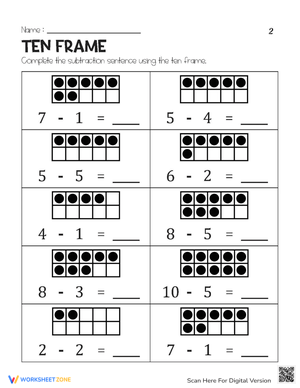
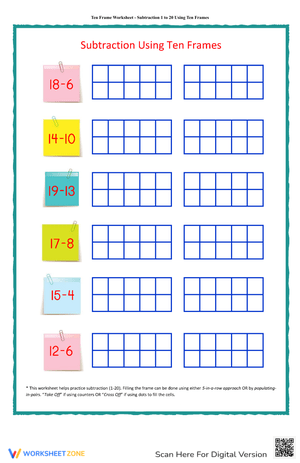
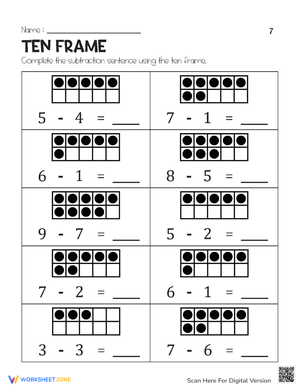
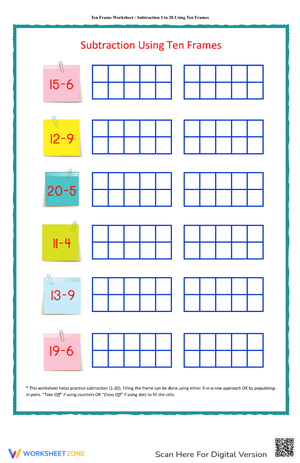
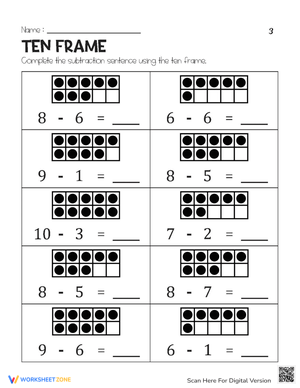
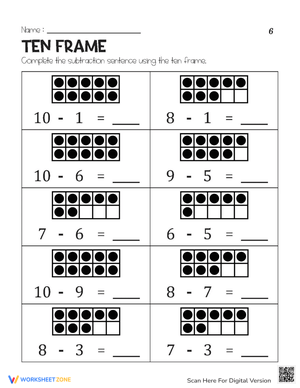
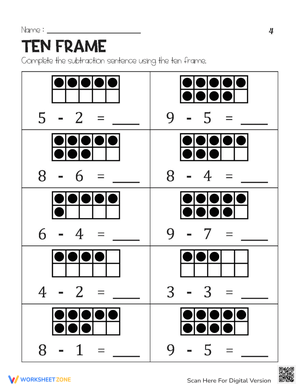
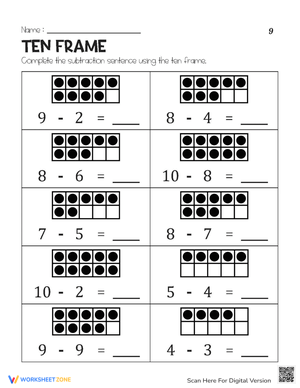
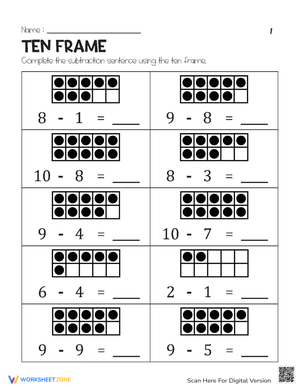
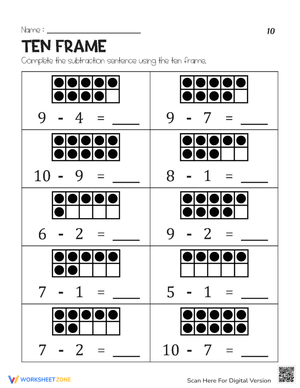
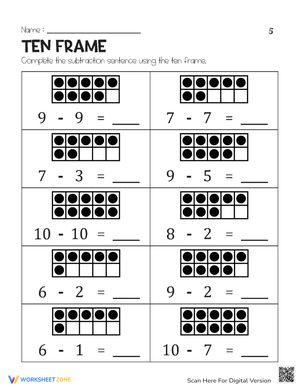
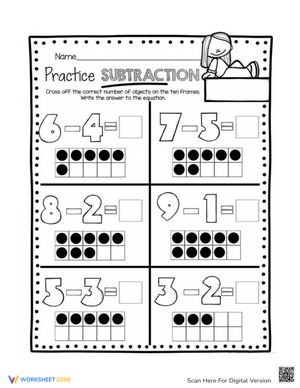
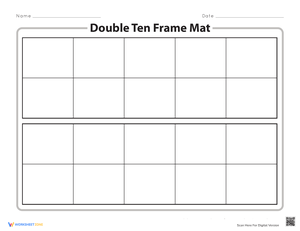
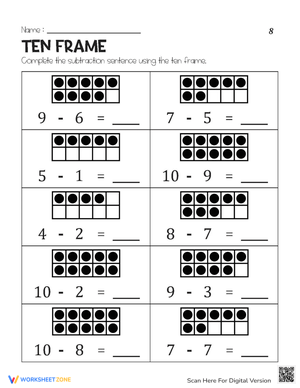
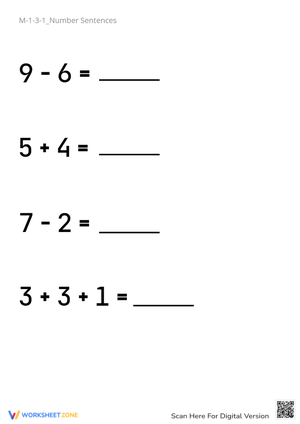
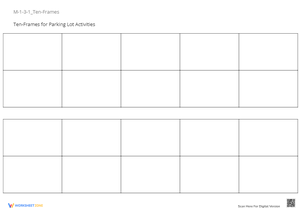
These subtraction and ten frames worksheets for 1st grade give teachers a reliable visual entry point into early subtraction — one that holds quantity steady in a two-row grid while students work through what taking away actually means. The set covers within-10 subtraction through multiple formats: marking counters, writing equations, matching frames to number sentences, and working backward from a difference to find what was removed.
Skills Each Worksheet Targets
Every worksheet in the set focuses on a distinct aspect of subtraction within 10, but all of them return to the same central tool: the ten frame. Students are never asked to visualize quantities in open space — the frame is always there, organizing the numbers before any calculation begins.
- Take-away with marked frames: Students examine a partially filled frame, cross out the counters being removed, and write the resulting equation.
- Missing-subtrahend problems: Students see a starting quantity and a remaining quantity, then use the frame to determine what was taken away — a significantly harder task than straight take-away.
- Frame-to-equation matching: Students connect a drawn ten frame to the subtraction sentence it represents, reinforcing symbol-to-model correspondence.
- Completing ten-frame models: Given an equation, students shade or mark the frame to match — reversing the direction of thinking entirely.
- Difference comparison tasks: Two frames appear side by side and students identify which shows fewer remaining counters, an informal bridge to subtraction comparison language.
Why Ten Frames Belong in Grade 1 Subtraction Instruction
First graders are making a specific cognitive leap during this unit: moving from counting all objects to trusting that a quantity can be held mentally while another is removed. That leap is harder than it looks. A ten frame supports it because the structure itself communicates quantity — a full top row is always 5, so students can anchor there without recounting. When three counters are crossed out, a child doesn't restart from 1; the frame shows what changed and what remains in the same image.
This connects to a well-documented phase in early numeracy development where students transition from count-all to count-on strategies. Ten frames accelerate that transition for subtraction specifically because they make partial quantities — the part still present after removal — visually immediate. A child looking at a frame with 7 filled and 3 crossed out can see 4 remaining without retrieving a count. That visual recognition is the foundation of later fact fluency, and printed worksheets extend the model beyond the hands-on phase without abandoning it.
Student Mistakes That Show Up Repeatedly in This Work
The most consistent error is recounting from 1 after crossing out. A student will mark out 3 counters on a frame showing 8, then count every remaining dot — touching each one individually — rather than recognizing the leftover group. This tells you the student understands the action of subtraction but hasn't yet internalized the frame's grouping structure. The fix isn't more practice; it's pausing to ask "How many do you see on the top row right now?" and building from that anchor point.
A second error is directional confusion on missing-subtrahend problems. When a worksheet shows 9 filled and 4 remaining and asks what was removed, many students write 4 instead of 5 — they locate a visible number and copy it rather than compute the difference. Marking the start and end quantities in different colors before asking students to find the missing piece reorients their thinking faster than re-explaining the problem type. A third, subtler mistake appears in equation notation: students write 3 - 8 = 5 instead of 8 - 3 = 5. The arithmetic is correct; the convention is backwards. No amount of circling the answer corrects this — it requires explicit discussion of what the first number in a subtraction sentence tells us.
Building These Worksheets Into a Weekly Rotation
The most effective sequence runs across three or four days rather than as a single isolated session. On day one, model one ten-frame problem with physical two-color chips on a projected frame, narrating each step aloud. On day two, use a guided worksheet — students cross out counters while you do the same and say the equation together. By day three, students handle an independent worksheet with mixed problem types. On day four, pull two or three problems as a brief exit check: five minutes, enough to see who is still counting all and who has started recognizing remaining groups at a glance.
For math centers, slide worksheets into dry-erase pockets and give students an expo marker and a small cup of actual counters. The ability to place a physical counter on each drawn circle before crossing it out gives students who are still concrete thinkers a way to make the visual model tactile. For homework, choose pages with one consistent format and directions simple enough to survive the trip home — a take-away page with a clear worked example at the top requires no parent interpretation at the kitchen table at 6 p.m.
Standard Alignment
These worksheets align to CCSS.MATH.CONTENT.1.OA.C.6, which requires students to add and subtract within 20 using strategies including making ten, counting on, and applying the relationship between addition and subtraction. The subtraction and ten frames worksheets for 1st grade address the within-10 portion of this standard directly, using the frame as a concrete strategy that precedes and supports the more abstract mental strategies named in the standard. In classroom terms, this material fits best in the first semester before attention shifts to within-20 work — typically after students have used ten frames for addition and are ready to see the same structure applied in reverse.
Adjusting the Worksheets Across Ability Levels
For students who are not yet stable on within-5 subtraction, restrict the frame to the top row only — five cells, five possible counters — by using a felt-tip marker to block out the bottom row. That keeps the worksheet format identical while narrowing the number range. Students working with this modification practice the same skill as peers; the frame just shows less. Pairing the written work with a sentence frame spoken aloud — I started with ___. I took away ___. I have ___ left. — gives students a verbal anchor before they touch the pencil.
Students who are ready to move beyond direct take-away benefit most from the missing-subtrahend format and from generating two related equations from a single frame: 7 − 3 = 4 and 7 − 4 = 3. That second step doesn't require a separate worksheet — it requires one extra instruction and two blank lines below each problem. For students furthest ahead, a prompt asking "What would the frame look like if you started with 10 instead?" turns a closed practice item into a genuine number-sense task without any additional materials.
Frequently Asked Questions
Do these worksheets work for students who haven't used ten frames before?
Yes, but introduce the frame structure before sending any worksheet to a center or home. Five minutes during whole-group instruction — establishing what a full row means, what an empty cell means, and how a crossed-out counter differs from an empty one — prevents most confusion. Students who skip this orientation tend to interpret crossed-out counters as absent rather than removed, which produces counting errors that look like subtraction errors but aren't.
How many problems should a single independent practice session include?
Six to eight items is the range that yields useful data without fatigue errors. More than ten problems for a first grader working within-10 subtraction tends to produce sloppy counting in the final third of the page — not because students don't know the math, but because sustained attention at this age runs short. Fewer clean items tell you more about what a student actually knows than a longer messy set.
Where do these worksheets fit if I'm already using a published math curriculum?
Most Grade 1 programs introduce ten frames for addition first, then extend the model to subtraction. These worksheets slot into that subtraction extension phase — typically four to eight weeks into the operations unit. The subtraction and ten frames worksheets for 1st grade function as supplemental practice alongside any published lesson sequence, not a replacement for it. If your core program already uses ten frames, students will recognize the format immediately and you can skip any orientation time entirely.
Can these be used for intervention with second graders?
Regularly. Second graders who haven't consolidated within-10 subtraction often have the same gap first graders do: they understand the concept but still count all rather than using visual grouping. The subtraction and ten frames worksheets for 1st grade content is leveled for any student still building that foundation, regardless of grade placement. The ten frame reads as a math tool, not a signal that the work is remedial — students at any grade engage with it straightforwardly once the structure is explained.













 Interactive Worksheet Maker
 Quiz Maker
 Word Search Maker
 Crossword Puzzle Maker
 Word Scramble Generator
 Sentence Scramble Generator
 Handwriting Worksheet Generator
 Name Tracing Generator
 Fill In The Blank Generator