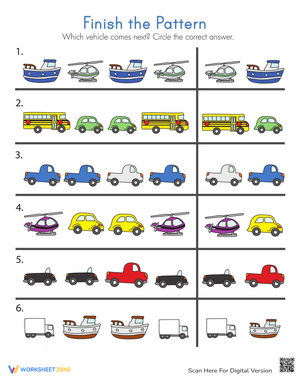
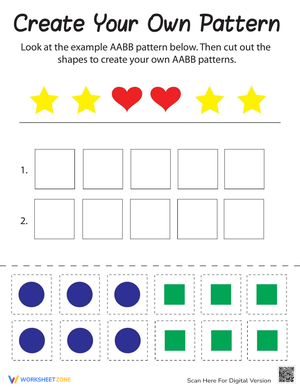
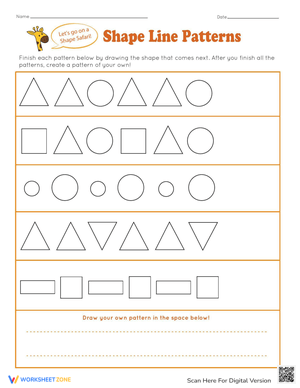
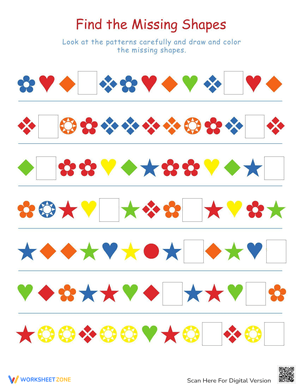
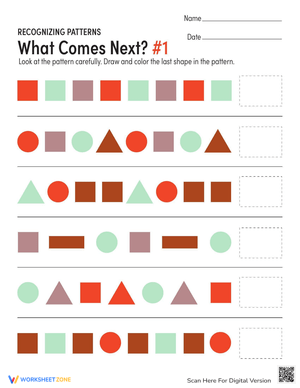
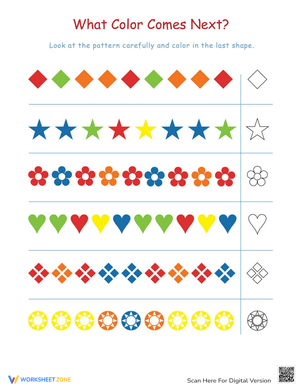
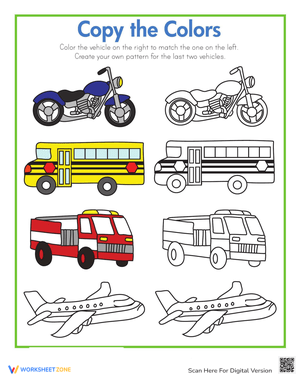
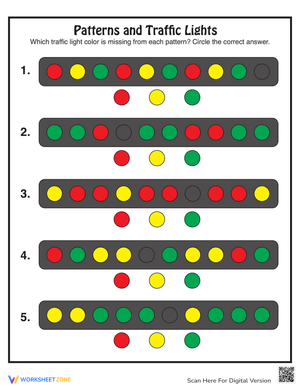
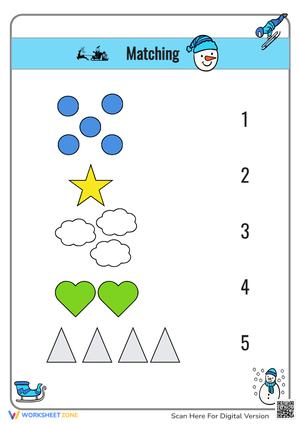
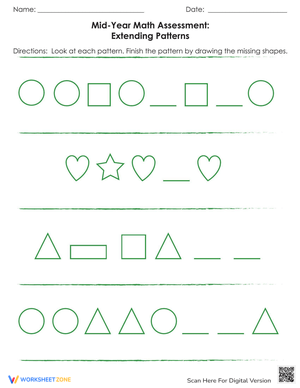
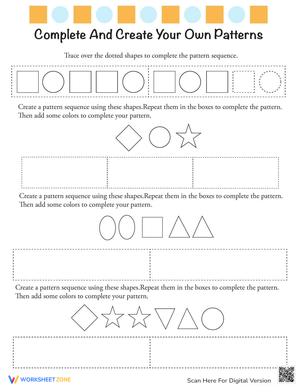
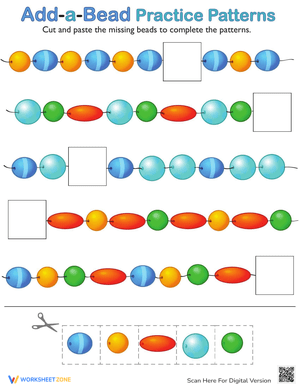
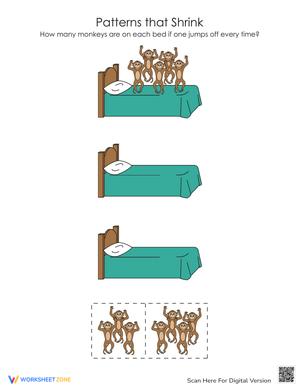
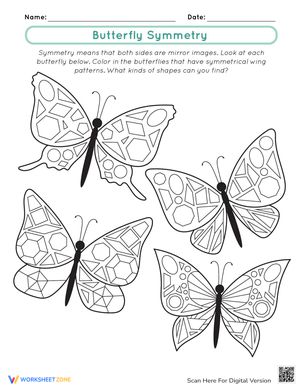
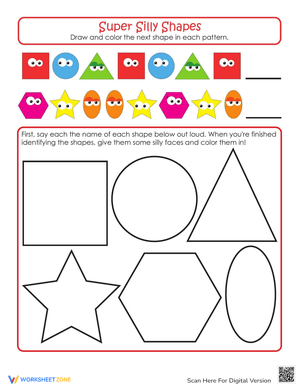
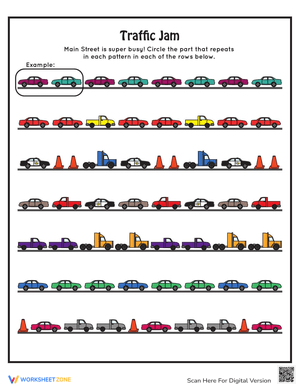
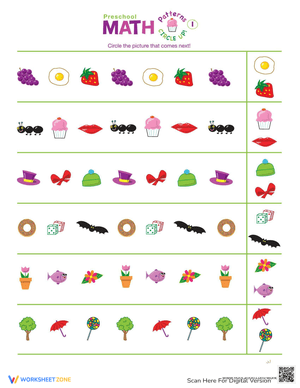
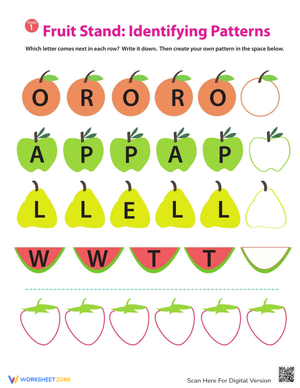
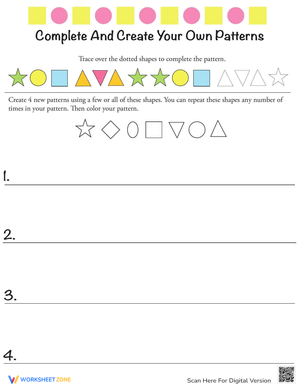
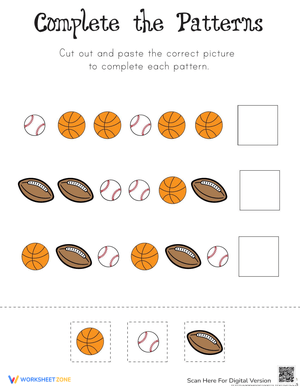
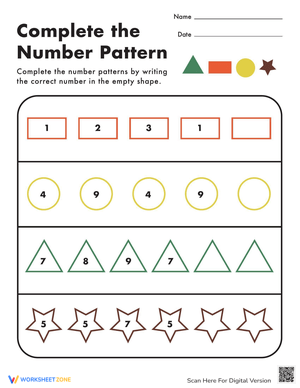
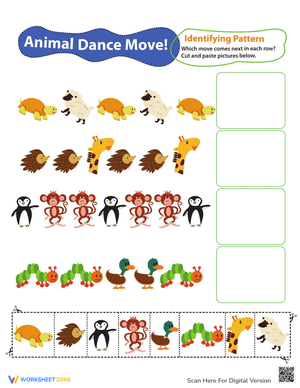
These shape patterns printable worksheets for 1st grade give teachers a ready-to-use set for building one of early math's most underestimated skills: identifying the repeating unit inside a sequence and using that rule to predict, extend, or fill in what comes next. Each worksheet isolates a pattern structure or combines familiar types in ways that demand genuine reasoning rather than rote copying. The result is a set that fits a warm-up block, a math center rotation, or a targeted small-group pull with equal ease.
The Specific Skills Each Worksheet Targets
The worksheets address four core repeating-pattern structures that first graders are expected to recognize and work with fluently: AB sequences (circle, square, circle, square), ABC sequences (triangle, circle, star, repeating), AAB sequences (square, square, triangle), and ABB sequences (circle, triangle, triangle). Within each structure, students practice a progression of task types:
- Naming and identifying each shape in a printed sequence
- Locating the repeating core — the chunk that cycles back to the beginning
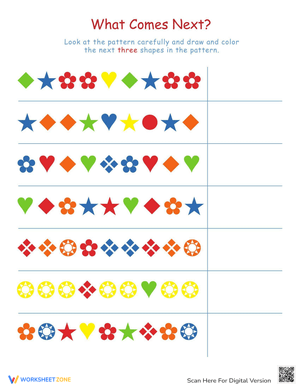
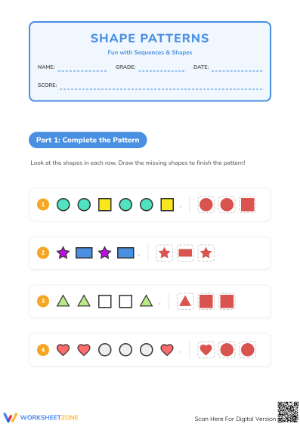
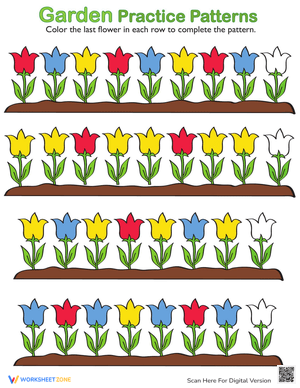
- Extending a pattern by drawing or coloring the next two to three shapes
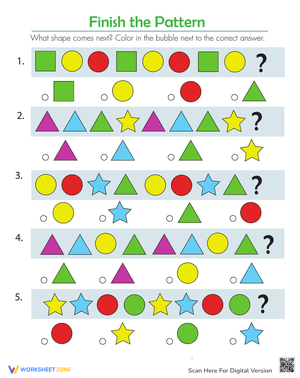
- Filling in a missing shape when the gap falls mid-sequence
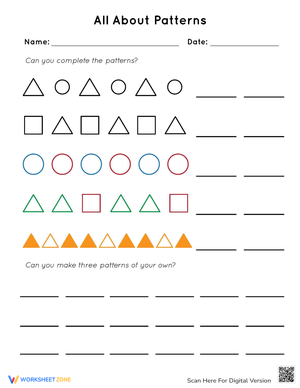
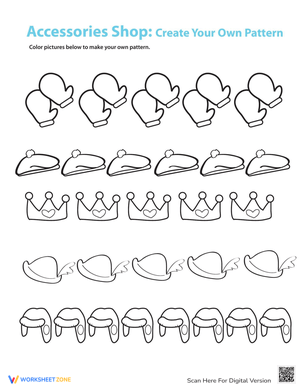
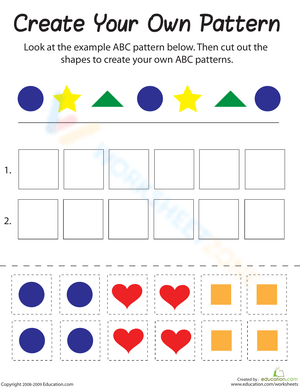
- Building an original pattern from a given set of shapes
That final task — creating an original pattern — is where genuine understanding surfaces. Students who have only memorized the steps frequently stall here, which makes the creation prompt a reliable formative checkpoint rather than just another coloring activity.
Why Repeating-Unit Recognition Belongs at This Grade Level
Patterning is introduced formally in kindergarten, but the 1st grade year is when students move from passive recognition to active manipulation. Developmentally, most six- and seven-year-olds can hold a two-element rule in working memory without much difficulty; the jump to three-element sequences — ABC, AAB, ABB — pushes against the limits of that capacity, which is precisely why it belongs in 1st grade instruction rather than being deferred to second. The concrete-representational-abstract progression applies directly here: students who have sorted physical blocks and played movement-based pattern games in kindergarten arrive ready to work with visual representations on paper. These worksheets sit squarely in that representational stage, bridging tactile experience toward the symbolic letter-code notation teachers introduce later in the year.
Errors Students Make That These Worksheets Help You Catch and Correct
The most predictable error on AAB patterns deserves its own explanation. When students see triangle, triangle, circle, triangle, triangle, circle, many read the two triangles as two independent steps rather than a single doubled unit. They extend the sequence correctly by position tracking — triangle, triangle, circle — but when a gap is placed on the second triangle, they write "circle" because they counted forward from the previous circle without grasping the rule. You can identify this student precisely: they fill in extensions correctly but miss gap tasks on the repeated element. Seeing that discrepancy on paper tells you more than any verbal check-in would.
A second pattern worth watching: first graders frequently treat a rotated shape as a different shape entirely. A triangle pointing left and a triangle pointing up read as "different triangles" to a student who has not yet internalized that orientation is a non-defining attribute. If a worksheet introduces rotated shapes without explicit pre-teaching, expect that confusion in roughly a third of the class. A two-minute anchor before independent work — holding up a physical triangle and rotating it slowly while students confirm it stays the same shape — addresses this before it becomes an error on paper.
How to Work These Worksheets Into Your Lesson Plans
The most effective placement for shape patterns printable worksheets for 1st grade is the first eight to ten minutes of math time on Monday, when students need a low-stakes re-entry into structured thinking after the weekend. AB and ABC extension tasks at this slot serve as spaced retrieval — students who worked with patterns the prior Thursday consolidate that learning by pulling it back to mind before new instruction begins. By Wednesday, when a new pattern type has been introduced, the higher-demand tasks — missing element, create-your-own — fit well as an exit slip or a center activity during the final rotation of the block.
For small-group instruction, pair each worksheet with a set of pattern blocks. Have students build the sequence on the table before marking anything on paper. When a student's physical build disagrees with what they drew, that disagreement is the instructional moment — not a correction, but a conversation: "Your blocks say triangle next, but your drawing says circle. Tell me your rule." This comparison step surfaces procedural errors that pencil-and-paper work alone will miss.
One limitation worth naming honestly: students who freeze when they see a long row of shapes — particularly those with attentional challenges — sometimes shut down before they locate the repeating unit. A small cardstock frame with a rectangular cutout, roughly the width of one full pattern cycle, lets those students physically slide the window along the sequence and isolate just one complete unit at a time. It takes thirty seconds to make and removes the visual overwhelm without reducing the cognitive demand of the task.
Adapting the Worksheets for Different Learners
For students still securing AB patterns, the most effective adjustment is covering the latter half of the sequence with a sticky note and working only with the first full cycle plus an extension of two shapes. Once they can extend reliably from a short prompt, uncover the rest. This removes the visual-field problem without changing the worksheet itself — no reprinting, no separate version.
Students who master the four standard structures quickly benefit from two extensions: introducing size or orientation as an additional variable within the shape sequence, and asking them to write the letter code for each sequence they complete — AABAABAAB — before identifying the core unit. That letter-coding step is the direct bridge to the algebraic notation they will use formally in 3rd and 4th grade. For shape patterns printable worksheets for 1st grade to serve a genuinely wide classroom, the create-your-own prompts are the most flexible entry point — both the student who is still building confidence and the one who is ready for added complexity can produce a pattern at their own level, and both papers reveal what they actually understand.
Standard Alignment
These worksheets address CCSS.MATH.CONTENT.1.G.A.1, which asks students to distinguish defining attributes of shapes — sides, angles, closed versus open — from non-defining attributes like color and orientation. That standard is the geometric foundation for pattern work: a student who cannot reliably identify a rotated square as still a square cannot apply a shape-based sequence rule consistently. The patterning strand itself carries no explicit CCSS code at grade 1 — the Common Core addresses repeating patterns formally within the Operations and Algebraic Thinking domain at grades 3 through 5 — but the National Council of Teachers of Mathematics frames repeating patterns as a core Pre-K–2 algebra concept, and most state frameworks that supplement CCSS include a patterning standard at grade 1. Texas TEKS 1.5(A) is one concrete example, explicitly requiring students to recognize and extend repeating patterns within the 1st grade algebra strand. Teachers working outside CCSS states should check their grade-level standards document under the algebra or patterns strand to locate the matching code for their context.
Frequently Asked Questions
Which pattern types should my students already know before starting these worksheets?
Students who had patterning exposure in kindergarten typically enter 1st grade comfortable with AB sequences, though their ability to name the rule — as opposed to just extending it — varies considerably. Before moving into ABC or AAB work, a brief whole-class sort using physical objects confirms where the group actually is. If more than a quarter of the class cannot extend a simple AB sequence by mid-September, begin there before introducing three-element cores.
Can these be used for assessment, or are they practice only?
The extension and missing-element tasks function well as formative checkpoints. Collect the create-your-own prompt at the end of a pattern unit and you have a student artifact that shows both procedural skill and conceptual understanding — a student who constructs a valid AABB pattern and can label the rule has demonstrated more than one who completes a pre-printed extension correctly. These are not standardized assessment instruments, but they generate the kind of observable work that informs small-group groupings and sharpens parent-conference conversations.
How do I help a student who extends patterns correctly but consistently misses the missing-element task?
That is almost always the doubled-unit confusion described above. The intervention that resolves it most reliably: print the shape patterns printable worksheets for 1st grade, then have the student use a crayon to bracket each complete cycle of the pattern before answering any questions. Once they can chunk the sequence into labeled units, they see that a gap on the second triangle sits inside the unit — not after it. Two or three sessions of that bracketing step, done aloud with a partner who has to agree on where each unit starts and ends, typically closes the gap.
Do students need manipulatives alongside these worksheets?
Not required, but valuable for students who are still building visual-spatial confidence. Pattern blocks are the most practical pairing — they match common worksheet shapes and allow students to build-before-draw, which separates errors caused by weak pencil control from errors caused by weak understanding. For a center running without adult supervision, a small laminated mat where students lay the blocks and check their sequence before drawing makes the activity largely self-correcting.













 Interactive Worksheet Maker
 Quiz Maker
 Word Search Maker
 Crossword Puzzle Maker
 Word Scramble Generator
 Sentence Scramble Generator
 Handwriting Worksheet Generator
 Name Tracing Generator
 Fill In The Blank Generator