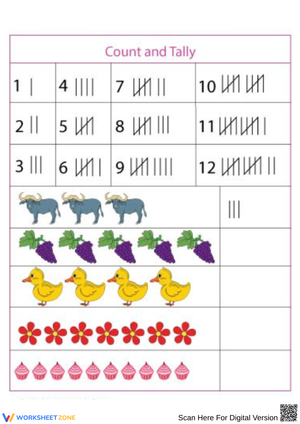
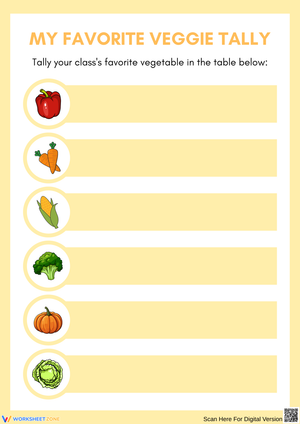
1st Grade Tally Marks printable worksheets
These 1st grade tally marks printable worksheets give teachers five distinct exercise formats — numeral-to-tally conversion, picture-scene counting, live classroom surveys, chart interpretation, and tally-to-bar-graph transfer — so students encounter the skill from multiple angles before any assessment. Tally marks are the first formal data-recording system most first graders use, and the structure built into each worksheet reflects that weight.
The Specific Skills Each Worksheet Targets
The set progresses from producing tally marks to reading them to connecting them to other representations. Individual worksheets address:
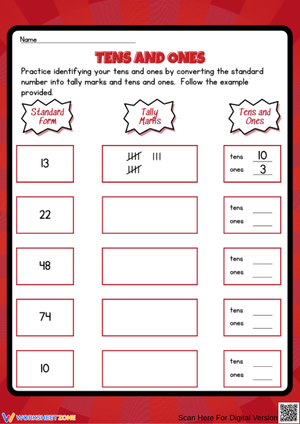
- Numeral-to-tally conversion — writing tally groups for numbers 1 through 20, including numbers that straddle a group boundary (7, 13, 18) where students must correctly place the diagonal slash and then count on from five.
- Tally-to-numeral conversion — reading a pre-drawn chart and writing the corresponding numeral, which requires understanding that a complete group always equals exactly five.
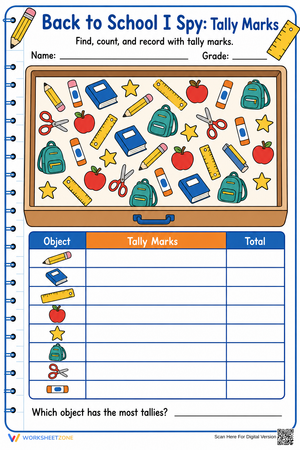
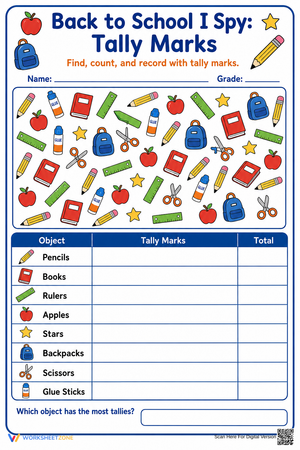
- Picture-scene tallying — counting objects sorted by category in a busy illustration and recording findings in an empty chart, with students marking each counted object to prevent double-counting.
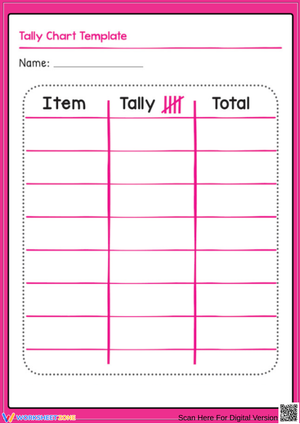
- Live survey collection — blank templates students carry around the room to gather real responses from classmates before returning to their seats to analyze the data.
- Chart interpretation — answering comparison questions from a pre-filled tally chart: which category has the most, which has the least, and how many more or fewer appear in one column compared to another.
- Tally-to-bar-graph transfer — taking completed tally data and coloring in a corresponding bar graph so students see the same information in two representations side by side.
Why Tally Marks Work as a First Data Tool at Grade 1
Tally marks sit precisely at the boundary between concrete counting and abstract representation — which is exactly where Grade 1 students live developmentally. Each mark has a strict 1:1 relationship with a counted object, unlike a numeral, which requires the child to hold a quantity in mind as a pure symbol. That one-to-one anchor makes tallying accessible to students who still need to see or touch each item they count. The five-group slash introduces the first real abstraction: a diagonal mark means "this group is complete; start fresh." That is a conceptual step, not just a procedural rule, and it lands at the right level of challenge for late Grade 1 — substantial enough to teach, small enough to fit inside a single lesson.
Cognitive load shapes how these worksheets are structured. When students tally from a picture, they hold two tasks at once — reading a visual scene and producing a symbol. Worksheets that instruct students to mark each counted object with a small dot reduce working memory demand enough that the tallying itself gets the attention it needs. Worksheets that skip this step consistently produce more counting errors, particularly in classes where students are still developing reliable one-to-one correspondence.
Student Mistakes Worth Anticipating Before the Lesson
The most persistent error is drawing five vertical marks instead of four verticals plus a diagonal. A student counting five birds makes five identical strokes — the group rule has not clicked yet. The error is invisible in marks one through four, which look perfectly correct, and only surfaces at five, which means a teacher scanning the room can miss it entirely until looking at a number like 8 and finding "|||||||" instead of "|||| |||." Reteaching in the moment a student makes this mistake is more effective than correcting before the error appears — students who have made it once understand immediately what the diagonal is preventing.
A second pattern worth watching: students misread pre-filled charts by counting "||||" as five instead of four. The visual memory of a complete tally group is strong enough that any cluster of vertical lines gets interpreted as five. This error shows up on interpretation tasks, not production tasks, which is why it surprises teachers who watched the same students produce tally marks correctly five minutes earlier. A quick diagnostic — ask the student to touch each mark while counting aloud — separates the skills cleanly and tells you whether the confusion is visual or procedural.
Standard Alignment
These worksheets address CCSS Math 1.MD.C.4, which requires first graders to organize, represent, and interpret data with up to three categories, including answering questions about the total number of data points and how the categories compare. Tally charts satisfy all three demands in one tool: students organize data as they make marks, represent it in the visible layout of the chart, and interpret it when answering comparison questions. Most Grade 1 pacing guides place 1.MD.C.4 in the third quarter, after students have stable numeral recognition and at least basic fluency with addition within 10, because the comparison questions require subtraction reasoning — "there are 9 votes for dogs and 6 for cats; how many more for dogs?" A 1st grade tally marks printable worksheets works best when introduced during that instructional window rather than earlier in the year when subtraction reasoning is still developing.
Where These Worksheets Fit in the Week
Start the sequence with picture-scene tallying — it is the most concrete format because students count things they can see in front of them. Save the chart-interpretation worksheets for after students have generated their own tally data at least twice; they read a chart more accurately when they remember what it felt like to build one from scratch. Morning meeting is a natural warm-up slot: tally the day's weather, lunch choices, or a quick classroom question together on chart paper, then send students to their seats to complete the individual worksheet version of the same task. The transition from shared chart paper to independent practice takes about three minutes and sets up the worksheet with context students actually recall.
The live survey worksheets in a 1st grade tally marks printable worksheets set take more time than the independent seat exercises — plan a full 20-minute block, not a 10-minute filler. Students need two to three minutes just to circulate, collect responses, and return before recording begins. Teachers who try to fit surveys into the eight minutes before lunch pickup usually end up with incomplete data and frustrated students. Use survey worksheets on days when the math block is protected and uninterrupted.
Tailoring Each Worksheet for Mixed Readiness Levels
Students still working on numeral recognition below 10 find the full 1–20 range on conversion worksheets overwhelming. Limiting their task to numbers 1 through 10 — and taping a number line along the top of the page as a reference — lets them focus on the tally procedure rather than splitting attention between the procedure and numeral retrieval. That modification takes thirty seconds with a marker or a sticky note. For students who move through the set quickly, the natural extension is asking them to write their own tally question, survey the class, and report their findings in a complete sentence — a task that reveals whether the student understands data as information or only as a drawing activity.
When using a 1st grade tally marks printable worksheets with English learners, the picture-scene tallying format carries the lightest language load because the counting task is entirely visual. Chart-interpretation questions — "How many more? How many in all?" — carry the heaviest language demand. Pairing those worksheets with a sentence frame such as "There are ___ more ___ than ___" keeps the math accessible while students build the vocabulary for comparison language. The two demands are separate skills and deserve to be taught that way.
Frequently Asked Questions
Why do students keep drawing five vertical lines instead of the diagonal slash?
The slash overrides a deeply practiced habit — one mark per object. Through four marks, the habit and the rule say the same thing. At the fifth mark they diverge, and without a strong cue, most students follow the habit. A physical movement helps: students say "one, two, three, four, and close the gate" while drawing the fifth mark as a sweeping diagonal motion in the air with their whole arm before touching paper. Running this three times on chart paper in front of the class — with students mirroring the movement — stops the error for most learners within the same session, faster than any amount of verbal explanation alone.
How does tallying reinforce skip-counting by fives?
Each completed tally group is a visible five. When students see three groups, they count 5, 10, 15 instead of counting every line individually. That connection does not happen automatically — students need to be asked directly: "How many in one group? How many in two groups? How many in three?" before the pattern becomes something they apply on their own. Worksheets that include multiple complete groups, rather than mostly partial groups, give students enough repeated exposure for the skip-counting pattern to surface within a single session rather than requiring a separate lesson on a different day.
When should students move from tally charts to bar graphs?
The transition belongs after students can both produce and read a tally chart without support. The bridging worksheet — tally data on the left, blank bar graph on the right — is the clearest transition tool because students see both representations simultaneously and color in the graph from data they already understand. Teachers who skip this step and move directly to bar graphs often find students graphing accurately but unable to explain where the numbers came from, which signals a procedure without understanding rather than true data literacy.
Clear All