


























Views
Downloads
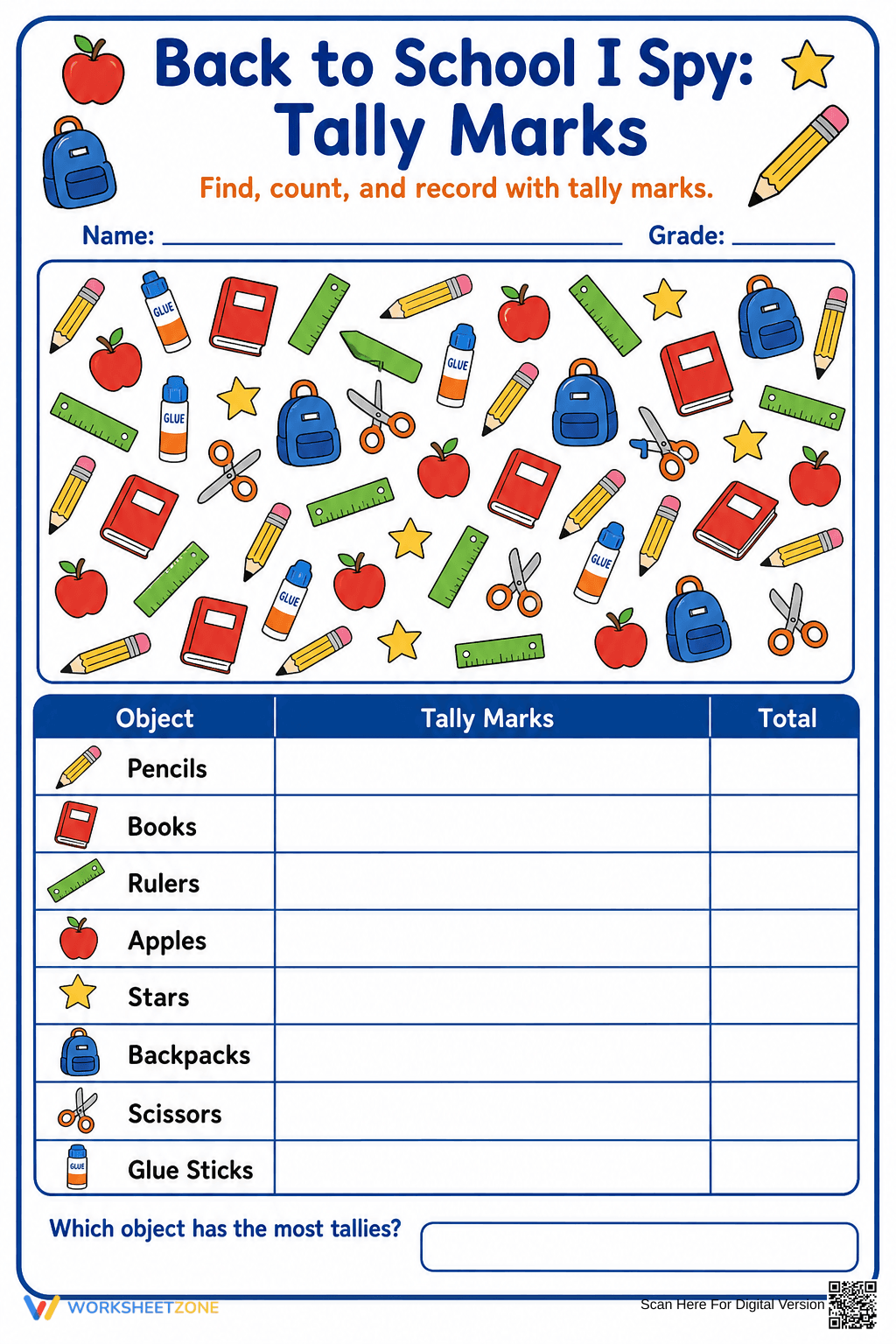

Grade 1 Tally Marks — Printable No-Prep Worksheet
Paste this activity's link or code into your existing LMS (Google Classroom, Canvas, Teams, Schoology, Moodle, etc.).
Students can open and work on the activity right away, with no student login required.
You'll still be able to track student progress and results from your teacher account.
This Grade 1 math worksheet gives students engaging practice with counting and data collection. By searching for hidden school supplies in an I Spy scene, learners record quantities using tally marks and write the corresponding totals. The activity concludes with a data interpretation question to reinforce analytical skills.
At a Glance
- Grade: 1 · Subject: Math
- Standard:
CCSS.MATH.CONTENT.1.MD.C.4— Organize, represent, and interpret data- Skill Focus: Counting and tally marks
- Format: 1 page · 9 problems · Answer key included · PDF
- Best For: Independent practice and centers
- Time: 10–15 minutes
This single-page resource features a vibrant I Spy illustration filled with eight types of classroom objects. Below the scene, a structured data table provides space for students to record findings using tally marks and numerical totals. The worksheet includes nine tasks, culminating in a question requiring students to identify the object with the highest frequency. An answer key is provided.
Zero-Prep Workflow
This resource is designed for immediate classroom implementation.
- Print (1 minute): Download the PDF and print a class set. The clean layout ensures high-quality copies.
- Distribute (1 minute): Hand out the worksheets and pencils. No extra materials are required.
- Review (3 minutes): Use the included answer key to quickly check student tables and the final question.
With prep time under two minutes, this activity is an excellent addition to any sub plan or math center.
Standards Alignment
This activity aligns to CCSS.MATH.CONTENT.1.MD.C.4, requiring students to organize, represent, and interpret data. By counting scattered objects and structuring that information into a tally chart, learners build foundational data representation skills. They also practice comparative analysis by determining which item appears most frequently. Both standard codes can be copied directly into lesson plans, IEP goals, or district curriculum mapping tools.
How to Use It
This worksheet serves as excellent independent practice following direct instruction on tally marks. Assign it during math rotations to keep students engaged while working with small groups. Alternatively, it works well as morning work to activate prior knowledge. As a formative assessment tip, observe students while they count; watch if they cross out objects to prevent double-counting. Most first graders will complete this within 10 to 15 minutes.
Who It's For
This resource is designed for first-grade students mastering early data collection. It also provides valuable review for second graders needing a refresher on tally mark grouping. To support students who struggle with visual tracking, encourage them to use colored crayons to circle objects before tallying. This pairs perfectly with a whole-class anchor chart demonstrating how to bundle tallies by fives.
Effective data representation instruction in early elementary grades relies heavily on engaging, context-rich practice that connects abstract concepts to tangible visuals. According to an EdReports 2024 analysis of foundational math curricula, integrating visual search tasks with structured data collection significantly improves student retention of organizational strategies. This specific worksheet targets CCSS.MATH.CONTENT.1.MD.C.4 by having students organize, represent, and interpret data through a highly familiar school-themed context. When young learners transition from randomly scattered objects to a neatly structured tally table, they develop critical cognitive mapping skills necessary for advanced statistics in later grades. Furthermore, the physical act of drawing tally marks reinforces one-to-one correspondence and grouping by fives, which are essential precursors to multiplication and skip counting. By combining a highly visual I Spy activity with rigorous data entry requirements, educators can accurately assess a student's ability to track, record, and analyze mathematical information independently.


