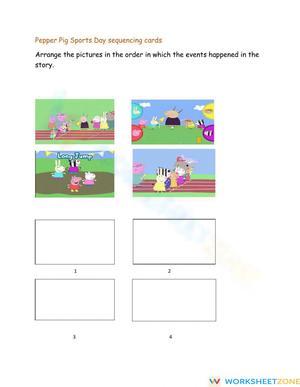
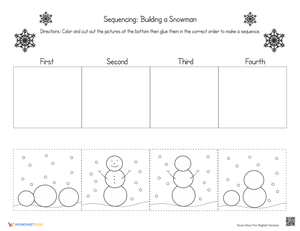
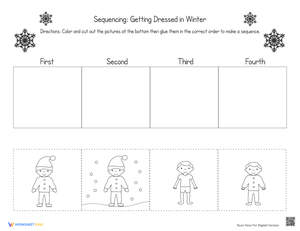
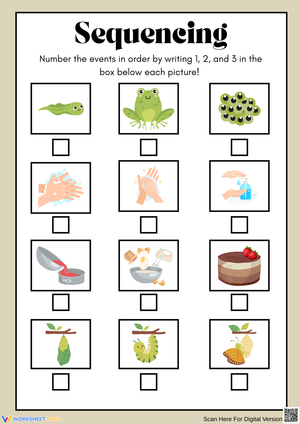
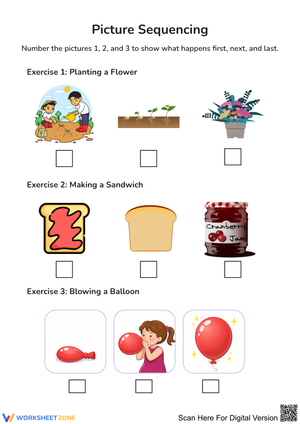
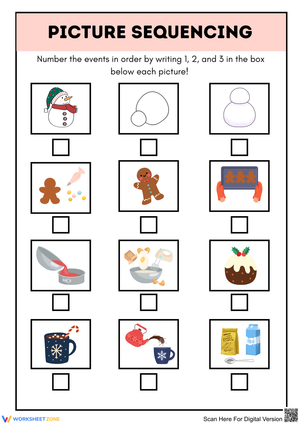
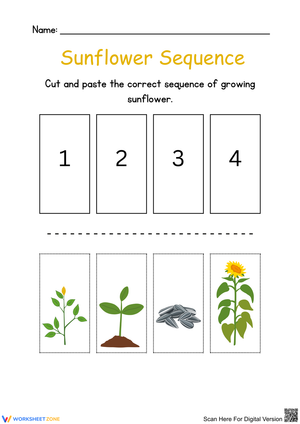
These 1st grade picture sequencing worksheets give teachers a ready-to-use set for building the story-order thinking that early comprehension depends on — without the prep time that more complex formats require. Each worksheet pairs clear illustrations with a straightforward task so students can focus on the sequencing itself rather than decoding directions.
What Students Practice Across the Set
The core work in each worksheet is placing images in the correct order — first, next, last — and being able to explain why. That sounds simple, but it pulls together several ELA skills that first graders are still building simultaneously. Students read visual details carefully, apply logical reasoning to event order, and use sequence vocabulary (before, then, finally, after that) to talk or write about their choices.
Beyond basic ordering, the worksheets also build retelling fluency. When a student can look at three images, arrange them correctly, and say aloud what happened from beginning to end, they're practicing the same comprehension move they'll need when working with leveled text. The visual format gives that thinking a low-stakes entry point before students are expected to retell in writing independently.
Standard Alignment
These worksheets address CCSS.ELA-LITERACY.RL.1.3, which asks first graders to describe characters, settings, and major events in a story using key details. In classroom terms, that standard expects students to distinguish between events and explain how one leads to another — exactly the thinking that picture sequencing requires. The worksheets also connect to CCSS.ELA-LITERACY.RL.1.2, the retelling standard, by giving students structured practice describing story events in sequence before they're expected to retell in writing. Most districts introduce sequencing as a comprehension skill in the first quarter of first grade and return to it in second quarter with informational text, making this set useful across more than one instructional unit.
Frequent Student Errors Worth Watching For and Correcting
The most common mistake isn't putting the pictures in random order — it's defaulting to left-to-right placement regardless of logic. Students in early first grade have internalized that we read left to right, and some will lay pictures out in a row that order without examining what's actually happening in each image. A student who places "seed planted in soil" before "watering the seedling" and after "a full sunflower blooming" is following a visual habit, not analyzing the sequence. Catching this early — and asking the student to narrate each image before placing it — usually breaks the pattern.
A second error appears in four-step sequences: students correctly identify the first and last images but swap the two middle steps. The beginning and ending of a story or process carry the most obvious visual cues. The interior events require closer examination, and that's where the comprehension work actually lives. Asking students to justify the middle steps ("why does this one come before that one?") makes the reasoning explicit and surfaces the confusion before the worksheet is submitted.
Working These Worksheets Into Your Lesson Plans Effectively
Three-picture sequences earn their place in the 8–10 minutes after a read-aloud, when students need an immediate comprehension task before transitioning. The format is quick enough to complete in that window, and the images keep the story events fresh rather than requiring recall from earlier in the period.
For small-group instruction, the most productive sequence is: model one set of pictures with a think-aloud, have partners talk through a second set before touching anything, then ask individuals to complete a third set independently. That gradual release moves quickly, and the oral discussion step consistently produces better written or numbered responses than skipping straight to independent work.
Morning work is another natural fit, particularly on Mondays. A familiar worksheet format — students already know whether they're numbering, cutting and pasting, or writing one sentence — lets them settle into the school day without needing extended directions. Keeping the response structure consistent across several weeks while rotating the picture sets pays dividends: when the routine is automatic, the teacher can watch what students do with the sequencing thinking rather than watching them navigate a new task format.
For sub plans, picture sequencing worksheets require almost no setup explanation, and the visual nature of the task means a substitute can support students without deep content knowledge. That practical reality makes a printed set worth keeping on hand even when other plans are in place.
Adjusting the Worksheets for a Range of Learners
Students who need additional scaffolding benefit from previewing the pictures as a set before any ordering begins. Walking through each image together — naming what is happening, identifying familiar vocabulary — gives those students the background they need to focus on sequence rather than content confusion. Starting with three-step sequences before introducing four-step ones is also a reliable support that doesn't alter the learning target.
For students who move through three-picture sequences quickly and accurately, four-step sequences with a writing extension add genuine challenge. Ask those students to write one sentence for each image using a different sequence transition word in each sentence — "First," "Then," "After that," "Finally." The constraint forces attention to both event order and language variety.
Differentiation by response mode also works without creating separate materials. Some students point and explain orally, which counts. Some number the images. Some cut and paste. Some write. Letting students access the task through the mode that fits their current skill level keeps the comprehension goal intact while allowing realistic participation across a mixed-ability class.
Frequently Asked Questions
How do three-step and four-step sequences differ in difficulty?
The jump isn't just one more picture. Four-step sequences require students to analyze two interior events rather than one, and those middle steps lack the obvious visual anchors of a beginning or ending image. Teachers often find that students who perform reliably on three-step sequences still need a few rounds of guided practice before four-step sequencing feels solid.
Can these worksheets connect to informational text, or are they limited to stories?
Both work. Process sequences — steps in making something, stages of a life cycle, how-to procedures — support informational comprehension and give teachers a way to hit sequencing standards across text types. Rotating between narrative and procedural sequences helps students see that first-next-last thinking applies beyond fiction.












 Interactive Worksheet Maker
 Quiz Maker
 Word Search Maker
 Crossword Puzzle Maker
 Word Scramble Generator
 Sentence Scramble Generator
 Handwriting Worksheet Generator
 Name Tracing Generator
 Fill In The Blank Generator