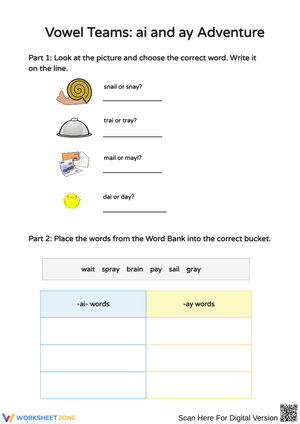
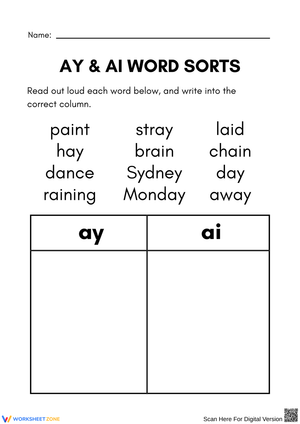
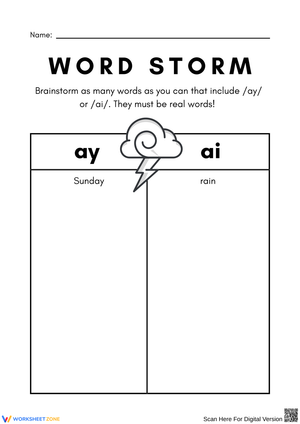
These 1st grade ay worksheets give early readers focused, repeated practice with one of the most consistent spelling patterns in the English language — the vowel team that almost always lands at the end of a word. Each worksheet isolates a specific skill, from identifying the /ay/ pattern in print to sorting words by vowel-team position to writing original sentences with high-frequency ay words.
The Specific Skills Targeted
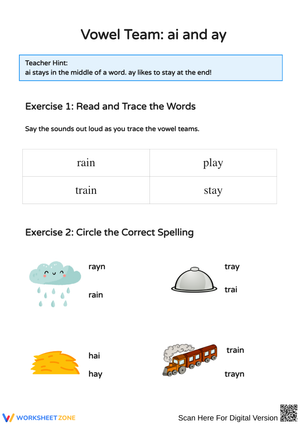
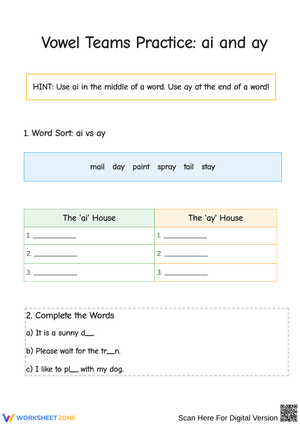
The worksheets move through the ay pattern systematically. Students begin by recognizing ay words embedded in word lists and short sentences, underlining or circling the vowel team to reinforce visual attention to the spelling. From there, the practice shifts toward discrimination work: given a picture of a word like rain or play, students decide whether the long /a/ sound sits in the middle of the word or at the end, then write the correct spelling — ai or ay — to complete it. This ai-vs-ay sorting is the conceptual core of the set, and it appears across several worksheets before students move on to production tasks.
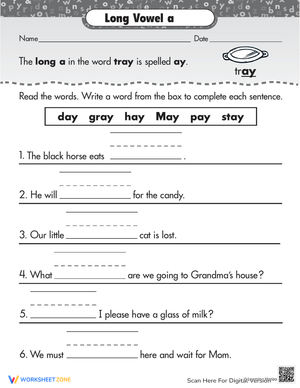
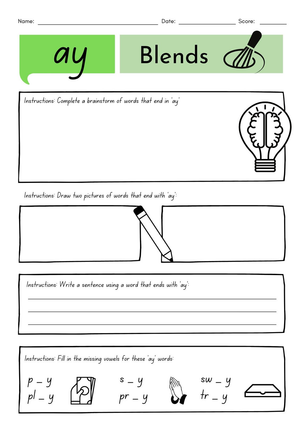
Later worksheets ask students to generate words independently. Cloze sentences pull from a word bank of high-frequency ay words — day, play, say, way, may, stay, tray — and students read each sentence for meaning before selecting the word that fits. A final group of worksheets asks students to write their own sentences using ay words they have already practiced, which requires retrieving the spelling without a visual prompt and embedding it in syntactically correct writing. That last step is a meaningful jump in difficulty.
Standard Alignment
These worksheets align to CCSS RF.1.3b, which requires first graders to decode regularly spelled one-syllable words, and RF.1.3a, which addresses knowledge of vowel team conventions. In classroom terms, RF.1.3b is where most phonics instruction lives in Grade 1 — it is the standard that governs the systematic progression from short vowels through blends to vowel teams like ay. Teachers typically reach ay patterns in the second half of the year, after students have covered consonant blends and basic digraphs. If your pacing guide places vowel teams in the spring semester, these worksheets fit into that window; some programs introduce ay earlier because its positional consistency makes it an easier entry point into vowel-team work than ai alone.
Mistakes Students Make That These Worksheets Help You Catch
The most telling error at this stage is not confusion between ai and ay but reversal of the pattern: a student writes plaay or dayy, treating the y as an addition rather than part of the team. That doubling signals the student has not yet solidified ay as a unit. Watch also for students who correctly read ay words aloud but write the long /a/ sound as a silent-e construction — playe instead of play. They understand the sound; they have not yet attached it to this spelling pattern specifically. The sorting and discrimination worksheets make this gap visible quickly because students have to commit to a spelling rather than just decode one.
A subtler error appears in sentences: students who can spell play correctly in isolation will write todey or thay under the cognitive load of composing a sentence. That is not a phonics failure — it is a working memory issue that eases with fluency. It is worth noting in your records as separate from a conceptual gap with the vowel team itself.
Smart Ways to Work These Worksheets Into Your Week
The recognition and circling worksheets work well as a Monday warm-up immediately after whole-group phonics instruction on the ay pattern. They take about five minutes, require no setup, and give you a quick read on which students absorbed the lesson and which need a pull-aside during small-group time later in the week.
The ai-vs-ay sorting worksheets are well suited to literacy centers after the initial lesson because they are self-directed but require real decision-making — students cannot complete them on autopilot. Reserve the sentence-writing worksheets for guided small-group sessions where you can observe the student's process. Watching a first grader pause mid-sentence to sound out stay tells you something a completed worksheet does not. If you run a word study block on Fridays, the cloze and sentence worksheets double as a retrieval check across the week's learning.
Adjusting the Worksheets for a Range of Learners
For students still consolidating CVC words, the circling and underlining worksheets provide accessible entry — they interact with the ay pattern without needing to produce it independently. Pair those with a printed anchor chart listing five or six ay words with pictures so the student has a reference while working. For students ready to move ahead, ask them to generate two additional ay words not on the worksheet and use each in a spoken sentence before writing one down. That extension does not require additional materials and pushes toward generalization beyond the given word list.
Students who are English language learners sometimes struggle less with the spelling rule and more with the vocabulary — they may not recognize tray or spray as words at all, which makes the cloze sentences ambiguous for the wrong reasons. Pre-teaching four or five of the less common ay words with quick picture support before those worksheets removes a vocabulary obstacle from what is meant to be a phonics task.
Frequently Asked Questions
Do these worksheets teach ay and ai together, or is ay treated separately?
Several worksheets in the set address both patterns together through sorting and discrimination tasks, because the ai-vs-ay distinction is where students most need structured practice. Others focus on ay alone, particularly the initial recognition activities. The sequence is designed so students see ay in isolation first, then encounter the contrast once the ay pattern itself is stable.
At what point in a phonics program do these worksheets fit?
Most programs introduce ay after students have worked through short vowels, consonant blends, and basic digraphs. That typically places these worksheets in the second semester of first grade, though some teachers use them earlier because ay's end-position rule is concrete and teachable without prerequisite vowel-team knowledge. If your program introduces vowel teams in a specific sequence, ay often comes before more irregular or less consistent patterns.
Can these be sent home for additional practice?
The recognition and cloze worksheets travel well as homework because they require no teacher explanation to complete. The sentence-writing worksheets are better kept for school, where you can observe the process — sent home, they often come back completed by a parent rather than the student, which tells you nothing useful about where the child actually is with the pattern.












 Interactive Worksheet Maker
 Quiz Maker
 Word Search Maker
 Crossword Puzzle Maker
 Word Scramble Generator
 Sentence Scramble Generator
 Handwriting Worksheet Generator
 Name Tracing Generator
 Fill In The Blank Generator